Hindu woman’s cow stolen and slaughtered near a Hindu temple ahead of Eid celebrations in Agra, Uttar Pradesh
 Agra, Uttar Pradesh, India
  24 May, 2026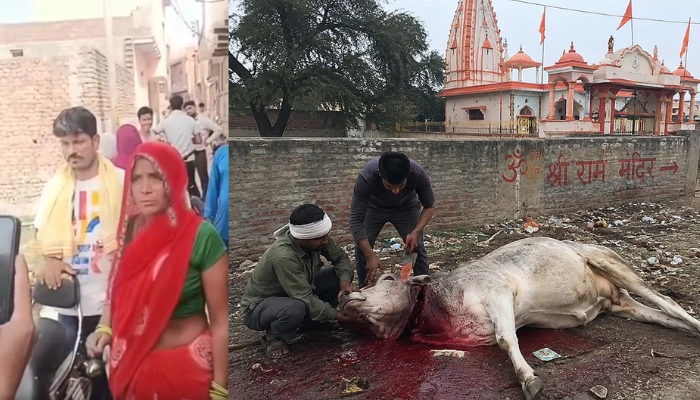
Case Summary
In Agra, Uttar Pradesh, a Hindu woman’s cow, which she had raised at her home, was stolen and slaughtered near a Hindu temple ahead of Eid celebrations by a few unidentified miscreants. According to reports, the incident came to light after panic spread in the area when unknown individuals slaughtered and carried away the cow late at night near the Ganga Temple on Achhnera Station Road. The incident angered local residents, and the cow's owner, along with her family, demanded the immediate arrest of the accused. Rajkumari, wife of Ghanshyam Shakya, stated that their three cows had been tied on their plot. All the cows were present until around 11 p.m. on 24 May 2026, but when she reached the spot around 4 a.m. on 25 May 2026, one cow was missing. A search revealed bloodstains in a nearby plot next to the Ganga Temple. Dust had been sprinkled over the blood in an apparent attempt to conceal the evidence. Upon discovering the blood of the cow near the plot, the Hindu family and local residents concluded that the cow had been slaughtered near the temple premises. Upon receiving information, police arrived at the scene, inspected the area, and collected blood samples. Following the incident, the atmosphere in the locality became tense, and residents expressed anger over the incident. Local resident Manoj stated that there was now fear of cow slaughter occurring openly, and people had become hesitant to tie their cattle in open spaces. The Hindu family and cow protection groups demanded that the administration swiftly solve the case and take strict action against the accused.
Why it is Hate Crime ?
The primary category selected is- Attack on Hindu religious representations. The subcategory selected is- Desecration of Hindu religious symbol. Icons and symbols or a religious representation of a spiritual ideal are widely revered in Hinduism. Iconography is of vital significance in the Hindu milieu. It helps connect people’s spiritual beliefs with the real world. Iconography within the Hindu faith takes several shapes and forms. Murtis are of most significance to Hindus, to which daily rituals, prayers and offerings are done. Besides the murtis, there are several other symbols which have deep significance in the Hindu faith – the Om and Swastika for example. Since these Hindu religious symbols hold paramount importance in Hinduism, any desecration of symbols, icons, murtis, religious representations and manifestations, is driven by animosity towards the faith itself which manifests itself through these murtis, icons and symbols. Therefore, any desecration of these Hindu religious symbols and representations is considered religiously motivated hate crimes under this category. The other subcategory selected is- Defiling religious customs. Sanatan Dharma is not a religion of one book, which is to say that while it has religious scriptures that form the central tenets of the faith, there are several traditions followed through thousands of years, mostly passed from generation to generation orally. There are several such customs and traditions that are followed by various Hindus and Hindu sects. Defiling of these traditions and customs is a breach of an individual or group’s religious practices. Such practices can range from dietary restrictions like not eating non-vegetarian food for a certain period of the year, not eating non-vegetarian food at all, not eating beef since the cow is considered holy in Hinduism, the sanctity of religious customs followed in the house (like many ISCKON devotees), etc. Any malicious action leading to the breach of such traditions or defilement of these traditions owing to animosity towards the faith or for the sake of activism stems not only from the lack of faith in the religion itself but also from disregard for the faith of the devotees who follow the customs/traditions and implicit bias against the faith, the tradition itself. Since these specific traditions are central to the faith of the devotees of that specific sect of Hindus, any non-compliance with these traditional rules would be considered a religiously motivated hate crime. This case is a clear example of a religiously motivated hate crime because a Hindu woman’s cow was stolen and slaughtered near a Hindu temple by unidentified miscreants ahead of the Eid festival. The nature of the act, the location chosen for the slaughter, and the timing of the incident collectively showcased clear religious motivations behind the crime. In Hinduism, the cow is regarded as sacred and is deeply revered by Hindus across the country. It is not merely an animal but a sacred religious symbol associated with purity, motherhood, compassion, and divinity. In this case, the cow that was slaughtered was home-raised by the Hindu family, meaning that Rajkumari and her family shared a deep emotional bond and sense of care towards the animal, having raised it within their household for years. The fact that the perpetrators stole the cow and slaughtered it specifically near a Hindu temple showcased clear religious motivations behind the crime. Slaughtering a cow in a public space where members of the Hindu community could witness the aftermath and experience emotional and religious hurt directly targeted Hindu religious sentiments. Furthermore, the fact that the slaughter took place near the temple premises demonstrated that this was not a random act of theft or cruelty, but an act rooted in anti-Hindu hostility aimed at desecrating a sacred Hindu symbol. Such desecration of sacred Hindu symbols like cows deeply hurts the religious sentiments of Hindus and amounts to a hate crime. The fact that the cow slaughter took place near the temple premises further showcased that the perpetrators intended to defile and desecrate a sacred Hindu space of worship by slaughtering an animal whose killing is considered a grave sin in Hinduism. Hindu traditions strictly forbid cow slaughter, and the cow is regarded with immense reverence and sanctity. Similarly, Hindu temples are sacred spaces of worship and spiritual purity for devotees, making any act of violence, desecration, or slaughter near temple premises deeply offensive to Hindu religious sentiments. The deliberate decision to slaughter the cow near a Hindu temple rather than at any isolated location strongly indicated that the perpetrators intended to defile the sanctity of the temple and insult Hindu religious beliefs. Such an act transformed the incident from ordinary animal cruelty into a deliberate religious provocation intended to humiliate and hurt the Hindu community. Therefore, the act amounted to a clear case of a religiously motivated hate crime. The timing of the incident also showcased religious animosity, as the slaughter took place just ahead of Eid celebrations. In the past, there have been several incidents where Muslim perpetrators slaughtered cows near Hindu temples, inside temple premises, or in public spaces visible to the Hindu community during Eid, with the intent of hurting Hindu sentiments by targeting an animal considered sacred in Hinduism. The fact that this incident occurred just two days before Eid further raised the seriousness of the crime and strengthened the indication of deliberate religious hostility behind the act. The timing, location, and nature of the act collectively demonstrated that the crime was intended not only to kill the animal but also to intimidate, provoke, and emotionally wound the Hindu community by attacking one of its most sacred religious symbols. Given that this case met the parameters of a religiously motivated hate crime targeting Hindu religious beliefs, sentiments, and sacred symbols, it is being added to the hate crime database of the Hinduphobia Tracker.


Case Status
Unknown


Perpetrators Details
Perpetrators
Unknown
Perpetrators Range
Unknown
Perpetrators Gender
unknown
 Sources




