Hindu woman pressured to wear a burqa by her husband, who converted to Islam, in Ghaziabad
 Ghaziabad, Uttar Pradesh, India
  24 May, 2026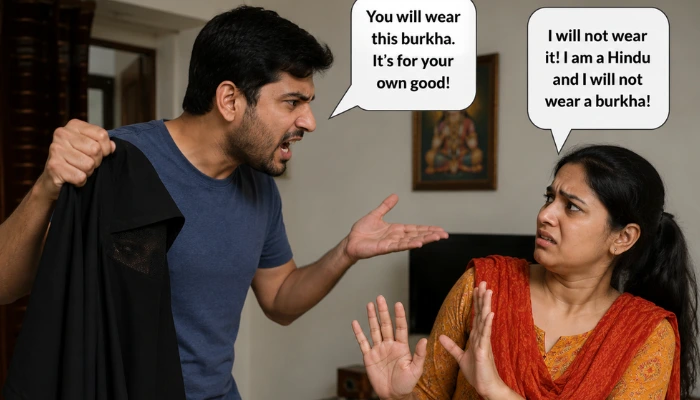
Case Summary
In the Nandgram area of Ghaziabad, Uttar Pradesh, a Hindu woman was pressured to wear a burqa by her husband, who had previously converted to Islam. This began with a domestic dispute involving religious conversion within a Hindu family, prompting a police complaint and intervention by local Hindu organisations. According to reports, the issue arose after the Hindu wife of a man from that family found a white Muslim-style cap in his pocket while washing clothes. Following this, the family stated that his behaviour had changed since November 2025, including speaking about Islam at home and attending a wedding wearing a similar Muslim-style cap. They also stated that the man, who was a painter by profession, had converted to Islam under influence. The Hindu wife and the man's family further stated that the accused was pressuring the Hindu wife to wear a burqa and was asking her to lead by his example of conversion, which led to escalating tensions within the household. The dispute eventually resulted in the family approaching the police, as well as informing members of the Vishwa Hindu Parishad (VHP) and Bajrang Dal. VHP officials subsequently filed a complaint. On 25 May 2026, VHP and Bajrang Dal workers accompanied the man’s father to the Nandgram police station, where they demanded an impartial investigation into the matter. During police questioning, the man denied any conversion allegation. Police also recorded statements from both the family members and the man as part of the preliminary inquiry. During this process, after his family members tried to reason with him, the young man admitted that he had converted to Islam. However, he later retracted his statement. At the time of writing this report, the police authorities had not confirmed any conversion, and the matter remained under investigation as a domestic dispute based on competing accounts.
Why it is Hate Crime ?
The primary category selected in this case is- Crimes against women in relationships and other sexual crimes. The subcategory selected is- Forced conversion after marriage. The tertiary category selected is- Forced to wear hijab. In such cases, a non-Hindu man marries a Hindu woman, and the force/pressure to convert to any Abrahamic faith, like Islam, begins after marriage. In such cases, typically, two patterns emerge. First, when the relationship is consensual, and the religious identity of the perpetrator is known to the Hindu woman in the relationship. The marriage could be under the Special Marriages Act, where neither parties are required to convert their religion for the marriage to be considered legitimate. While the victim in such cases enters matrimony assuming that religious identity is not a barrier, the non-Hindu man starts to pressure the woman to convert her religion after marriage. The second is when the woman gets into a marriage with the man, pretending to share her faith. Later, when the truth is revealed, the man starts pressuring the woman to convert her religion and give up her religious identity. In both situations, there is application of force by the perpetrator, including the denial of the woman’s religious rights. Some of the means by which the woman is forced/pressured to convert include force-feeding beef, being forced to read the Kalma, being forced to wear a hijab, forced to undergo Halala, etc. There are several instances where, after marriage, the woman voluntarily converts to Islam. Such cases are often argued to be a result of religious brainwashing, however, for the purpose of documenting religiously motivated hate crimes, in the absence of the victim complaining of forced conversion, such cases do not form a part of the database. This case serves as an example of a religiously motivated hate crime because it involves the systemic pressure exerted on a Hindu woman to wear a burqa following her husband's conversion to Islam. While an individual’s (the victim's husband) right to change their faith is a matter of personal liberty, the subsequent attempt to forcibly impose an Islamic lifestyle on a non-consenting Hindu spouse (the Hindu woman) crosses into the realm of religious coercion. The enforcement of the burqa represents far more than a simple alteration in attire; it is the visual and cultural erasure of the victim's existing Hindu identity. By demanding that she adopt a garment deeply tied to the Islamic faith, the perpetrator attempted to sever her connection to her Hindu faith and traditions, directly violating her fundamental right to religious autonomy and personal freedom. Furthermore, the explicit demand for the victim to follow her husband's footsteps into post-conversion life underscores a calculated effort to target her for a forced rewriting of her entire religious identity. By expecting her to conform to his new faith, the perpetrator sought to systematically dismantle the Hindu woman's lifelong spiritual allegiance and replace it with an Islamic framework. In this strategy, the forced wearing of the burqa serves as the critical first step, a visible compliance mechanism intended to break her psychological resistance before demanding full conversion to Islam. This method illustrates how forced proselytisation often operates through incremental coercion and manipulation rather than a singular, sudden demand. Forcing a married Hindu woman to adopt Islamic attire is a deliberate imposition of an Islamic lifestyle designed to erode her individual agency over time. Such actions directly infringe upon the victim’s constitutional and fundamental rights to freely practice, profess, and propagate her own faith, Hinduism, establishing the incident as a targeted act rooted in religious animosity. The severity of the harm is magnified by the breach of trust within the marital union. Having married within her own faith, the victim had a reasonable expectation of shared religious and cultural values. The husband's subsequent conversion and his immediate, aggressive attempts to force the same path upon her caused profound emotional and psychological trauma, fundamentally shattering the sanctity and foundational trust of their marriage. That this manipulation occurred within the privacy and presumed safety of a domestic relationship underscores the targeted nature of the coercion, transforming a domestic space into an environment of religious subjugation. When viewed within the broader context of forced conversions affecting Hindu women, actions of this nature reflect a pattern of behaviour that undermines the religious freedoms of the Hindu community. The systematic attempt to erase a Hindu woman's religious identity through marital pressure demonstrates that the crime was driven by doctrinal intolerance. Consequently, due to the explicit targeting of the victim's faith and the coercion used to suppress her religious practices, this case has been documented as a religiously motivated offence within the hate crime database of the Hinduphobia Tracker. Disclaimer: The Hinduphobia Tracker records incident dates based on when the victim’s ordeal begins, rather than the date on which the incident is reported in the media. However, in the present case, available reports do not specify the exact date on which the victim’s ordeal began. The reports only mention the date on which the complaint was filed, i.e., 25 May 2026. Therefore, for documentation purposes, an indicative incident date has been assigned as 25 May 2026. This date is used solely for record-keeping and classification purposes in the absence of a clearly stated onset date.
Victim Details
Total Victim
1
Deceased
0
Gender
- Male 0
- Female 1
- Third Gender 0
- Unknown 0
Caste
- SC/ST 0
- OBC 0
- General 0
- Unknown 1
Age Group
- Minor 0
- Adult 1
- Senior Citizen 0
- Unknown 0


Case Status
Complaint filed


Perpetrators Details
Perpetrators
Muslim Extremists
Perpetrators Range
One Person
Perpetrators Gender
male
 Sources




