Hindu man accused of blasphemy in Sindh, Pakistan; Muslim mob blocks road and raises ‘Sar Tan Se Juda’ slogans
 Sindh, Pakistan
  23 May, 2026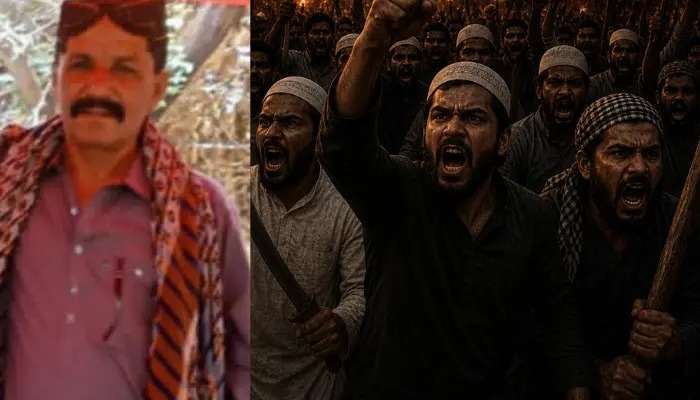
Case Summary
In Mirpurkhas, Sindh, Pakistan, a Hindu man belonging to the Rebari community in Roshanabad was issued threats after being accused of blasphemy by Muslims who were followers of Pir Sarhandi, an Islamic Sufi peer. Following this, a Muslim mob blocked roads and raised “Sar Tan Se Juda” beheading slogans against the Hindu man. This incident came to light when Pakistani Hindu activist Shiva Kachhi, Chairman and Founder of Minority Rights Organisation 'Pakistan Darawar Ittehad', tweeted about it on his official X handle on 25 May 2026. Shiva Kachhi narrated the entire incident on social media. He stated that, according to local residents of Roshanabad, the Hindu victim worked as a night watchman for shops in the area. On the night of 23 May 2026, someone had applied glue to the locks of a store belonging to a Muslim man. On the morning of 24 May 2026, an argument took place between the Hindu Rebari watchman and the Muslim shop owner. Following the argument, the Muslim shop owner made a false blasphemy allegation against the Hindu victim. He claimed that the victim had made derogatory remarks against Islam and mosques. Afterwards, news of the blasphemy allegation spread across the area, causing communal tensions, and the Muslim community became outraged over the matter. Subsequently, Muslim mobs blocked roads in Roshanabad and raised the beheading slogans of “Sar Tan Se Juda”. Several Muslims online also targeted the Hindu man with “Sar Tan Se Juda” threats by accusing him of committing blasphemy. As per Shiva Kachhi, the local community in Roshanabad clearly sided with the Hindu man and stated that no such blasphemy had been committed by the victim. Shiva Kachhi also stated that such allegations of blasphemy were used as a pretext to incite violence against Hindus and other religious minorities in Pakistan. He requested the local government authorities to take legal action against the accused Muslim shopkeeper who made the false blasphemy allegations, as well as against those Muslims who raised the “Sar Tan Se Juda” slogans. He also stated that he was not scared to speak about atrocities against Hindu minorities and said that he would continue his Hindu activism in Pakistan. This incident reflected the broader pattern of persecution and insecurity faced by the Hindu minority in Pakistan, where Hindus continue to face systemic discrimination, communal hostility, religiously motivated violence, and social marginalisation because of their religious identity. Hindu temples and religious symbols are frequently vandalised, while Hindu individuals and families often face threats, intimidation, and mob violence. Hindu women and minor girls remain particularly vulnerable to abduction, forced conversion to Islam, and forced marriages to Muslim men. Blasphemy allegations are also disproportionately used against Hindus, often resulting in false accusations, communal mobilisation, arbitrary arrests, threats, and violent attacks. Many Hindu families are forced to flee their homes due to religious intolerance, living in constant fear of attacks. This sustained persecution highlights the dire conditions for Hindus in Pakistan, where their religious identity makes them targets of oppression. Such incidents create a constant atmosphere of fear and vulnerability within the Hindu community, highlighting the precarious condition of religious minorities in Pakistan.
Why it is Hate Crime ?
The first primary category selected in this case is- Attack not resulting in death. The subcategory selected is- Attacked over 'Blasphemy'. Blasphemy essentially refers to the desecration of anything which is held sacred/holy to a group of people. However, for religious supremacist groups, the elements of ‘blasphemy’ are ever-changing, shifting and expanding – leading to infringement on the rights of other religious groups, freedom of speech and expression, threats and even physical violence. There are instances where blasphemy is also used as a dog whistle to target Hindus owing to intrinsic animosity towards Hinduism. There are several instances where stating truths as mentioned in the non-Hindu doctrine itself has led to unmitigated violence against Hindus. There have also been instances where non-Hindus have themselves created a ‘blasphemous’ situation, like placing a Quran in a temple, to use it as an excuse to attack Hindus. Essentially, Blasphemy charges are often made up and/or are used to shut down any form of criticism of non-Hindu faiths and as a tool to target Hindus. Any physical violence over Blasphemy charges against Hindus are foundationally based on animosity for Hindus and their faith owing to religious supremacist ideologies, therefore, such attacks would be documented as religious motivated hate crimes under this category. The second primary category selected is- Hate Speech against Hindus. The subcategory selected is- Violent Threats. Violent threats, explicit, implicit or implied, is the most dangerous form of hate speech since it goes beyond discriminatory and prejudicial language to express the intent of causing harm to an individual or a group of people based on their religious identity and faith. There could be several different kinds of threats that are issued to Hindus based on religious animosity. An explicit threat would mean the direct threat of violence towards an individual Hindu, a group of Hindus or Hindus at large. Physical violence, death threats, threats of destruction of property belonging to Hindus and threats of genocide would mean explicit threats against Hindus for their religious identity. Implicit threats may not be a direct threat but implied through the use of symbols of actions – for example – in the Nupur Sharma case, other than explicit threats, there were also implicit threats when Islamists took to the streets to burn and beat her effigies. It implies that they want to do the same to Nupur Sharma – thereby is considered an implicit threat. Violent threats can be delivered in person, through letters, phone calls, graffiti, or increasingly through social media and other online platforms. It would be important to understand that a threat – explicit or implicit, online or offline – to an individual who happens to be a Hindu does not qualify as a religiously motivated threat. Such a threat, while vile and dangerous, could be owing to non-religious reasons and/or personal animosity. To qualify as a religiously motivated threat, it would need to exhibit an indication that the individual is being targeted for religious reasons and/or owing to his/her religious identity as a Hindu. This case is a clear example of a religiously motivated hate crime because a Hindu man was issued death threats by Muslims after being falsely accused of blasphemy in Pakistan. The victim was also subjected to “Sar Tan Se Juda” beheading threats by the perpetrators. This overall showcased the religious motives behind the crime and amounted to a clear case of a hate crime rooted in anti-Hindu animosity. In this case, the Hindu victim had not committed any blasphemy against Islam or mosques. However, merely because he got into an argument with a Muslim man over a completely non-religious issue, he was falsely accused of blasphemy by the Muslim shopkeeper. This demonstrated the perpetrator’s deep-seated religious animosity towards the Hindu victim, as the allegation was made with the malicious intent to mobilise members of the Muslim community against him by exploiting religious sentiments. In Muslim-majority countries such as Pakistan, accusations of blasphemy against Islam are frequently weaponised against Hindus and other religious minorities. In many such cases, it does not matter whether any blasphemy had actually taken place or whether the accused had made any remarks against Islam. A mere allegation is often enough to provoke outrage, communal mobilisation, threats, and violence against Hindus under the pretext of defending religion. This reflected hostility towards the victim because of his Hindu identity and transformed a non-religious dispute into a communal and life-threatening situation. Such allegations of blasphemy often rely on hearsay, selective interpretation, exaggeration, or completely fabricated claims, yet they remain capable of provoking immediate public outrage and vigilante reactions even before any impartial investigation takes place. In Pakistan, Muslim extremists have historically exploited blasphemy allegations to intimidate religious minorities, particularly Hindus, silence dissent, and reinforce social control through fear and mob intimidation. Hindus remain especially vulnerable because allegations involving Islam frequently trigger communal mobilisation regardless of whether any credible evidence exists. Over the years, such accusations have repeatedly resulted in attacks on Hindu communities, destruction of Hindu homes and temples, forced displacement, social ostracism, long-term persecution, and, in several cases, even murders and beheadings carried out in the name of punishing alleged blasphemy. This broader pattern demonstrates how accusations of blasphemy are often weaponised as tools of religious persecution against Hindus because of their identity as a vulnerable religious minority. Such false accusations also create a constant atmosphere of fear, insecurity, and vulnerability within the Hindu community in Pakistan. Incidents like these send a broader message that even ordinary disagreements or personal disputes with members of the Muslim majority can rapidly escalate into life-threatening accusations carrying the risk of mob violence, social boycott, displacement, arrest, or death. The fear generated by such allegations discourages many Hindus from speaking openly, defending themselves, or seeking justice, as they remain aware that even an unverified accusation can place their lives in danger. This overall reflected the systemic insecurity, marginalisation, and communal intimidation faced by Hindus in Pakistan due to deep-rooted anti-Hindu hostility and religious prejudice. Furthermore, the slogan “Sar Tan Se Juda” constituted an explicit and religiously motivated threat directed at the Hindu victim in Pakistan. “Gustakh-e-Rasool ki Ek hi saza, sar tan se Juda, sar tan se Juda”, which translates to “There is only one punishment for being disrespectful to Rasool (Prophet Muhammad), their head separated from their torso, their head separated from the torso”, is an Islamist clarion call that has become closely associated with Muslim mob vigilantism, religious extremism, and acts of violence carried out in the name of punishing alleged blasphemy against Islam. In Pakistan, where accusations of blasphemy frequently trigger mob mobilisation and vigilante violence, the use of this slogan against a Hindu man carried a direct implication of beheading and religiously motivated violence. Its usage in this case, therefore, amounted to a serious hate-filled violent threat rooted in anti-Hindu hostility. Though the slogan originated with radical Islamist circles in Pakistan, it has, over the years, become deeply embedded within Muslim mobilisation surrounding allegations of blasphemy. Large crowds of Islamists have repeatedly raised the “Sar Tan Se Juda” slogan during protests and communal mobilisation linked to alleged insults against Islam or the Prophet Muhammad. The slogan itself is nothing but a direct incitement to violence and execution through beheading against those accused of blasphemy, including religious minorities such as Hindus. Its repeated invocation in cases involving blasphemy accusations demonstrates how Islamic extremist rhetoric is used to legitimise mob violence and create a climate of fear for non-Muslims, particularly Hindus in Pakistan. The radicalised outcry is not merely a statement of disapproval; it is an open call for the execution of an individual through beheading based on accusations linked to blasphemy. When this slogan is raised, it sends a clear and terrifying message not only to the individual targeted but also to the wider Hindu community and other religious minorities. It creates an atmosphere of intimidation where religious minorities are reminded that even an accusation, whether true or false, can place their lives in danger. This tactic is frequently used to silence dissent, suppress minorities, and instil fear within vulnerable communities. Islamist groups and radical elements often exploit blasphemy allegations to settle personal disputes or target non-Muslims, particularly Hindus, by levelling fabricated accusations that provoke outrage and paint a target on the accused individual. The underlying hostility towards Hindus and other non-Muslims drives these false accusations and transforms them into tools of persecution and communal intimidation. The appearance of the “Sar Tan Se Juda” slogan in this case demonstrated how deeply such violent rhetoric had permeated sections of society in Pakistan. The public raising of these slogans during communal mobilisation transformed public spaces into theatres of intimidation, where the Hindu victim was openly threatened with death in the name of religion. Such slogans served as a chilling warning not only to the targeted individual but also to the broader Hindu community, reinforcing their vulnerability and insecurity within a hostile communal environment. The repeated chanting of slogans calling for beheading effectively legitimised violence and encouraged vigilante attitudes against the accused Hindu man. The danger of the slogan lay not merely in its verbal content but also in its historical and contemporary consequences. Across Pakistan and other parts of South Asia, there have been numerous recorded instances where individuals accused of blasphemy were murdered, lynched, or attacked after such slogans were raised by radical Muslim crowds. The slogan, therefore, functioned as a bridge between verbal incitement and physical violence, collapsing the distance between threat and action. In this context, the “Sar Tan Se Juda” chants raised against the Hindu victim were not symbolic expressions of anger but explicit calls for violent punishment and execution. The slogan was not a matter of religious expression or protest; it was an explicit incitement to religiously motivated violence and killing. Its use against a Hindu man in Pakistan, following a false allegation of blasphemy, underscored the vulnerability of Hindu communities to targeted intimidation, mob threats, and communal persecution. It also illustrated the broader pattern wherein Islamist groups used allegations of blasphemy, whether fabricated or exaggerated, as tools to victimise Hindus, reinforce fear, and suppress vulnerable religious minorities through threats of violence. This slogan, although originating in Pakistan, has not remained limited to Pakistan alone and has increasingly become associated with Islamic extremist mobilisation and acts of violence across South Asia. In India, Hindu individuals such as Kanhaiya Lal and Umesh Kolhe were murdered by Muslims following controversies linked to alleged blasphemy against Prophet Muhammad. Similarly, Kamlesh Tiwari, a Hindu man, was brutally killed after being accused of making blasphemous remarks against Islam. Even Bharatiya Janata Party spokesperson Nupur Sharma was accused of blasphemy for merely quoting verses of Islamic scriptures regarding Prophet Muhammad. Widespread Islamist protests erupted across multiple regions, with “Sar Tan Se Juda” slogans emerging as a central rallying cry during demonstrations. The controversy was further amplified online by figures such as Mohammed Zubair, an anti-Hindu Muslim journalist and a co-founder of Alt News, after which multiple incidents involving threats, communal mobilisation, intimidation, and violence were witnessed. These examples demonstrated that the slogan was not merely rhetorical in nature but had repeatedly been associated with actual acts of Islamic extremist violence, murders, and beheading threats carried out in the name of punishing perceived blasphemy. Overall, since this current case meets the parameters of a religiously motivated offence, it is being added to the hate crime database of the tracker. Disclaimer: Although this incident involved multiple Muslim perpetrators, including members of a Muslim mob that raised beheading threats and communal slogans against the Hindu victim, the exact number of individuals involved was not specified in the available source material. Only one accused individual, namely the Muslim shop owner who made the blasphemy allegation against the Hindu man, was specifically identified. Therefore, the perpetrator count in this case has been recorded as '1'. This should be understood as a conservative estimate maintained solely for documentation and data-recording purposes.
Victim Details
Total Victim
1
Deceased
0
Gender
- Male 1
- Female 0
- Third Gender 0
- Unknown 0
Caste
- SC/ST 0
- OBC 0
- General 0
- Unknown 1
Age Group
- Minor 0
- Adult 1
- Senior Citizen 0
- Unknown 0


Case Status
Unknown


Perpetrators Details
Perpetrators
Muslim Extremists
Perpetrators Range
One Person
Perpetrators Gender
male
 Sources




