Hindu villagers targeted with inducements and anti-Hindu remarks during Christian conversion drive in Bilaspur
 Bilaspur, Chhattisgarh, India
  24 May, 2026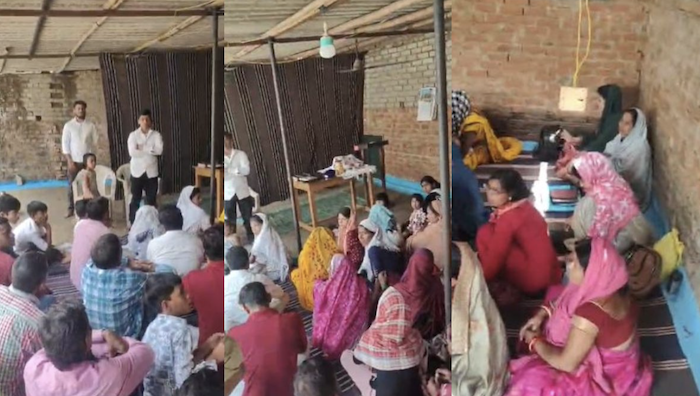
Case Summary
A group of Hindu villagers in Bilaspur, Chhattisgarh, were targeted during a Christian prayer gathering where inducements were offered to encourage religious conversion. The incident surfaced in Mohra village under the Sipat police station area after local residents received information about a gathering taking place under a tin shed in a residential courtyard. Hindu attendees were promised better facilities, marriage into good families, and free medical treatment in exchange for converting to Christianity. Objectionable remarks were also made against Hindu gods and goddesses during the gathering. On the morning of 24th May 2026, Sumit Yadav received information that a Christian prayer meeting was being conducted at the house of Ram Swaroop Suryavanshi in Mohra village, Bilaspur district, Chhattisgarh. The gathering was being held under a tin shed constructed in the courtyard of the house. The Hindu complainant was informed that Christian preaching was taking place at the location and that attempts were being made to persuade Hindu attendees to abandon their faith and convert to Christianity. After receiving the information, Sumit Yadav travelled to the spot along with Dhiraj Bhoi, Subhash Sahu, and Shubhanshu Bhoi. Upon arriving at the gathering, they found Ram Swaroop Suryavanshi, Jitendra Suryavanshi, and Pankaj Kumar Kariyare present. Bibles and refreshments had been arranged at the venue, and Christian preaching was ongoing before the assembled attendees. During the meeting, Hindu attendees were encouraged to convert to Christianity through promises of material and social inducements. Individuals present at the gathering were told that conversion would provide them with better facilities, marriage into good families, and free medical treatment. The inducements were presented as benefits available upon accepting Christianity. The gathering specifically targeted Hindu villagers by encouraging them to abandon their existing faith traditions in exchange for social and economic incentives. The Hindu complainants also stated that objectionable and derogatory remarks were made against Hindu gods and goddesses during the gathering. The comments hurt the religious sentiments of the Hindu attendees. The meeting, therefore, combined Christian preaching with inducements for conversion and insulting references directed towards Hindu deities and beliefs. The incident created concern among local Hindu residents in Mohra village after details of the gathering became public. The matter quickly became a topic of discussion within the surrounding area due to the nature of the conversion attempts and the remarks directed against Hindu religious beliefs. Following the complaint, Sipat police station registered a case against Ram Swaroop Suryavanshi, Jitendra Suryavanshi, and Pankaj Kumar Kariyare. The case was registered under Section 299 of the Bharatiya Nyaya Sanhita and Sections 3 and 4 of the Chhattisgarh Freedom of Religion Act, 1968. Police confirmed that an investigation into the matter was ongoing and stated that further legal action would be taken based on the findings of the enquiry.
Why it is Hate Crime ?
This case has been added to the tracker under the primary category- Predatory Proselytisation. Within this, the subcategory selected is - Proselytisation by grooming, brainwashing, manipulation or subtle indoctrination. Under this, the selected tertiary category is: Pattern of targeting Hindus. Religious brainwashing essentially means the often subtle and forcible indoctrination to induce someone to give up their religious beliefs to accept contrasting regimented ideas. Religious grooming or brainwashing also involves propaganda and manipulation. It involves the systematic effort, driven by religious malice and indoctrination, to persuade “non-believers’ to accept allegiance, command, or doctrine to and of a contrasting faith. Cases of such grooming or brainwashing are far more nuanced than direct threats, coercion, inducement and violence. In such cases, it is often seen that there is repeated, subtle and continual manipulation of the victim to induce disaffection towards their own faith and acceptance of the contrasting faith of the perpetrator. While subtle indoctrination is widely acknowledged as predatory, an element which is often understated in such conversions or the attempts of such conversion is the role of loyalty and trust which might develop between the perpetrator and the victim. Fiduciary relationships are often abused to affect such religious conversion. For example, an educator transmitting religious doctrine of a competing faith to a Hindu student. The Hindu student is likely to accept what the teacher is transmitting owing to existence of the fiduciary relationship. The exploitation of the fiduciary relationship to religiously indoctrinate victims would also be included in this category. Since the underlying animosity towards the victim’s faith forms the basis of predatory proselytization, such cases are considered religiously motivated hate crimes. The other subcategory selected for this case is - Conversion/attempts to convert by inducements. Predatory Proselytisation is not just limited to threat, harassment, force and violence, but it also has contours of stealth. In several cases, the Hindu victim is exploited to convert, with non-Hindus taking advantage of their poverty. In such cases, the Hindu victim who is suffering financially is offered monetary benefits, including lucrative offers for jobs, health treatment, education, etc, to induce the victim into changing his/her religion. In such cases, the religious identity of the victim and the aim to disenfranchise him from his faith form the heart of the crime. Also, taking advantage of and exploiting an individual’s economic vulnerabilities is widely acknowledged as exploitation, forms of which are often penalised by law. Such cases therefore are considered religiously motivated hate crimes since the victim’s religious identity forms the very heart of the crime itself. Another subcategory selected in this case is - Attempting to convert/converting by denigrating Hinduism. In several cases, Hindus are converted or an attempt is made to convert Hindus by denigrating their faith, Hinduism. In such cases, the Hindus associate with the non-Hindu perpetrators often by choice and then, the attempt to convert them by insulting their faith, showing the faith down etc begins. An example of this would be a non-Hindu gathering where the Hindus are attending the gathering of their own free will. However, once they attend the gathering, there is an explicit attempt to convert them by abusing their faith and hailing the faith of the perpetrator. The denigration of the Hindu faith is often based on misrepresentation of the Hindu faith, its doctrine and scriptures and insult to espoused traditions if not blatant lies about Hindu beliefs and ways. Such conversions or attempts at conversions are driven by animosity towards the Hindu faith and are therefore documented as religiously motivated hate crimes. This case qualified as a religiously motivated hate crime because the accused carried out organised proselytisation activities specifically directed at vulnerable Hindu villagers through manipulation, inducements, and denigration of Hindu beliefs in an effort to secure religious conversion to Christianity. The targeting was not random preaching but a structured attempt to exploit economically and socially vulnerable Hindus by presenting conversion as a pathway to material and social upliftment. The case shows how the perpetrators systematically attempted to influence Hindu villagers over time through organised prayer meetings and sustained religious messaging. The gathering was specifically arranged in a village setting where economically weaker and socially vulnerable Hindus could be more easily influenced through emotional persuasion and dependency-based tactics. By organising repeated Christian preaching sessions, distributing Bibles, arranging food, and creating an environment centred around gradual religious persuasion, the accused attempted to normalise Christian conversion among vulnerable Hindus. This reflected calculated targeting because such communities are often more susceptible to manipulation through promises of relief, support, and social advancement. The deliberate focus on vulnerable Hindu villagers demonstrated a broader pattern of targeting Hindus for conversion activities through psychological influence and subtle indoctrination rather than open theological engagement alone. The incident also reflected a clear pattern of targeting Hindus because the accused specifically directed their conversion campaign towards members of the Hindu community while simultaneously attempting to undermine confidence in Hindu beliefs and practices. The prayer meeting was not conducted as a neutral religious gathering but as an organised effort to persuade Hindus to abandon their existing faith. The accused selected a predominantly Hindu social environment and attempted to influence attendees through inducements, emotional pressure, and repeated religious messaging. Such targeting showed deliberate religious motivation because the objective was not merely the practice of Christianity but the active conversion of Hindus away from their own religion. The organised nature of the gathering, the coordinated presence of multiple accused individuals, and the use of inducements and anti-Hindu remarks demonstrated a sustained and structured attempt to penetrate vulnerable Hindu communities for religious conversion purposes. The other aspect which was particularly alarming was that the accused offered promises of better facilities, marriage into good families, and free medical treatment if individuals converted to Christianity. These promises were directly linked to religious conversion and were presented as incentives for abandoning Hinduism. Such inducements exploited the financial insecurity, medical vulnerability, and social aspirations of economically weaker Hindus in order to pressure them towards conversion. The offer of material benefits in exchange for religious change demonstrated that the conversion effort relied not on free spiritual choice but on exploiting hardship and dependency. The complainants described the activities as attempts to lure Hindus into Christianity through inducements, showing that the conversion effort was rooted in calculated exploitation of vulnerable individuals. The use of promises relating to healthcare, marriage prospects, and economic improvement reflected a coercive structure designed to influence religious decisions through material pressure rather than genuine conviction. The case also qualified as a religiously motivated hate crime since attempts were made to convert by denigrating Hinduism. Derogatory remarks were made against Hindu gods, goddesses, and religious beliefs during the gathering. By insulting Hindu deities while simultaneously encouraging conversion to Christianity, the accused attempted to weaken the faith of Hindu attendees and create religious alienation from Hinduism. This went beyond ordinary preaching and reflected a deliberate, religiously motivated effort to undermine Hindu beliefs as part of the broader conversion campaign. Taken together, the organised prayer meetings, manipulation of vulnerable Hindu villagers, inducements tied to conversion, and derogatory remarks against Hindu deities established a coordinated campaign aimed at converting Hindus to Christianity while showing clear animosity towards Hinduism. These targeted proselytisation activities stemmed from hostility towards the victims’ professed faith, making this a religiously motivated crime against Hindus. Therefore, this case is being added to the hate crime database of the Hinduphobia Tracker. Disclaimer: Since the exact date on which the conversion activities and targeting of Hindu villagers began could not be independently established from available reports and sources, 25th May 2026, the date of publication of the incident report, has been used as the incident date for documentation purposes only.


Case Status
Complaint registered


Perpetrators Details
Perpetrators
Christian Extremists
Perpetrators Range
From 2 To 5
Perpetrators Gender
male
 Sources




