Hindu woman, along with her two minor children, pressured for religious conversion by her Christian husband; subjected to assault upon refusal
 Udham Singh Nagar, Uttarakhand, India
  23 May, 2016
Case Summary
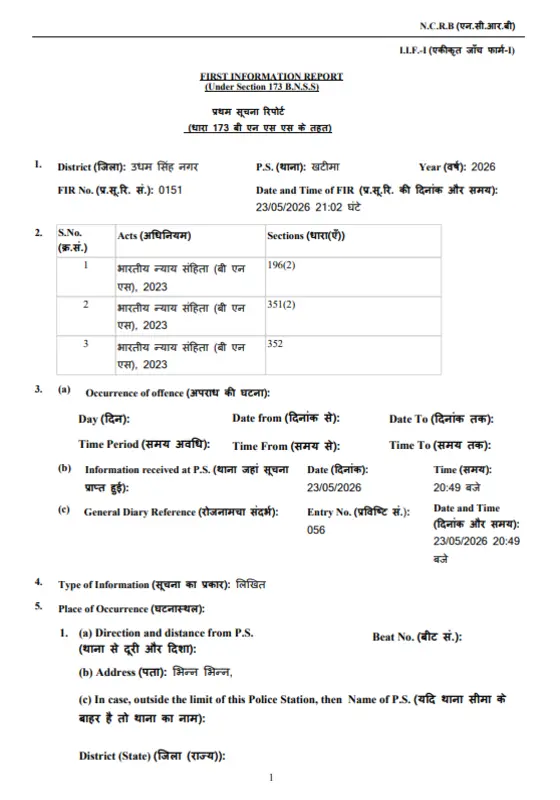
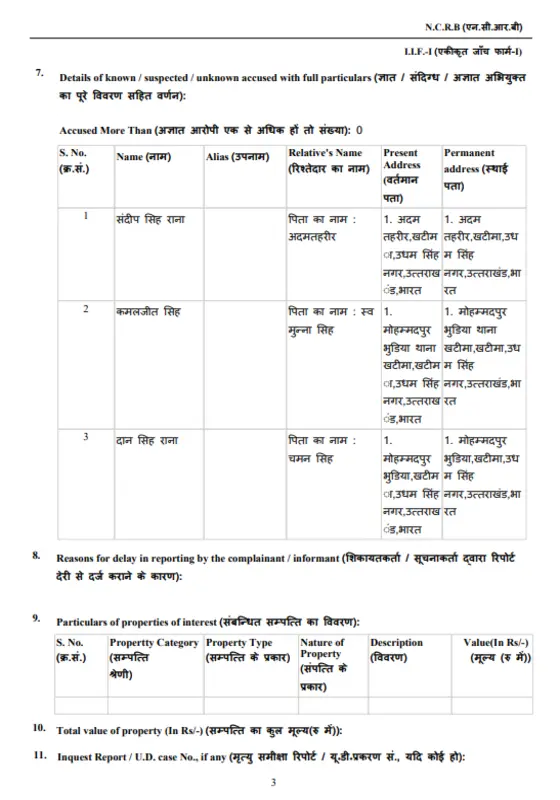
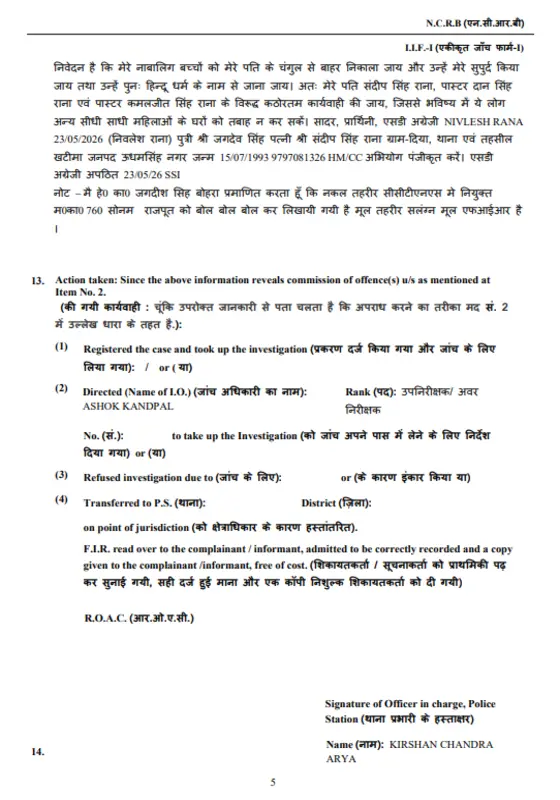
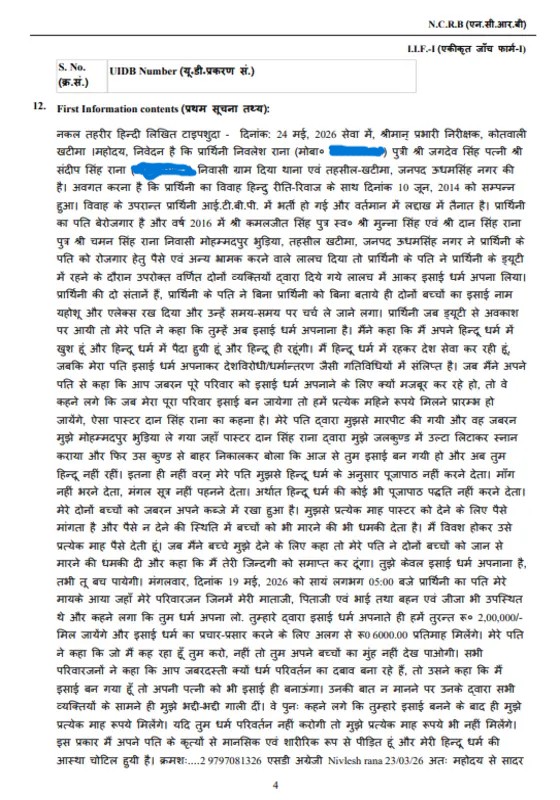
In Khatima, Udham Singh Nagar district of Uttarakhand, a Hindu woman named Nivlesh Rana, along with her two minor children, was pressured for religious conversion by her Christian husband named Sandeep Singh Rana and two Christian pastors. When she refused and resisted, she was subjected to abuse and assault. The Hinduphobia Tracker accessed the FIR filed by the victim, Nivlesh Rana. Based on her complaint, Khatima police registered FIR No. 0151/26 against Sandeep Singh Rana, Pastor Dan Singh Rana, and Pastor Kamaljeet Singh Rana under Sections 196(2), 351(2), and 352 of the Bharatiya Nyaya Sanhita (BNS), and initiated an investigation into the matter. According to the complaint, the victim stated that her marriage was solemnised according to Hindu customs on 10 June 2014. After the marriage, she secured employment in the ITBP and was posted in Ladakh, while her husband remained unemployed. During this period, in 2016, Sandeep Singh Rana came into contact with Kamaljeet Singh and Dan Singh Rana, residents of Mohammadpur Bhudiya village in Khatima, who influenced him towards Christianity by offering inducements in the form of employment and financial gain. Following this, he converted to Christianity while his wife was away on duty. She further stated that they had two children, and that without her knowledge or consent, her husband renamed them with Christian names, “Yahoshu” and “Alex”, and regularly began taking them to church. When she returned home on leave and objected, her husband pressured her to abandon Hinduism and adopt Christianity as well. She informed him that she wished to continue following Hindu traditions and remain within her ancestral faith. She further stated that her husband told her that the entire family would begin receiving monthly payments after converting to Christianity, and that Pastor Dan Singh Rana had assured him of such benefits. The victim further revealed that her husband physically assaulted her and forcibly took her to Mohammadpur Bhudiya, where Pastor Dan Singh Rana immersed her upside down in a water tank or baptism pool and declared that she had become a Christian from that day onward. Thereafter, she was prevented by her husband from observing Hindu customs and rituals. She stated that he stopped her from performing Hindu worship, wearing a mangalsutra, and applying sindoor, all of which were associated with her Hindu identity and Hindu traditions. She also stated that her husband kept both children under his control and demanded money from her every month, which he intended to hand over to the pastor. She stated that whenever she failed to provide money, he threatened to kill the children. Out of fear and helplessness, she continued sending him money regularly. She further stated that when she demanded custody of the children, her husband threatened to kill both the children and her unless she accepted Christianity. She further recorded that on 19 May 2026, Sandeep Singh Rana arrived at her parental home in the presence of several family members and again pressured her to convert. During the confrontation, he stated that upon her conversion, the family would immediately receive ₹2 lakh, along with ₹6,000 every month for spreading Christianity. When relatives objected to the pressure being exerted on her, he reportedly declared that he had already become a Christian and would ensure that his wife and children converted as well. He also abused and humiliated her in front of her relatives, while insisting that he would only continue receiving financial benefits if she accepted Christianity. She stated that the sustained pressure, threats, abuse, and restrictions on her religious practices caused her severe mental and physical distress and deeply hurt her faith in Hinduism. She requested police protection, custody of her minor children, restoration of their Hindu names, and strict legal action against Sandeep Singh Rana, Pastor Dan Singh Rana, and Pastor Kamaljeet Singh Rana so that other women would not face similar circumstances in the future. As of the date of writing this report, the police have registered an FIR based on the complaint and an investigation was ongoing.
Case Images
Why it is Hate Crime ?
This case has been added to the tracker under the primary category of - Crimes against women in relationships and other sexual crimes. Within it, the sub-category selected is - Forced conversion after marriage. In such cases, a non-Hindu man is in a relationship with a Hindu woman when the pressure to convert her religion begins to manifest. In such cases, typically, two patterns emerge. First, when the relationship is consensual, and the religious identity of the perpetrator is known to the Hindu woman in the relationship, however, at some point during the relationship, the non-Hindu man starts to force the victim to convert her religion and give up her Hindu religious identity. The second is when the woman gets into a marriage with the man pretending to share her faith. Later, when the truth is revealed, the man starts pressuring the woman to convert her religion and give up her religious identity. In both the situations, the methods used to force the victim to convert her religion often revolve around force-feeding beef, forcing her to wear hijab, forcing her to read the Kalma or even pressurizing the victim to do ‘Nikah’, which is marriage under Islamic law, with a prerequisite being conversion to Islam. Cases where a Hindu woman consensually converts to Islam in a relationship will be left out of the hate crime database, even though it could be argued in several cases that the conversion was a result of religious brainwashing. The second sub-category selected here is - Assault or threat upon refusal to convert. When Hindu women are in a relationship with non-Hindu men, there are cases where the woman faces threats or assault after she refuses to convert and change her religious identity owing to pressure/force by the non-Hindu man. Such relationships may be consensual with the religious identity of the non-Hindu man known to the victim. Somewhere along the relationship, the non-Hindu man starts pressurizing the Hindu woman to convert to Islam and upon her refusal, assaults or threatens the victim. Such cases are driven by specific religious motivations and against the religious identity of the victim and are therefore qualified as hate crimes. Cases where the Hindu woman converts to Islam and does not file a complaint about the force or threat, are not considered a part of the hate tracker, even though, it may be argued that the woman was brainwashed or threatened to convert to Islam. The second primary category selected here is - Predatory Proselytisation. Within it, the sub-category selected is - Harassment, threats, coercion for conversion. Harassment covers a wide range of behaviours of an offensive nature. It is commonly understood as behaviour that demeans, humiliates, and intimidates a person, including threats and coercion. Harassment and threats, in this case, find their root on discriminatory grounds which has the effect of nullifying a person’s rights or infringing upon his freedom to exercise his right specifically owing to the victim’s religious identity. Verbal and physical threats and psychological or physical harassment are often used against Hindu victims because they choose to practice their professed religion. Religious harassment also includes forced and involuntary conversions by harassment, threats or coercion. Coercion includes intimidatory tactics like force-feeding a Hindu victim beef to convert to another religion, forceful circumcision etc. In several cases documented, non-Hindu perpetrators or those who harbour specific animosity towards Hinduism, harass victims simply based on their religious identity. Such cases often also include harassment to ensure the Hindu victim abandons his/her professed religion and adopts the religion of the perpetrator. Such cases where Hindu victims are harassed to convert to the perpetrator’s religion are rooted in animosity towards the victim’s religious identity and are therefore documented as religiously motivated hate crimes. The other sub-category selected here is- Conversion/ attempts to convert by inducement. Predatory Proselytisation is not just limited to threat, harassment, force and violence, but it also has contours of stealth. In several cases, the Hindu victim is exploited to convert, with non-Hindus taking advantage of their poverty. In such cases, the Hindu victim who is suffering financially is offered monetary benefits, including lucrative offers for jobs, health treatment, education, etc, to induce the victim into changing his/her religion. In such cases, the religious identity of the victim and the aim to disenfranchise him from his faith form the heart of the crime. Also, taking advantage of and exploiting an individual’s economic vulnerabilities is widely acknowledged as exploitation, forms of which are often penalised by law. Such cases therefore are considered religiously motivated hate crimes since the victim’s religious identity forms the very heart of the crime itself. The other sub-category selected here is - Proselytisation by grooming, brainwashing, manipulation or subtle indoctrination, with the tertiary category being - Conversion of minor. Religious brainwashing essentially means the often subtle and forcible indoctrination to induce someone to give up their religious beliefs to accept contrasting regimented ideas. Religious grooming or brainwashing also involves propaganda and manipulation. It involves the systematic effort, driven by religious malice and indoctrination, to persuade “non-believers’ to accept allegiance, command, or doctrine to and of a contrasting faith. Cases of such grooming or brainwashing are far more nuanced than direct threats, coercion, inducement and violence. In such cases, it is often seen that there is repeated, subtle and continual manipulation of the victim to induce disaffection towards their own faith and acceptance of the contrasting faith of the perpetrator. While subtle indoctrination is widely acknowledged as predatory, an element which is often understated in such conversions or the attempts of such conversion is the role of loyalty and trust which might develop between the perpetrator and the victim. Fiduciary relationships are often abused to affect such religious conversion. For example, an educator transmitting religious doctrine of a competing faith to a Hindu student. The Hindu student is likely to accept what the teacher is transmitting owing to existence of the fiduciary relationship. The exploitation of the fiduciary relationship to religiously indoctrinate victims would also be included in this category. Since the underlying animosity towards the victim’s faith forms the basis of predatory proselytization, such cases are considered religiously motivated hate crimes. This case has been added to the tracker because it involved sustained coercion, abuse, intimidation, and religious targeting directed at a Hindu woman and her minor children with the objective of forcing them to abandon their Hindu faith and adopt Christianity. The victim’s husband, along with two pastors, subjected her to continuous pressure to convert, physically assaulted her, interfered with her Hindu religious practices, renamed her children with Christian names, and attempted to isolate the family from their Hindu identity through coercive religious influence and inducements. Firstly, a central aspect of the case was that after the accused husband converted to Christianity, he began systematically pressuring his Hindu wife and their minor children to also abandon Hinduism and adopt Christianity. Despite the victim repeatedly expressing her desire to continue practising Hinduism and preserve her religious identity, she was persistently subjected to pressure to convert. Attempting to compel a Hindu individual to renounce her faith and embrace another religion constituted an attack on her freedom of conscience and religious autonomy. It was not a matter of personal choice; it was coercion rooted in hostility towards the victim’s Hindu identity. Such an attempt reflected religious animosity because the act was not simply about personal differences but about erasing the victim’s Hindu faith, making it a religiously motivated act of targeted abuse. Secondly, when the victim resisted conversion and continued asserting her Hindu faith, she was subjected to abuse, threats, and physical assault by her husband. In such cases, violence served a dual purpose: physical subjugation and religious humiliation. The intention behind the abuse was not merely to dominate the victim physically, but to emotionally, mentally, and spiritually break her resistance so that she could be converted against her will. The victim was punished specifically for refusing to surrender her Hindu identity, making the assault religiously targeted rather than random or incidental. Such acts demonstrated an organised and sustained effort to force religious conformity through intimidation and fear. Thirdly, it is further important to note here that the two children were minors, which means the element of consent and genuine change of conscience was missing ab initio. Minors, due to their young age and lack of maturity, are particularly vulnerable to manipulation and coercion. They may not have the ability to fully understand the implications of converting to another religion, and the accused purposely targeted and exploited this vulnerability of the minors. Fourthly, another significant aspect of the case was that the accused changed the names of the children to “Yahoshu” and “Alex” and regularly took them to church. Renaming children in this manner carried deep symbolic and cultural significance because names often represent familial, religious, and civilisational identity. The replacement of Hindu names with Christian names was not merely cosmetic; it represented an attempt to alienate the children from their Hindu roots and impose a different religious identity upon them. Similarly, repeatedly taking them to church while simultaneously distancing them from Hindu customs reflected an effort to gradually detach them from their ancestral traditions and social identity. Such actions amounted to the forceful removal of their Hindu identity and the assertion of Christian identity over Hindu identity within the household. Fifth, the victim further stated that similar methods were used against her personally in an attempt to distance her from Hinduism and sever her connection with Hindu customs and traditions. She was forcibly taken to a church-related location where Pastor Dan Singh Rana immersed her in a water tank or baptism pool and declared that she had become Christian. Thereafter, her husband reportedly prevented her from engaging in Hindu religious practices and symbols associated with her faith and marriage. She stated that she was stopped from performing puja, wearing a mangalsutra, and applying sindoor, all of which held deep religious and cultural significance within Hindu tradition. Preventing a Hindu woman from practising her rituals and wearing symbols associated with her faith and marriage amounted to a deliberate attempt to erase her visible Hindu identity and psychologically distance her from her religion. Such acts reflected a pattern of coercive religious control intended to gradually sever her emotional, spiritual, and cultural connection with Hinduism. Sixth, the accused informed the victim that the family would receive ₹2 lakh upon conversion and additional monthly payments for spreading Christianity. The victim further stated that her husband claimed he would receive financial benefits only if she converted as well. The use of monetary incentives and promises of recurring payments indicated that conversion was being pursued not through voluntary spiritual conviction but through material inducement and pressure. Exploiting economic incentives to persuade or compel vulnerable individuals to abandon their religion undermines genuine religious freedom and reflects a coercive approach towards conversion. Taken together, the facts presented in the complaint indicated a sustained pattern of religious coercion, intimidation, forced identity alteration, suppression of Hindu religious practices, and targeting of both a Hindu woman and her minor children for conversion to Christianity. The combination of threats, physical violence, interference with religious customs, renaming of children, inducements, and attempts to erase visible expressions of Hindu identity reflected a broader pattern of hostility towards the victims’ Hindu faith. Consequently, this case has been included in the tracker as an instance of coercive and targeted religious persecution directed against Hindus. Disclaimer: It is important to clarify that none of the media sources covering this case has specified the exact date when the victim's ordeal began or when the accused began pressuring her to convert, though it is mentioned that the accused converted to Christianity in 2016. Thus, to document this case, we have used an indicative date, 24 May 2016, as a placeholder to represent the beginning of her suffering. While media coverage of the incident emerged on 24 May 2026, the Hinduphobia Tracker records the incident based on when the victim’s ordeal began, not when it was reported.
Victim Details
Total Victim
3
Deceased
0
Gender
- Male 0
- Female 1
- Third Gender 0
- Unknown 2
Caste
- SC/ST 0
- OBC 0
- General 0
- Unknown 3
Age Group
- Minor 2
- Adult 1
- Senior Citizen 0
- Unknown 0


Case Status
Complaint registered


Perpetrators Details
Perpetrators
Christian Extremists
Perpetrators Range
From 2 To 5
Perpetrators Gender
male
 Sources




