Hindu temple targeted, sacred Shivalinga desecrated by Muslims in Siliguri, West Bengal; police arrest Hindu activists protesting the desecration
 Siliguri, West Bengal, India
  21 May, 2026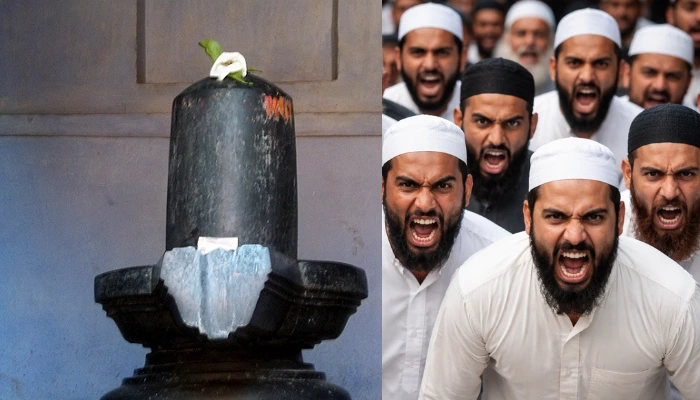
Case Summary
In West Bengal’s Siliguri, a Hindu temple was targeted, and its sacred Shivalinga was desecrated after a few Muslim goons placed a used condom on the Shivalinga. When Hindu activists protested against the incident, they were arrested by the police under the Mamata Banerjee-led Trinamool Congress government. This incident came to light when journalist Yatendra Sharma spoke about it during News18 India’s programme ‘Panchayat With Reporters’. Speaking about the incident, he stated, “I went to Siliguri to cover this election, and this incident happened around Siliguri. There is a very old Shiva temple there.” He further stated, “At that Shiva temple, I have no problem saying that there were Muslim goons. Those goons were not locals. These were people who were given space there illegally. The Mamata government of West Bengal had given them space, and their courage was so high that they placed a used condom at that Shiva temple, on the Shivalinga. How could anyone have that much courage without the government?” Yatendra Sharma further explained, “When the locals realised that this was a case of hurting religious sentiments and that action should be taken, they made a video and gave it to the police. However, the police arrested the Vishwa Hindu Parishad, a Hindu organisation, members who had taken the video and detained them at the police station. The video was also deleted in order to prevent it from spreading further.” He additionally spoke about what he described as Muslim appeasement under Mamata Banerjee’s rule, stating that action was taken against the Vishwa Hindu Parishad (VHP) members, while no action was taken against those accused of desecrating the temple, despite complaints that they were Bangladeshi Muslim infiltrators.
Why it is Hate Crime ?
The first primary category selected in this case is- Attack on Hindu religious representations. The subcategory selected is- Desecration of Hindu religious symbol. Icons and symbols or a religious representation of a spiritual ideal are widely revered in Hinduism. Iconography is of vital significance in the Hindu milieu. It helps connect people’s spiritual beliefs with the real world. Iconography within the Hindu faith takes several shapes and forms. Murtis are of most significance to Hindus, to which daily rituals, prayers and offerings are done. Besides the murtis, there are several other symbols which have deep significance in the Hindu faith – the Om and Swastika for example. Since these Hindu religious symbols hold paramount importance in Hinduism, any desecration of symbols, icons, murtis, religious representations and manifestations, is driven by animosity towards the faith itself which manifests itself through these murtis, icons and symbols. Therefore, any desecration of these Hindu religious symbols and representations is considered religiously motivated hate crimes under this category. The other subcategory selected is- Attack on Temples. In Hinduism, a temple is the abode of the Deity. The Deity in the Temple is consecrated, thereby, making it a real, breathing entity. Hindus believe that not just the Deity but the temple premises itself are sacred to Hindus since Hindus hold the faith that the entire Temple space is an amalgamation of the divine energy of the deity. Given the central significance of Temples in Hindu Dharma, any attack against a Hindu Temple or its peripheral premises is an attack on the faith itself and is born out of animosity towards the faith, of which, the Temple is a central tenet. Any manner of attack against a Temple and/or its premises would therefore be considered a religiously motivated hate crime. The second primary category selected is- Attack not resulting in death. The subcategory selected is- Attacked for opposing radicals or trying to save victim. In several cases, Hindus are attacked for opposing religiously motivated crimes being committed against a fellow Hindu or simply for voicing an opinion opposing radical elements, who either have in the past or continue to persecute Hindus. In such cases, the initial attack against the victim, against which the Hindu was trying to defend the victim, would also need to be classified as a religiously motivated hate crime. Since the initial crime itself was religiously motivated and the subsequent crime of attempting to save the victim or speaking against the radical elements ends up inviting a violent attack, it would also be classified as a religiously motivated hate crime under this category. This case constitutes a clear example of a religiously motivated hate crime, as the Muslim perpetrators desecrated a sacred Shivalinga and the police arrested Hindu activists opposing this desecration instead of the accused, overall demonstrating the religiously driven nature of the crime. The Shivalinga is one of the holiest and most sacred symbols in Hinduism and represents Lord Shiva, one of the principal deities of the Hindu faith. For millions of Hindus, the Shivalinga is not merely an object of worship but a deeply revered religious symbol associated with devotion, purity, cosmic creation, and divine consciousness. It occupies the central sanctified space within Shiva temples and is worshipped daily through rituals, prayers, and offerings. Any deliberate act intended to defile or insult the Shivalinga, therefore, carries profound religious and emotional consequences for Hindus. In this case, placing a used condom upon the sacred Shivalinga constituted an act of extreme desecration designed to insult and humiliate Hindu religious beliefs and practices. Such an act violated the sanctity attached to one of Hinduism’s most sacred religious symbols and inflicted deep emotional and spiritual injury upon devotees. The degrading and explicit nature of the desecration further underscored the perpetrators’ contempt towards Hindu beliefs and demonstrated a deliberate intention to outrage Hindu religious sentiments. Consequently, the act bore all the characteristics of a hate crime motivated by hostility towards the Hindu faith and its adherents. Further, this incident occurred within the premises of a Hindu temple, which itself is regarded as a sacred spiritual space in Hinduism. In Hindu religious tradition, the deity, the sanctum, the Shivalinga, idols, and the temple complex together form an inseparable sacred ecosystem. The sanctity of the temple is intrinsically tied to the sanctity of the deity and the sacred objects housed within it. Therefore, the desecration of the Shivalinga also amounted to the desecration of the entire temple and its spiritual purity. By carrying out such an act inside a Hindu temple, the perpetrators not only insulted a sacred religious symbol but also violated a consecrated place of worship central to the faith and identity of the Hindu community. Such deliberate targeting of a Hindu temple demonstrated clear hostility towards Hindu religious institutions and showcased deep-seated religious animosity directed against the Hindu community as a whole. The attack, therefore, amounted to a clear case of a hate crime motivated by hatred towards Hinduism and its followers. The subsequent police response further intensified concerns regarding institutional bias against Hindus. According to reports, Hindu activists and members of the Vishwa Hindu Parishad who protested against the desecration and demanded action against the perpetrators were detained and subjected to police action, while no comparable immediate action appeared to have been taken against those accused of desecrating the temple. Such selective treatment demonstrated that individuals raising their voices against anti-Hindu acts were being criminalised, while the Muslim perpetrators were shielded from accountability. This response reflected broader allegations of institutionalised bias against Hindus under the Mamata Banerjee-led Trinamool Congress government in West Bengal. Consequently, the incident extended beyond the desecration itself and raised serious concerns regarding discriminatory state response and the suppression of Hindu grievances. It also reinforced fears that Hindus who oppose anti-Hindu activities or seek accountability for attacks on their religious institutions are increasingly vulnerable to targeted state action and intimidation in states such as West Bengal. This is not an isolated incident. Over the past several years, a disturbing pattern has emerged in West Bengal where incidents targeting Hindus, their temples, and festivals have occurred and received support from the state and administration. This targeting has become institutionalised under the leadership of Chief Minister Mamata Banerjee, whose government stands accused of deliberately shielding anti-Hindu elements while clamping down on Hindu rights. There are increasing instances where the state actively suppresses Hindu religious expression. Hindus have been arrested simply for chanting “Jai Shri Ram”, a phrase vilified by the administration and the ruling party. Permission for Hindu processions, especially during festivals like Ram Navami or Hanuman Jayanti, is routinely denied on grounds of "law and order concerns", while Muslim religious gatherings face no such hurdles. Moreover, over the years, the Mamata-led government issued numerous prejudicial directives, like orders restricting Durga Puja immersions citing Muharram processions. Inaction on anti-Hindu mob violence in areas like Dhulian, Islampur, and Kaliachak. Public endorsements and appeasement of radical clerics and Islamist leaders, while dismissing concerns raised by Hindu groups as “communal provocation”. The systematic suppression of Hindu voices, denial of communal violence, and criminalisation of Hindu identity expressions such as “Jai Shri Ram” reflect not just administrative failure but deeper ideological hostility towards the Hindu community. Even communal attacks against Hindus have been downplayed by the state and police authorities. A glaring example of this systemic whitewashing appears in the handling of the Murshidabad violence, as well as multiple other incidents in Basirhat, Malda, Midnapore, and Uttar Dinajpur. In the Basirhat case (March 2025), for instance, when a Kali temple was vandalised and the idol desecrated, the police quickly dismissed the communal nature of the attack and labelled the perpetrator as “mentally unstable” without serious investigation or due process. In the aftermath of widespread anti-Hindu violence in Murshidabad and Malda (April 2025), which included arson, looting, and idol desecration, the West Bengal Police attempted to present the violence as “minor clashes” or “local disputes” unrelated to religion. Reports indicated that despite credible accounts of Hindu homes and temples being attacked, the police either failed to act in time or took a biased stance that allowed the violence to escalate. In many cases, police statements contradicted eyewitness reports and video evidence shared on social media, showcasing institutionalised bias against Hindus who are victims of hate crimes. Overall, since this case meets various parameters of a hate-driven offence, it is being added to the hate crime database of the Hinduphobia Tracker. Disclaimer: The Hinduphobia Tracker records incident dates based on when the crime occurred rather than when it was reported by the media. However, in the present case, media reports did not specify the exact date on which the incident took place. Therefore, the date on which the incident first came to light publicly, namely 22 May 2026, when News18 India published details regarding the matter, has been selected as the indicative incident date for documentation purposes only. In this case, the desecration of the sacred Shivalinga and Hindu temple was carried out by Muslim perpetrators, making them the primary perpetrators in the incident. At the same time, the response of the state administration and police, who detained Hindu activists protesting against the desecration instead of taking immediate action against the perpetrators, demonstrated institutional bias and suppression of Hindu grievances. However, since the direct act constituting the hate crime was committed by the Muslim perpetrators, the perpetrators' identity has been recorded as "Muslim extremists".


Case Status
Unknown


Perpetrators Details
Perpetrators
Muslim Extremists
Perpetrators Range
Unknown
Perpetrators Gender
unknown
 Sources




