Hindu woman deceived by married Muslim man she met online posing as Tilak wearing Hindu man “Sagar” in Dehradun
 Dehradun, Uttarakhand, India
  22 May, 2026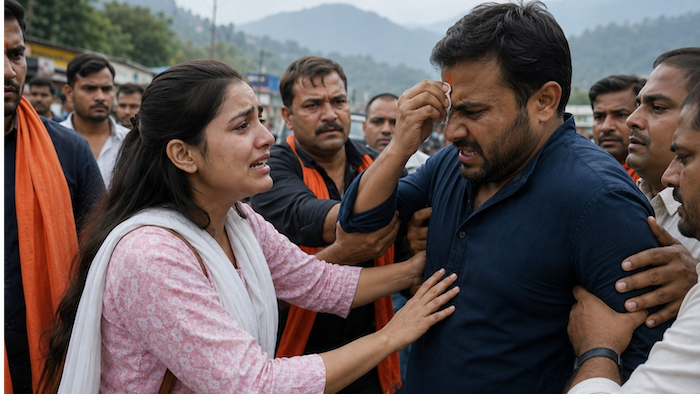
Case Summary
A Hindu woman from Dehradun, Uttarakhand, was deceived by a Muslim man who concealed his religious identity and approached her using a Hindu name. The Hindu woman believed she was interacting with a Hindu man named “Sagar” after he introduced himself that way on social media and in person. The deception continued until his real identity as Sarfaraz, a married Muslim man from Lakhimpur Kheri, Uttar Pradesh, was exposed during a confrontation in Dehradun. The Hindu woman first came into contact with Sarfaraz through Facebook, where he presented himself as “Sagar”. He maintained the false Hindu identity while communicating with her and sent photographs of himself wearing a tilak on his forehead in order to strengthen the deception. By adopting Hindu religious markers and concealing his Muslim identity, he created the impression that he belonged to the same religious community as the Hindu woman. During the course of their interaction, the Hindu woman remained unaware of his real identity and marital status. On 19th May 2026, the Hindu woman and Sarfaraz travelled from Dehradun towards Mussoorie. Near Kuthalgate in Dehradun, Bajrang Dal activists and local residents stopped them after becoming suspicious about the man’s identity. When questioned, Sarfaraz identified himself as “Sagar”. His Aadhaar card and mobile number were then checked, following which it emerged that his real name was Sarfaraz. The Hindu woman then discovered that the man she had been interacting with had concealed his Muslim identity and had falsely represented himself as Hindu. Further enquiries revealed that Sarfaraz was a resident of Lakhimpur Kheri in Uttar Pradesh and had already been married for around one year. Bajrang Dal workers contacted his family and learned that he had left home, saying he was travelling to Lucknow, but had instead come to Dehradun. The Hindu woman called her brother to the scene after learning the truth about his identity and marriage. A confrontation followed at the location. During the incident, local people and Bajrang Dal workers smeared Sarfaraz’s face with soot and placed bangles on his hands before handing him over to the police. The Hindu woman stated that she had befriended him, believing he was a Hindu man named “Sagar”, and later discovered that he had deliberately concealed his real identity. The use of a Hindu name, Hindu appearance, and Hindu religious symbol in the form of a tilak formed part of the deception used to gain the trust of the Hindu woman. Following the incident, Rajpur Police registered a case against Sarfaraz on the basis of the Hindu woman’s complaint. Police confirmed that he had introduced himself using the false Hindu identity of “Sagar” and concealed his real name while communicating with the Hindu woman. The investigation into the matter remained ongoing.
Why it is Hate Crime ?
This case has been added to the tracker under the primary category - Crimes against women in relationships and other sexual crimes. Within this, the subcategory selected is - Man pretends to be Hindu. Under this, the tertiary categories selected are - Name changed, and Wears symbols of Hinduism. When a non-Hindu man pretends to be a Hindu to deceive a Hindu woman into a relationship, the act is seen as triggered by malafide intentions. In some cases, the woman eventually accepts the man’s original religious identity and converts after the man’s identity is revealed. These cases could be argued as cases of religious brainwashing and a result of the pressure a woman feels after getting into a relationship with a man. The woman, it can be argued, also changed her religious identity because of the stigma she believes she might face if she chooses to walk out of a deceptive relationship. However, for the purpose of documenting hate crimes, the cases in this subcategory are limited to those where there is explicit violence aimed at religious conversion against the wishes of the victim (force-feeding beef, blackmailing with intimate videos, rape on refusal to convert, etc), or if the woman herself complains of the man’s religious deception. In such cases, it is established that the deception of the non-Hindu man had a specific aim of religious conversion or targeting of the victim due to her Hindu religious identity, therefore, making it a religiously motivated hate crime. The other sub-category selected for this case is - Brainwashed and/ or groomed. Under this, the tertiary category selected is - Victim says she was brainwashed/groomed. In our database, we have not added incidents where women have converted to another religion of their free will and no allegations of forced/involuntary conversion have been made. However, there are certain cases of conversion where the consent itself is a result of the brainwashing or grooming of a minor by the non-Hindu perpetrator trying to victimise a woman for her Hindu religious identity. The phenomenon of grooming points to non-Hindu perpetrators identifying their Hindu victims’ vulnerabilities and exploiting them over months and sometimes years, to extract the supposed ‘consent’ in order to convert their religion. In most cases of grooming, the victims are minors or the grooming started when the victim was a minor. In other cases of grooming, the non-Hindu perpetrator brainwashes and grooms a minor victim to extract their trust and then proceeds to rape them repeatedly with the intent of converting them to their faith. It is pertinent to understand here that when the victim is a minor, the ‘consent’ to convert or enter into a romantic relationship with an adult itself is redundant – addressed by POCSO. While every case of conversion of a minor and incidents of establishing a physical relationship with a minor by an adult is a crime, for the purpose of this database, a case would be considered a hate crime only if there is a distinct religious angle to the grooming. For example, in the UK, if a Hindu minor is targeted by Pakistani grooming gangs, it would be considered a hate crime because the victims are specifically targeted owing to their non-Muslim religious identity with the perpetrators being Muslim. In other cases, if a Hindu minor is brainwashed into entering a physical relationship with the non-Hindu adult perpetrator and the family alleges grooming/brainwashing of the minor to convert her religion, it would form a part of this database. If the victim is a Hindu adult, the case would form a part of this database only if the victim herself says that she was brainwashed/groomed to convert her religion. However, if the victim is deceased (murdered or otherwise), the case would form a part of this database if her family/friends provided testimony that the victim was brainwashed/groomed to convert her religion. Since these crimes have a distinct religious angle where the victim is being targeted owing to her Hindu religious identity, these cases are considered a hate crime. This case qualified as a religiously motivated hate crime because the Muslim perpetrator deliberately concealed his religious identity in order to gain the trust of a Hindu woman by presenting himself as a Hindu man. Rather than approaching the victim honestly, he adopted the Hindu name “Sagar” and built an entirely fabricated identity designed to create familiarity, comfort, and acceptance within the Hindu woman’s social and religious framework. The deception was not incidental; it was carefully constructed around Hindu identity itself. By abandoning his real Muslim identity and selecting a common Hindu name, the perpetrator specifically exploited the trust that comes from perceived shared religion and cultural belonging. The religious nature of the deception became even more explicit through the perpetrator’s deliberate use of Hindu symbols and outward religious markers. He wore a tilak on his forehead and projected himself as a Hindu in photographs and interactions with the victim. The tilak carries deep religious and cultural significance within Hinduism and is commonly associated with devotion, faith, and Hindu identity. By wearing it while concealing his real identity, the perpetrator intentionally weaponised Hindu religious symbolism to strengthen his false persona and emotionally manipulate the Hindu woman into believing he belonged to her faith community. This demonstrated calculated intent to misuse Hindu religious practices and symbols in order to deceive a Hindu victim. The sustained deception and prolonged interaction between the perpetrator and the Hindu woman also reflected clear elements of grooming and psychological manipulation. The two came into contact online, after which the Muslim perpetrator continued cultivating the false Hindu identity over time in order to build emotional trust and dependency. The deception was maintained consistently throughout their communication and meetings, showing that the impersonation was not momentary but part of a deliberate process designed to gradually draw the Hindu woman into a relationship under false religious pretences. The grooming relied specifically on exploiting the victim’s belief that she was interacting with a Hindu man who shared her religious and cultural background. The victim’s own statements after the incident further reinforced the existence of grooming and religious deception. After Bajrang Dal activists and local residents confronted the accused and verified his real identity through his Aadhaar card and mobile details, the Hindu woman stated that she had no idea that the Muslim man posing as “Sagar” was actually Sarfaraz. Her reaction established that the relationship had been built entirely on fraudulent religious representation and concealment of identity. The fact that she only discovered the truth after third-party intervention demonstrated the extent to which the perpetrator had successfully manipulated and deceived her by falsely presenting himself as Hindu. This incident is not an isolated case but part of a broader pattern where Hindu women are deliberately targeted through deception and coercion for exploitation. Such predatory actions stem from doctrinal animosity towards the Hindu faith and its adherents. Taken together, the use of a false Hindu name, deliberate use of Hindu religious symbols, sustained online grooming, and the victim’s confirmation that she was deceived about the perpetrator’s identity established clear religious markers within this case. The Muslim perpetrator specifically exploited Hindu identity and religious trust to initiate and sustain the relationship, reflecting deliberate religious deception and calculated targeting of a Hindu woman. Disclaimer: The exact date of when the Hindu woman and the Muslim perpetrator first came into contact was not specified in the available sources. However, the incident became publicly known through reports published on 23rd May 2026. Accordingly, the Hinduphobia Tracker has recorded the respective date as the incident date for documentation purposes only.
Victim Details
Total Victim
1
Deceased
0
Gender
- Male 0
- Female 1
- Third Gender 0
- Unknown 0
Caste
- SC/ST 0
- OBC 0
- General 0
- Unknown 1
Age Group
- Minor 0
- Adult 1
- Senior Citizen 0
- Unknown 0


Case Status
Arrested


Perpetrators Details
Perpetrators
Muslim Extremists
Perpetrators Range
One Person
Perpetrators Gender
male
 Sources




