Hindu deity idol dismembered in Bangladesh as three Muslim youths cut sacred Ganesh idol's head and ears off with a rod cutter blade
 Joypurhat District, Bangladesh
  19 May, 2026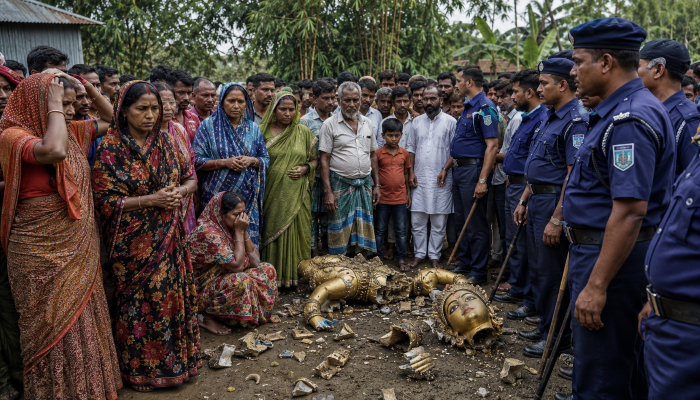
Case Summary
A metal Ganesh idol [Bhagwan Ganesh is one of the most widely venerated deities in Hinduism, revered as the remover of obstacles and the deity of wisdom, prosperity, and new beginnings] was discovered buried under soil in Gainpur village, Sonamukhi Union, Akkelpur Upazila, Joypurhat district, Bangladesh, on 20 May 2026, when three Muslim youths found it while collecting fruit from a tree. The youths subsequently cut the idol's head and ears off with a rod cutter blade, divided the pieces among themselves, and attempted to conceal the act. The deliberate dismemberment of the Hindu deity idol caused widespread panic and outrage across the village and surrounding area. As per details, Saju Hossain, son of Akram Hossain of Gainpur village, along with his friends Minhaj and Rabbani, discovered the golden-coloured metal Ganesh idol buried in the soil near a bamboo jungle beside their house on the afternoon of 20 May 2026. Believing the idol might be made of gold due to its colour and weight, they initially kept the discovery secret. After washing the idol in pond water and taking it to Saju's house, the three youths cut the idol's head and ear portions with a rod cutter blade and divided the pieces among themselves. Minhaj and Rabbani kept the head and one ear. The other ear and the idol's main body remained with Saju. Saju's elder brother, Sijib, subsequently took the remaining portion of the idol and left the house, after which his mobile phone was switched off, adding further mystery to the incident. On the morning of 21 May 2026, Saju's family members approached Minhaj's and Rabbani's households to recover the cut portions, after which the incident spread throughout the village. Hundreds of people gathered at the scene. Local UP member Sardar Aynal Hossain confirmed that widespread panic had erupted in the area. Akkelpur police station acting officer Shaheen Reza confirmed that police were sent to the scene and that recovery efforts were underway. No arrests were confirmed at the time of publication. The idol was considered potentially significant archaeologically.
Why it is Hate Crime ?
The primary category for this case is "Attack on Hindu religious representations". The sub-category for this case is "Desecration of Hindu religious symbol". Icons and symbols or a religious representation of a spiritual ideal are widely revered in Hinduism. Iconography is of vital significance in the Hindu milieu. It helps connect people’s spiritual beliefs with the real world. Iconography within the Hindu faith takes several shapes and forms. Murtis are of most significance to Hindus, to which daily rituals, prayers and offerings are done. Besides the murtis, there are several other symbols which have deep significance in the Hindu faith – the Om and Swastika for example. Since these Hindu religious symbols hold paramount importance in Hinduism, any desecration of symbols, icons, murtis, religious representations and manifestations, is driven by animosity towards the faith itself which manifests itself through these murtis, icons and symbols. Therefore, any desecration of these Hindu religious symbols and representations is considered religiously motivated hate crimes under this category. The discovery of the Ganesh idol in Gainpur village was not merely an act of criminal greed. It was the deliberate physical dismemberment of one of Hinduism's most sacred and universally venerated deities by three Muslim youths who cut his head and ears from his body with a mechanical blade and divided the pieces among themselves. Bhagwan Ganesh is not a peripheral figure in Hindu devotional life. He is invoked at the beginning of every significant Hindu undertaking, worshipped as the remover of obstacles and the deity of wisdom and prosperity, and his form is among the most recognisable and beloved in the entire Hindu pantheon. The deliberate cutting of his head from his body is not a culturally neutral act. It is an act that carries specific and profound religious significance as an assault on the most sacred physical representation of a deity revered by hundreds of millions of Hindus. The methodology of the destruction reflects a level of deliberate violence against the idol that goes beyond the extraction of material value. If the sole objective had been to extract the metal for its monetary worth, the youths could have melted the idol or sold it intact to a metal dealer. Instead, they chose to cut the idol's head and ears off with a rod cutter blade and divide the pieces among themselves. The specific dismemberment of the head and ears, the most devotionally significant parts of the Ganesh form, reflects an act of targeted iconoclasm rather than purely extractive metal theft. The head of Bhagwan Ganesh is the seat of his divine consciousness and the most recognisable element of his sacred form. Its deliberate severing from the body was not incidental to the act of metal extraction. It was integral to it. The subsequent behaviour of the three youths further establishes the deliberate and organised character of the desecration. The idol was initially kept secret, washed in pond water, taken to Saju's house, cut apart, and divided in a coordinated operation among three individuals. When the act was discovered, Saju's elder brother, Sijib, took the remaining main portion of the idol and fled, switching off his mobile phone to prevent it from being traced. The flight of a family member with evidence following the exposure of the desecration reflects an awareness of the gravity of the act and a deliberate effort to prevent accountability. A family that collectively conceals, divides, and then flees with the dismembered portions of a Hindu deity idol is not a family that treated the act as a minor or incidental criminal matter. The broader context of Bangladesh during the 2024 to 2026 period of documented anti-Hindu persecution is essential to this case. The desecration of Hindu idols in Bangladesh is not an isolated phenomenon. It is a documented pattern of anti-Hindu targeting in which Hindu sacred objects are attacked, destroyed, and defiled as expressions of hostility toward the Hindu minority community. The discovery of an ancient Ganesh idol in Gainpur village, potentially of archaeological significance, and its immediate dismemberment by Muslim youths who divided its sacred form among themselves as pieces of potential metal value, reflects the broader devaluation of Hindu religious objects and Hindu sacred heritage that characterises the documented pattern of anti-Hindu conduct in Bangladesh during this period. Given that this case met the parameters of a religiously motivated hate crime, the conduct of Saju Hossain, Minhaj, and Rabbani reflected more than criminal greed or metal theft. By cutting the head and ears from a Ganesh idol with a mechanical blade, dividing the dismembered sacred form among themselves, and subsequently concealing and fleeing with the evidence, their actions demonstrated a deliberate and organised desecration of a Hindu deity representation that cannot be adequately characterised as purely financially motivated. The Ganesh idol of Gainpur village was targeted specifically because its sacred form made its metal contents accessible through desecration, and the dismemberment of the deity was treated by the perpetrators as a transaction in which the monetary value of Hindu sacred metal outweighed any recognition of the devotional significance of the object they destroyed. This reflects an underlying indifference to and hostility toward Hindu religious identity that cannot be characterised as anything other than religiously motivated. Given that this case met the parameters of a religiously motivated hate crime, it was added to the hate crime database of the tracker.


Case Status
Complaint filed


Perpetrators Details
Perpetrators
Muslim Extremists
Perpetrators Range
From 2 To 5
Perpetrators Gender
male
 Sources




