Hindu businessman strangled to death by Muslim man in public view over 20 taka payment in Bangladesh
 Dhaka Division, Bangladesh
  21 May, 2026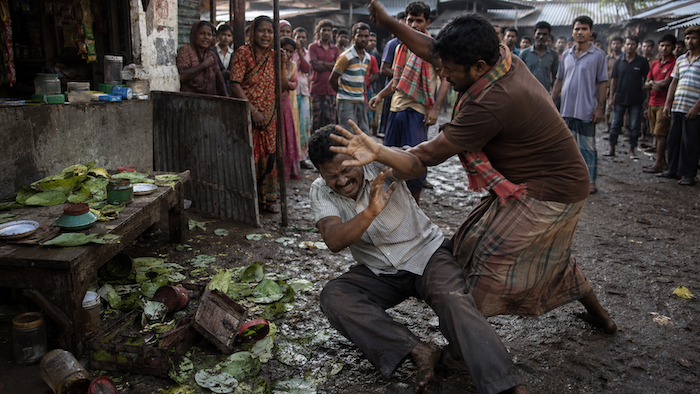
Case Summary
A Hindu businessman was strangled to death in broad daylight in the Singair area of Manikganj, Bangladesh, after demanding the remaining 20 taka owed to him for betel leaves sold at his shop. The killing took place in the Jamtup market area of Jamtup Union on 22nd May 2026. The Hindu victim collapsed at the scene after being physically assaulted and strangled. His death triggered shock and fear among local Hindus in the area. The Hindu victim was identified as 55-year-old Sribas Chandra Saha, a resident of the Madhyapara area in Savar, Dhaka. He had operated a betel leaf business in Jamtup market for a long period of time. The Muslim perpetrator was identified as Isha Mollah, a resident of the Box Market area of Baktarpur village under Jamtup Union. On 22nd May 2026, Isha Mollah went to the Hindu businessman’s shop and purchased betel leaves worth 30 taka. After making a payment of 10 taka, he attempted to leave the shop without paying the remaining 20 taka. When Sribas Chandra Saha asked for the unpaid amount, an altercation broke out between the two men inside the market area. During the confrontation, Isha Mollah became violent and first physically assaulted the Hindu businessman. He then grabbed Sribas Chandra Saha by the throat and strangled him in public view. The assault caused the Hindu businessman to collapse immediately at the scene. He died shortly afterwards from the attack. Following the killing, the Muslim perpetrator fled the area. The killing of a Hindu businessman over a minor financial dispute unfolded amidst an ongoing atmosphere of anti-Hindu hostility and insecurity in Bangladesh, where Hindu minorities continued to face targeted violence, intimidation, assaults, land-related attacks, mob violence, sexual violence, vandalism, displacement and killings. The brutality of the attack and the disproportionate violence used against the Hindu victim reflected the heightened vulnerability faced by Hindu minorities living and working in Muslim-majority areas of Bangladesh. This escalation of violence against Hindus in Bangladesh unfolded in three distinct phases, first following the ouster of Sheikh Hasina’s government in August 2024, second after the death of Sharif Osman Bin Hadi in December 2025, and third in the immediate aftermath of the 13th National Parliamentary Election 2026. Following the ouster of Sheikh Hasina, multiple incidents documented attacks on Hindu homes, temples and religious institutions, alongside intimidation campaigns, arson and mob assaults targeting minority neighbourhoods. The Hinduphobia Tracker recorded 336+ such incidents against the Hindu minority, highlighting the scale and persistence of anti-Hindu violence during this period. A further escalation followed the death of Sharif Osman Bin Hadi, a Muslim political activist and student leader known for anti-Hindu and anti-India rhetoric. Hadi had been involved in political unrest after the fall of the Hasina government and was killed in Dhaka on 18th December 2025 during clashes. In the aftermath of his death, Hindu communities were blamed and subsequently targeted in retaliatory violence. Hindu homes were selectively set ablaze in multiple localities, forcing families to flee and leaving many displaced. The attacks appeared patterned rather than sporadic, with Muslim mobs focusing on Hindu neighbourhoods, properties and religious symbols. Among the victims was Dipu Chandra Das, who was lynched to death and his body set ablaze by a Muslim mob over false blasphemy allegations. The Hinduphobia Tracker documented 51+ incidents of anti-Hindu violence in the period following Hadi’s death alone. Such incidents highlighted the vulnerability of the Hindu minority amidst rising communal hostility and the weaponisation of religious accusations. Posters and written materials calling for the extermination of Hindus were also displayed in public spaces, signalling an alarming normalisation of genocidal rhetoric. Combined with acts of arson, vandalism, assault and targeted intimidation, these developments reflected a coordinated environment of hostility aimed at terrorising the Hindu community and reinforcing majoritarian dominance. The third phase of violence unfolded after the 13th National Parliamentary Election 2026. Within days of the announcement of results, Hindu families in districts such as Noakhali, Rangpur, Nilphamari, Sylhet, Thakurgaon and Dinajpur faced coordinated attacks involving arson, looting, assault and vandalism of temples and homes. In several incidents, Hindu homes were selectively targeted, looted, and families were threatened with displacement. Singair Police Station Officer in Charge Mohammad Mahbubur Islam confirmed that police were aware of the incident. He stated that no written complaint had been filed at the time. He further stated that legal action would be taken once a formal complaint was received.
Why it is Hate Crime ?
This case was added to the tracker under the primary category, Attack resulting in death. The subcategory selected was, Attacked for Hindu identity. In several cases, Hindus are attacked merely for their Hindu identity without any perceived provocation. A classic example of this category of religiously motivated hate crime is a murder in 2016. 7 ISIS terrorists were convicted for shooting a school principal in Kanpur because they got ‘triggered’ seeing the Kalava on his wrist and tilak that he had put. In this, the Hindu victim had offered no provocation except for his Hindu religious identity. The motivation for the murder was purely religious, driven by religious supremacy. Such cases where Hindus are targeted merely for their religious identity would be documented as a hate crime. Under this category, cases where the attack led to the death of the Hindu victim/s would be documented. In this case, a Hindu businessman in Manikganj’s Singair area of Bangladesh was violently strangled to death in public after demanding the remaining 20 taka owed to him for betel leaves sold at his shop. In the prevailing environment of anti Hindu hostility in Bangladesh, this incident aligned with the wider pattern of violence, intimidation and disproportionate attacks faced by vulnerable Hindu minorities, particularly Hindu businessmen and small traders living and working within Muslim majority localities. While some may argue that the case details did not explicitly record a religious motive, the broader context of anti Hindu persecution in Bangladesh remained relevant for classification. During periods of sustained violence against Hindus based on religious identity, the Hinduphobia Tracker applied a contextual presumption that attacks on Hindu victims were likely faith targeted, even when the immediate incident did not contain an openly stated religious marker. In such periods, the normalisation of hostility towards Hindus and the social dehumanisation of minority communities could contribute to acts of extreme violence without perpetrators explicitly articulating communal intent. For the purpose of documenting the 2024 to 2026 ethnic cleansing of Hindus in Bangladesh and the subsequent persecution after the political exile of Sheikh Hasina, the death of Sharif Osman Hadi, and the 13th National Parliamentary Election 2026, the Hinduphobia Tracker records such incidents as likely religiously motivated at the point of entry. If any case is later established through credible investigation or court findings to stem from motivations other than religious hostility, it will be revised or removed from the hate crime database. The brutality and disproportionate nature of this killing, where a Hindu businessman was publicly assaulted and strangled to death over an unpaid amount of only 20 taka, mirrored multiple documented attacks on Hindus in Bangladesh during this period. The violence escalated far beyond the nature of the dispute itself. The case warranted documentation as probable religious targeting given the victim’s Hindu minority status, the excessive and fatal violence inflicted upon him in a public marketplace, and the broader pattern of anti Hindu persecution in Bangladesh, while remaining open to any new evidence that may emerge through investigation. This killing in Singair must be viewed within Bangladesh’s documented anti Hindu environment, where Hindu businessmen, traders and working class families frequently faced intimidation, insecurity, economic vulnerability and targeted violence while living as minorities within Muslim majority areas. The public nature of the assault and the immediate resort to lethal violence over a trivial monetary disagreement reflected the precarious reality faced by many Hindus whose social vulnerability often left them exposed to disproportionate aggression. Sribas Chandra Saha’s killing joined a growing pattern of incidents where ordinary disputes involving Hindu victims escalated into extreme violence amidst a wider climate of anti Hindu hostility and impunity. The targeting of a Hindu businessman over such a minor disagreement also reflected the deteriorating sense of security experienced by Hindu minorities in Bangladesh during this period. Hindu traders and small business owners often occupied economically vulnerable positions within local marketplaces and communities. In such an atmosphere, even routine commercial interactions could become sites of intimidation and violence. The killing of Sribas Chandra Saha in broad daylight reinforced fears amongst local Hindus regarding their physical safety, social protection and ability to conduct everyday economic activity without risk of targeted violence. The murder of Sribas Chandra Saha reflected this broader environment where Hindu identity increasingly became a source of vulnerability in public life. The disproportionate violence inflicted upon the Hindu victim over a negligible financial disagreement highlighted how ordinary interactions could rapidly escalate into deadly attacks against members of a persecuted minority community. The extreme nature of the response to such a trivial trigger also reflected an underlying and intrinsic hostility towards Hindus, where even minor disputes became sufficient justification for unleashing brutal violence against a Hindu individual. The incident contributed to the wider climate of fear faced by Hindu minorities in Bangladesh amidst continuing communal hostility and targeted violence. Given Bangladesh's sustained anti-Hindu persecution environment, this case meets all thresholds for inclusion in the Hinduphobia Tracker's hate crime database.
Victim Details
Total Victim
1
Deceased
1
Gender
- Male 1
- Female 0
- Third Gender 0
- Unknown 0
Caste
- SC/ST 0
- OBC 0
- General 1
- Unknown 0
Age Group
- Minor 0
- Adult 1
- Senior Citizen 0
- Unknown 0


Case Status
Unknown


Perpetrators Details
Perpetrators
Muslim Extremists
Perpetrators Range
One Person
Perpetrators Gender
male
 Sources




