Hindu leader Suvendu Adhikari threatened with violence by Indian Muslim politician during Bangladeshi media interview
 West Bengal, India
  8 May, 2026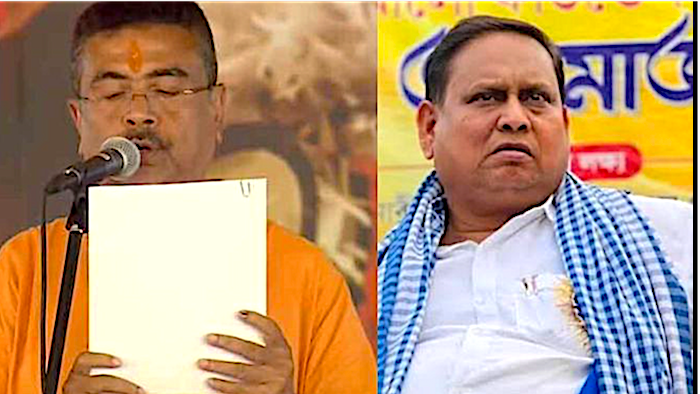
Case Summary
Hindu political leader Suvendu Adhikari was threatened with physical assault by Muslim politician Humayun Kabir during a televised interview with a Bangladeshi media platform. The threats were made shortly after Suvendu Adhikari took the oath as Chief Minister of West Bengal. The remarks directly referenced Muslim political solidarity and warned of retaliatory violence against the Hindu leader. The incident took place in West Bengal and quickly drew public attention because the threats were delivered on a foreign media platform while discussing communal and political tensions inside the state. Humayun Kabir, a former Trinamool Congress Member of the Legislative Assembly and founder of the Janata Unnayan Party, openly spoke about confronting Suvendu Adhikari both inside and outside the Vidhan Sabha. During the interview, he stated that if Suvendu Adhikari touched any Muslim Member of the Legislative Assembly, he would “thrash” him. He further escalated the threat by stating that if Suvendu touched any Muslim, “we will beat Suvendu too”. The threats came days after Suvendu Adhikari assumed office as Chief Minister on 9th May 2026, following the Bharatiya Janata Party's win in the West Bengal 2026 elections. The remarks were delivered during an interview with Bangladeshi anchor Sahifur Sagar on the channel “Face the People”. Kabir framed the confrontation explicitly around Muslim political identity and Muslim communal solidarity. He repeatedly referred to Suvendu Adhikari in the context of conflicts involving Muslim legislators and Muslim political interests. The interview drew additional attention because Humayun Kabir had already become controversial for proposing to build a mosque modelled on the Babri Masjid in Beldanga, Murshidabad. Despite suspension from the Trinamool Congress following that controversy, he proceeded with the foundation ceremony for the proposed structure. He later formed the Janata Unnayan Party and attempted to consolidate support around Islamist political mobilisation in West Bengal. The threats against the Hindu leader circulated widely across social media platforms. Online reactions included visible support from sections of Bangladeshi users, with comment sections filling with Islamic slogans and expressions of approval for the remarks. The controversy triggered political discussion because the statements involved direct threats of violence against the sitting Hindu Chief Minister of West Bengal and invoked communal retaliation linked specifically to Muslim identity and Muslim political solidarity. No information confirming formal police action, arrest, or registration of a First Information Report against Humayun Kabir was available in the source material at the time of documentation. The matter remained part of the ongoing political and public debate following the circulation of the interview and related clips online.
Why it is Hate Crime ?
This case has been added to the tracker under the primary category- Hate speech against Hindus. Within this, the sub-category is - Violent threats. Violent threats, explicit, implicit or implied, is the most dangerous form of hate speech since it goes beyond discriminatory and prejudicial language to express the intent of causing harm to an individual or a group of people based on their religious identity and faith. There could be several different kinds of threats that are issued to Hindus based on religious animosity. An explicit threat would mean the direct threat of violence towards an individual Hindu, a group of Hindus or Hindus at large. Physical violence, death threats, threats of destruction of property belonging to Hindus and threats of genocide would mean explicit threats against Hindus for their religious identity. Implicit threats may not be a direct threat but implied through the use of symbols of actions – for example – in the Nupur Sharma case, other than explicit threats, there were also implicit threats when Islamists took to the streets to burn and beat her effigies. It implies that they want to do the same to Nupur Sharma – thereby is considered an implicit threat. Violent threats can be delivered in person, through letters, phone calls, graffiti, or increasingly through social media and other online platforms. It would be important to understand that a threat – explicit or implicit, online or offline – to an individual who happens to be a Hindu does not qualify as a religiously motivated threat. Such a threat, while vile and dangerous, could be owing to non-religious reasons and/or personal animosity. To qualify as a religiously motivated threat, it would need to exhibit an indication that the individual is being targeted for religious reasons and/or owing to his/her religious identity as a Hindu. The other sub-category selected is- Mocking/denigrating Hindu leaders. Hate speech is defined as any speech, gesture, conduct, writing, or display that is prejudicial against a specific individual and/or group of people, which is leading to or may lead to violence, prejudicial action or hate against that individual and/or group. Religious leaders are often seen as representatives of the community, especially, the community’s religious faith and beliefs. Mocking or denigrating a religious leader specifically owing to his religious identity and/or the religious rituals he observes can be considered hate speech because the motivating factor of the speech is animosity and/or dislike for what he represents – the religious beliefs and faith of the community. It is important to note that mere insulting words against an individual do not constitute hate speech. It is entirely possible that insulting words are used for an individual, however, the specific speech is not the result of religious hate and/or animosity towards the professed faith of the religious leader, but the individual himself. For the speech to be considered hate speech, the speech itself or the motivating factor behind the speech has to be religious in nature. Such speech which denigrates Hindu religious leaders specifically owing to animosity towards the faith they profess and the community faith they represent will be treated as hate speech under this category. This case qualified as a religiously motivated hate crime because the Hindu leader Suvendu Adhikari was singled out by Muslim politician Humayun Kabir through direct threats of physical violence tied explicitly to communal identity. The threats were not framed as ordinary political disagreement but were delivered in explicitly religious terms, where Kabir declared during a televised interview that if Suvendu Adhikari “touched any Muslim”, he would be beaten. By framing the threat around the protection of Muslims as a collective religious bloc against a Hindu political leader, the speech transformed a political conflict into a communal confrontation rooted in religious hostility. The threat targeted a prominent Hindu face associated with Hindu political representation in West Bengal, making the motivation clearly religious in nature. The physical threats issued against Suvendu Adhikari constituted a clear case of violent intimidation intended to instil fear and signal consequences for challenging Muslim political or communal interests. Humayun Kabir openly declared in the interview that he would “thrash” Suvendu Adhikari if any Muslim MLA was touched and further escalated the rhetoric by publicly stating, “If Shuvendu touches any Muslim, we will beat Shuvendu too.” These statements were delivered openly on a Bangladeshi media platform and framed violence against a Hindu leader as justified retaliation for actions against Muslims. The aggressive tone, communal framing, and repeated emphasis on physically assaulting Adhikari demonstrated explicit violent threats directed at a Hindu politician because of his identity and perceived representation of Hindu political interests. The attack was also religiously motivated because Suvendu Adhikari was not targeted merely as an individual politician but as a Hindu leader associated with the Bharatiya Janata Party, a party widely viewed by Islamists and communal actors as representing Hindu interests and Hindu political assertion. The hostility directed towards him stemmed from this identity and symbolism. Kabir specifically positioned himself as a defender of Muslim political power against Adhikari and portrayed confrontation with the Hindu leader as a communal struggle. This showed that the targeting was tied directly to Adhikari’s Hindu identity and role as a Hindu political figure, rather than a routine ideological disagreement. The communal nature of the threats became even clearer because the statements were delivered during an interview with Bangladeshi media while invoking collective Muslim solidarity against a Hindu leader in India. The rhetoric framed Muslims as a unified religious bloc under threat and portrayed violence against a Hindu political opponent as a legitimate response. This reflected broader Islamist and communal mobilisation centred around hostility towards Hindu political representation. By threatening violence specifically against a Hindu leader identified with Hindu causes and Hindu political assertion, the speech crossed beyond political rhetoric into religiously motivated hate speech and intimidation. Humayun Kabir's background further reinforced the communal and religious dimensions of the case. Kabir had earlier been associated with the foundation of a mosque modelled after the Babri Masjid and had repeatedly positioned himself within Islamist political mobilisation in West Bengal. His statements against Suvendu Adhikari, therefore, formed part of a larger pattern of communal antagonism directed towards Hindu political leadership and Hindu assertion in the state. The targeting of a Hindu leader through explicit threats of assault, framed around Muslim identity and collective retaliation, demonstrated clear religious animosity and justified the inclusion of this case in the hate crime database.
Victim Details
Total Victim
1
Deceased
0
Gender
- Male 1
- Female 0
- Third Gender 0
- Unknown 0
Caste
- SC/ST 0
- OBC 0
- General 1
- Unknown 0
Age Group
- Minor 0
- Adult 1
- Senior Citizen 0
- Unknown 0


Case Status
Unknown


Perpetrators Details
Perpetrators
State and Establishment
Perpetrators Range
One Person
Perpetrators Gender
male
 Sources




