Hindu family lured for Christian conversion through monetary and medical inducements; threatened with social exclusion upon refusal
 Dindori, Madhya Pradesh, India
  21 May, 2026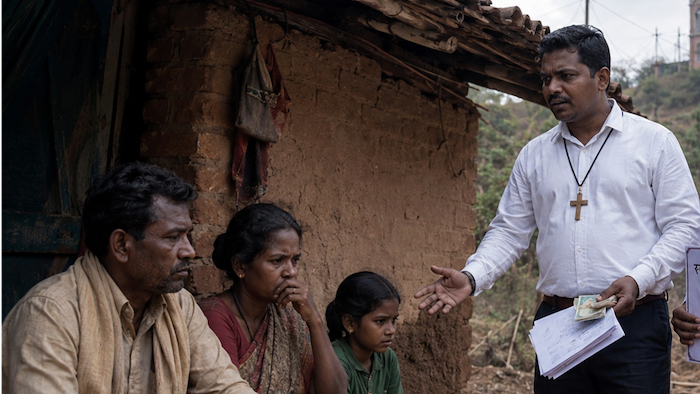
Case Summary
A Hindu family in Dindori, Madhya Pradesh, faced sustained pressure to abandon their faith and convert to Christianity after accepting financial and medical assistance during a period of illness and economic hardship. The Hindu victim and his family stated that they were repeatedly coerced into attending church gatherings and were later threatened with social exclusion when they stopped participating. The pressure intensified over several months and eventually forced the family to seek intervention from senior police authorities. The incident took place in the Bajag police station area of Dindori district, Madhya Pradesh. Hindu villager Rakesh Kumar Borkar from Tantar Panchayat Chada stated that a Christian church member named Bahman Singh Mandle approached his family during a period when his wife was unwell. During this vulnerable phase, the perpetrator provided approximately 800 rupees in the name of financial assistance and medical treatment support. After establishing contact through this assistance, the perpetrator began pressuring the Hindu victim and his family to convert to Christianity. The Hindu victim stated that promises were made that his family’s financial condition would improve and that better treatment would be arranged for his wife if they accepted conversion. Following this, the Hindu family attended church related religious gatherings and events for approximately two to three months. During this period, the family remained in regular contact with members associated with the church. The Hindu victim later stopped attending church activities voluntarily. After distancing himself from these gatherings, the family faced constant pressure from church linked individuals. The Hindu family stated that they were threatened that their lives in the village would be made difficult if they refused to convert to Christianity and discontinue their Hindu faith. They also stated that they were warned about social exclusion and expulsion from the village if they did not continue attending church. The Hindu victim and his family approached the Bajag police station and submitted a complaint regarding the coercion and conversion pressure. The family stated that no concrete action was taken after the initial complaint, which increased fear and insecurity within the household. As the pressure continued, the Hindu family escalated the matter to the Superintendent of Police office in Dindori and demanded intervention and protection. Police authorities confirmed that the complaint had been received and stated that the matter was under investigation. Officials stated that appropriate legal action would be taken following inquiry into the allegations of coercive religious conversion and intimidation.
Why it is Hate Crime ?
This case has been added to the tracker under the primary category- Predatory Proselytisation. Within this, the subcategory selected is - Conversion/attempts to convert by inducements. Predatory Proselytisation is not just limited to threat, harassment, force and violence, but it also has contours of stealth. In several cases, the Hindu victim is exploited to convert, with non-Hindus taking advantage of their poverty. In such cases, the Hindu victim who is suffering financially is offered monetary benefits, including lucrative offers for jobs, health treatment, education, etc, to induce the victim into changing his/her religion. In such cases, the religious identity of the victim and the aim to disenfranchise him from his faith form the heart of the crime. Also, taking advantage of and exploiting an individual’s economic vulnerabilities is widely acknowledged as exploitation, forms of which are often penalised by law. Such cases therefore are considered religiously motivated hate crimes since the victim’s religious identity forms the very heart of the crime itself. Another subcategory selected in this case is - Harassments, threats, coercion for conversion. Harassment covers a wide range of behaviours of an offensive nature. It is commonly understood as behaviour that demeans, humiliates, and intimidates a person, including threats and coercion. Harassment and threats, in this case, find their root on discriminatory grounds which has the effect of nullifying a person’s rights or infringing upon his freedom to exercise his right specifically owing to the victim’s religious identity. Verbal and physical threats and psychological or physical harassment are often used against Hindu victims because they choose to practice their professed religion. Religious harassment also includes forced and involuntary conversions by harassment, threats or coercion. Coercion includes intimidatory tactics like force-feeding a Hindu victim beef to convert to another religion, forceful circumcision etc. In several cases documented, non-Hindu perpetrators or those who harbour specific animosity towards Hinduism, harass victims simply based on their religious identity. Such cases often also include harassment to ensure the Hindu victim abandons his/her professed religion and adopts the religion of the perpetrator. Such cases where Hindu victims are harassed to convert to the perpetrator’s religion are rooted in animosity towards the victim’s religious identity and are therefore documented as religiously motivated hate crimes. This case qualified as a religiously motivated hate crime because the Hindu victim and his family were systematically targeted through sustained Christian proselytisation that exploited illness, financial vulnerability, and social insecurity in order to secure religious conversion. The process began when the family was struggling due to the illness of the victim’s wife and economic hardship. Inducements in form of financial assistance and medical support were used in an effort to convert the Hindu family. Offering incentives or making false promises, especially when directed at vulnerable individuals in need, shows that these incentives are not acts of kindness or charity. Instead, they are calculated moves to exploit vulnerable Hindus because of religion. By providing inducements or promising healing in exchange for conversion, the accused were effectively blackmailing those who might have been desperate for assistance or hope. Such instances are seen in many cases where members of Christian missionary groups target socially and economically vulnerable Hindus to further their agenda of religious conversions. This form of coercion strips people of their agency and dignity and results in coerced conversions. These are not random or isolated incidents, but rather cases deeply rooted in religious animosity towards Hindu victims The Hindu victim attended church gatherings for nearly two to three months before recognising the sustained conversion pressure attached to the assistance being offered. This demonstrated a deliberate pattern of grooming and manipulation where emotional vulnerability and dependency were used as tools for conversion. The prolonged contact, repeated persuasion, and promises of relief from hardship reflected organised religious indoctrination directed at vulnerable Hindus. The coercive nature of the conversion campaign became even clearer after the Hindu family attempted to distance themselves from church activities. Once the victim voluntarily stopped attending church gatherings, the family was subjected to continued harassment and intimidation. They were threatened that their lives in the village would be made difficult if they refused conversion or stopped attending church. The family also stated that they faced warnings of social exclusion and expulsion from the village if they did not comply. This was religiously significant because the threats emerged specifically after the Hindu family resisted conversion pressure and attempted to retain their Hindu faith. The intimidation therefore, functioned as punishment for refusing religious conformity. The use of fear, coercion, and threats of social isolation demonstrated that the objective was not merely religious preaching, but the forced submission of a Hindu family into conversion through sustained pressure and intimidation. These instances of targeted proselytisation activities stem from inherent hostility towards the victims' professed faith since Abrahamic faiths believe that any non-adherent to their faith is subject to being dehumanised till they convert, making it a religiously motivated crime against Hindus. Therefore, this case is being added to the hate crime database of the Hinduphobia Tracker. Disclaimer: The exact date of when the coercive conversion activities and sustained pressure against the Hindu family first began was not specified in the available sources. Therefore, the article publication date of 22nd May 2026 has been used as the incident date for documentation purposes only within the tracker. Disclaimer: The Hinduphobia Tracker acknowledges that the coercive conversion pressure and threats were directed at the entire Hindu family of Rakesh Kumar Borkar. However, since only Rakesh Kumar Borkar was explicitly identified by name in the available source material, the number of victims has been recorded as one for documentation purposes only within the tracker.
Victim Details
Total Victim
1
Deceased
0
Gender
- Male 1
- Female 0
- Third Gender 0
- Unknown 0
Caste
- SC/ST 0
- OBC 0
- General 0
- Unknown 1
Age Group
- Minor 0
- Adult 1
- Senior Citizen 0
- Unknown 0


Case Status
Complaint filed


Perpetrators Details
Perpetrators
Christian Extremists
Perpetrators Range
One Person
Perpetrators Gender
male
 Sources




