Hindu woman deceived, sexually exploited, and coerced into religious conversion by Muslim man wearing kalava and posing as Hindu
 Bareilly, Uttar Pradesh, India
  21 May, 2023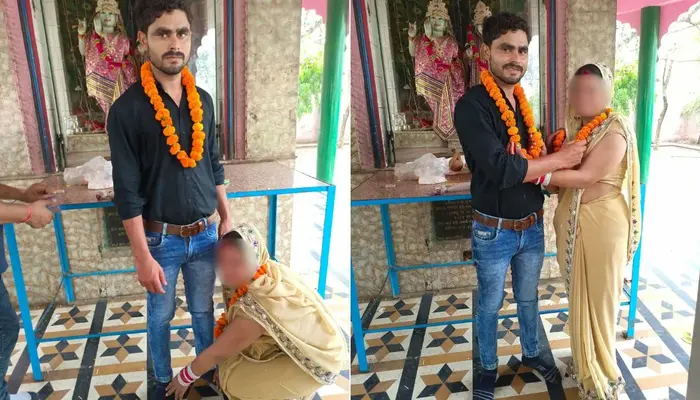
Case Summary
In the CBganj area of Bareilly, Uttar Pradesh, a 23-year-old Hindu woman was deceived, sexually exploited, and coerced into religious conversion by a Muslim man named Qayyum, who concealed his religious identity and posed as a Hindu. According to the complaint submitted before the Senior Superintendent of Police (SSP), the accused, later identified as Qayyum from Sambhal, met the victim in 2023 while she was employed as a security guard at a private company in Gurugram. He introduced himself as a Hindu man, an engineer named Raj Gupta, and adopted visible Hindu symbols and practices to reinforce the deception. He wore a tilak on his forehead, tied a kalava (sacred thread) around his wrist, visited temples, and performed Hindu rituals in front of the victim, leading her to trust him. The woman, who was caring for her deceased sister’s two children, initially resisted his proposal for marriage, but he assured her that he would accept responsibility for the children and marry her. After the victim lost her job and returned to Bareilly, the accused maintained contact with her and visited her in March 2024. Under the pretext of arranging employment and marriage, he took her to a hotel on the Rampur Highway where he sexually exploited her. When she became pregnant, he attempted to pressure her into undergoing an abortion in Gurugram. Following her refusal and warning that she would approach the police, he married her in a temple according to Hindu rituals. Members of the woman’s family attended the ceremony, and videos of the wedding were uploaded to social media, further strengthening the false impression that he was a Hindu man entering into a legitimate Hindu marriage. The victim stated that shortly after the marriage, the accused’s brother, Akram Saifi, invited the couple to his flat in Modinagar, Ghaziabad. There, she was informed that the marriage had merely been a “joke” frequently played on Hindu girls. During the visit, Akram Saifi raped the victim while Qayyum threatened her with a knife and instructed his brother to kill her if she resisted. It was during this incident that she discovered that “Raj Gupta” was actually Qayyum and belonged to a Muslim family. The woman further stated that after she gave birth to a daughter in February 2025, Qayyum and his relatives pressured her to convert to Islam as a condition for accepting both her and the child. When she refused, she was abandoned and forced to live separately in a rented room in the CBganj area. Even after separating from her, Qayyum reportedly continued visiting her residence, where he physically assaulted her, raped her, and repeatedly pressured her to embrace Islam. The woman stated that when she became pregnant again, he deceitfully administered abortion pills, which severely affected her health. She further revealed that he threatened to cut her into pieces, place her body in refrigerators and suitcases, and dispose of her when she resisted conversion. The victim approached the police but stated that no action was initially taken. She subsequently appeared before SSP Anurag Arya seeking protection and justice. Following her complaint, the CBganj police registered a case against Qayyum and Akram Saifi and initiated an investigation into charges relating to rape, criminal intimidation, religious concealment, coercion, assault, and pressure for religious conversion.
Why it is Hate Crime ?
This case has been added to the tracker under the primary category - Crimes against women in relationships and other sexual crimes. Within this, the subcategory selected is - Man pretends to be Hindu. Under this, the tertiary categories selected are - Name changed, Marries as per Hindu rituals and Wears symbols of Hinduism. When a non-Hindu man pretends to be a Hindu to deceive a Hindu woman into a relationship, the act is seen as triggered by malafide intentions. In some cases, the woman eventually accepts the man’s original religious identity and converts after the man’s identity is revealed. These cases could be argued as cases of religious brainwashing and a result of the pressure a woman feels after getting into a relationship with a man. The woman, it can be argued, also changed her religious identity because of the stigma she believes she might face if she chooses to walk out of a deceptive relationship. However, for the purpose of documenting hate crimes, the cases in this subcategory are limited to those where there is explicit violence aimed at religious conversion against the wishes of the victim (force-feeding beef, blackmailing with intimate videos, rape on refusal to convert, etc), or if the woman herself complains of the man’s religious deception. In such cases, it is established that the deception of the non-Hindu man had a specific aim of religious conversion or targeting of the victim due to her Hindu religious identity, therefore, making it a religiously motivated hate crime. The other sub-category selected for this case is - Brainwashed and/ or groomed. Under this, the tertiary categories selected are - Rape and sexual assault/harassment. In our database, we have not added incidents where women have converted to another religion of their free will and no allegations of forced/involuntary conversion have been made. However, there are certain cases of conversion where the consent itself is a result of the brainwashing or grooming of a minor by the non-Hindu perpetrator trying to victimise a woman for her Hindu religious identity. The phenomenon of grooming points to non-Hindu perpetrators identifying their Hindu victims’ vulnerabilities and exploiting them over months and sometimes years, to extract the supposed ‘consent’ in order to convert their religion. In most cases of grooming, the victims are minors or the grooming started when the victim was a minor. In other cases of grooming, the non-Hindu perpetrator brainwashes and grooms a minor victim to extract their trust and then proceeds to rape them repeatedly with the intent of converting them to their faith. It is pertinent to understand here that when the victim is a minor, the ‘consent’ to convert or enter into a romantic relationship with an adult itself is redundant – addressed by POCSO. While every case of conversion of a minor and incidents of establishing a physical relationship with a minor by an adult is a crime, for the purpose of this database, a case would be considered a hate crime only if there is a distinct religious angle to the grooming. For example, in the UK, if a Hindu minor is targeted by Pakistani grooming gangs, it would be considered a hate crime because the victims are specifically targeted owing to their non-Muslim religious identity with the perpetrators being Muslim. In other cases, if a Hindu minor is brainwashed into entering a physical relationship with the non-Hindu adult perpetrator and the family alleges grooming/brainwashing of the minor to convert her religion, it would form a part of this database. If the victim is a Hindu adult, the case would form a part of this database only if the victim herself says that she was brainwashed/groomed to convert her religion. However, if the victim is deceased (murdered or otherwise), the case would form a part of this database if her family/friends provided testimony that the victim was brainwashed/groomed to convert her religion. Since these crimes have a distinct religious angle where the victim is being targeted owing to her Hindu religious identity, these cases are considered a hate crime. The other sub-category selected here - Forced conversion after marriage. In such cases, a non-Hindu man marries a Hindu woman, and the force/pressure to convert to any Abrahamic faith, like Islam, begins after marriage. In such cases, typically, two patterns emerge. First, when the relationship is consensual, and the religious identity of the perpetrator is known to the Hindu woman in the relationship. The marriage could be under the Special Marriages Act, where neither parties are required to convert their religion for the marriage to be considered legitimate. While the victim in such cases enters matrimony assuming that religious identity is not a barrier, the non-Hindu man starts to pressure the woman to convert her religion after marriage. The second is when the woman gets into a marriage with the man, pretending to share her faith. Later, when the truth is revealed, the man starts pressuring the woman to convert her religion and give up her religious identity. In both situations, there is application of force by the perpetrator, including the denial of the woman’s religious rights. Some of the means by which the woman is forced/pressured to convert include force-feeding beef, being forced to read the Kalma, being forced to wear a hijab, forced to undergo Halala, etc. There are several instances where, after marriage, the woman voluntarily converts to Islam. Such cases are often argued to be a result of religious brainwashing, however, for the purpose of documenting religiously motivated hate crimes, in the absence of the victim complaining of forced conversion, such cases do not form a part of the database. The other sub-category selected here is - Leaves Hindu partner upon refusal to convert. When Hindu women are in a relationship with non-Hindu men, there are cases where the woman faces pressure/threats/violence to convert and change her religious identity by the non-Hindu man. However, when the Hindu woman refuses to convert, the non-Hindu man ends the relationship or divorces the woman, as the case might be. Such relationships may be consensual with the religious identity of the non-Hindu man known to the victim. Somewhere along the relationship, the non-Hindu man starts pressuring the Hindu woman to change her religious identity and upon her refusal, ends the relationship. Cases where the Hindu woman converts to Islam and does not file a complaint about the force, or threat after she refuses to convert to Islam, are not considered a part of the hate tracker. The other sub-category selected here is - Assault or threat upon refusal to convert. When Hindu women are in a relationship with non-Hindu men, there are cases where the woman faces threats or assault after she refuses to convert and change her religious identity owing to pressure/force by the non-Hindu man. Such relationships may be consensual with the religious identity of the non-Hindu man known to the victim. Somewhere along the relationship, the non-Hindu man starts pressurizing the Hindu woman to convert to Islam and upon her refusal, assaults or threatens the victim. Such cases are driven by specific religious motivations and against the religious identity of the victim and are therefore qualified as hate crimes. Cases where the Hindu woman converts to Islam and does not file a complaint about the force or threat, are not considered a part of the hate tracker, even though, it may be argued that the woman was brainwashed or threatened to convert to Islam. This case has been added to the tracker because a Hindu woman was deliberately targeted, deceived, sexually exploited, and subjected to coercion and violence by a Muslim man, Qayyum, who concealed his religious identity in order to entrap her in a relationship and marriage Firstly, the accused deliberately concealed his religious identity and pretended to be a Hindu man named Raj Gupta to initiate and sustain a relationship with a Hindu woman. This itself is a clear manifestation of bias and malicious intent towards the victim's religion. By concealing his true identity, he exploited her trust, targeting her under false pretences. This indicates a premeditated intent to manipulate her based on her religious background. In cases like these, the tactic of adopting a false Hindu identity to manipulate and "ensnare" a Hindu individual is not just an act of personal betrayal but can also be interpreted as an expression of disdain or disregard for Hinduism and its customs that reflects a deeper animosity towards Hindus and their beliefs. In such instances, identity concealment is not merely a personal deception but a calculated strategy rooted in religious targeting and profiling. The accused was aware that the victim, being Hindu, may not have consented to the relationship had she known his real identity from the outset. He therefore circumvented her ability to exercise informed choice by deliberately lying about his name and religious background. This demonstrated a premeditated effort to exploit the victim specifically on the basis of her religious identity. Secondly, the Muslim accused married the Hindu woman inside a Hindu temple, according to Hindu customs, to further mislead her into believing that he was a Hindu. The choice to marry her in a temple, a sacred space for Hindus, further highlights the malicious intent behind the act. This was a significant violation of the woman’s religious beliefs, as it exploits her faith and religious practices to entrap her in a marriage founded on lies. The use of a temple marriage serves to legitimise the union in the eyes of the woman and her community, making the deception all the more egregious. Thirdly, the accused also sexually exploited her while maintaining the deception of being a Hindu. This was not a random act of sexual abuse; it was a targeted assault driven by religious bias, aimed at singling out and violating a Hindu woman because of her religious identity. Such acts of exploitation through manipulation and religious deception clearly underline the religiously motivated nature of this crime. The victim became pregnant during the course of this deception, after which the accused attempted to pressure her into undergoing an abortion. The pattern of conduct revealed systematic manipulation, emotional coercion, and sexual exploitation directed at a Hindu woman who had been intentionally misled regarding the identity and intentions of the accused. Often in such cases, sexual violence serves a dual purpose: physical subjugation and religious humiliation. The intention was to break the victim down, emotionally, physically, and spiritually, so that she could be converted. This was not random violence; it was systematic, targeted, and rooted in religious animosity. Fourth, the abuse intensified after the victim discovered the accused’s real identity. She was subjected to pressure to convert to Islam by the accused and his relatives as a condition for accepting both her and the child. This demonstrated that the relationship and marriage were not merely based on personal deception, but had evolved into an attempt to compel the victim to abandon her Hindu faith under emotional, familial, and physical pressure. The fact that acceptance of the child was tied to the mother’s conversion placed the victim in a deeply vulnerable position, where her role as a mother was weaponised to force religious compliance. Such coercion exploited her emotional dependence and maternal responsibilities in order to break her resistance and sever her connection to her religious identity. Furthermore, pressuring a Hindu individual to discard her religious faith and embrace another was a direct attack on her religious identity and dignity. It was not a matter of personal choice; it was coercion rooted in hostility towards the victim's Hindu identity. Such an attempt reflects religious animosity because the act was not simply about personal differences but about erasing the victim’s Hindu faith, making it a religiously motivated crime. Fifth, when the victim refused to convert, she was physically assaulted and thrown out of the house. Here, physical violence was used as a strategic tool of terror aimed at forcing religious conversion. This violence was directly tied to her refusal to give up her Hindu faith, constituting a clear case of religiously motivated hate crime. This establishes a clear nexus between the abuse and the victim’s religious identity. The case also involved the participation of the accused’s family members, including the accused’s brother, who informed the victim that the marriage had merely been a “joke” played on Hindu girls and subsequently raped her. This statement is significant because it revealed a pattern of predatory behaviour in which Hindu women were specifically targeted through false identities and sham marriages. The cumulative facts of the case, religious concealment, adoption of Hindu symbols and practices to gain trust, temple marriage under false pretences, sexual exploitation, coercive conversion attempts, and violence upon refusal to convert, demonstrated that the victim was targeted not randomly, but specifically as a Hindu woman. This act goes beyond mere criminal behaviour; it is a calculated and malicious attack on her religious identity. Such actions stem from inherent hostility towards the victim's professed faith, since Abrahamic faiths believe that any non-adherent to the faith is subject to being dehumanised until they convert. Since such predatory actions stem from doctrinal animosity towards the Hindu faith and its adherents, this case is being documented as a religiously motivated hate crime. Disclaimer: It is important to clarify that none of the media sources covering this case have specified the exact date when the victim's ordeal began, though it is mentioned that she came into contact with the accused in 2023. Thus, to document this case, we have used an indicative date, 22 May 2023, as a placeholder to represent the beginning of her suffering. While media coverage of the incident emerged on 22 May 2026, the Hinduphobia Tracker records the incident based on when the victim’s ordeal began, not when it was reported. The Hinduphobia Tracker acknowledges that multiple individuals, including members of the accused’s family, were involved in the exploitation, intimidation, and conversion-related coercion of the Hindu woman. However, only two individuals, Qayyum alias “Raj Gupta” and Akram Saifi, were explicitly identified by name in the available reports and complaint records. Accordingly, for documentation and database standardisation purposes, the perpetrator count in this case has been recorded as 2.
Victim Details
Total Victim
1
Deceased
0
Gender
- Male 0
- Female 1
- Third Gender 0
- Unknown 0
Caste
- SC/ST 0
- OBC 0
- General 0
- Unknown 1
Age Group
- Minor 0
- Adult 1
- Senior Citizen 0
- Unknown 0


Case Status
Complaint filed


Perpetrators Details
Perpetrators
Muslim Extremists
Perpetrators Range
From 2 To 5
Perpetrators Gender
male
 Sources




