Hindu temple in Delhi desecrated, illegal Bangladeshi infiltrator attacks sacred premises, urinates on Shivling and assaults elderly priest
 South Delhi, Delhi, India
  1 May, 2026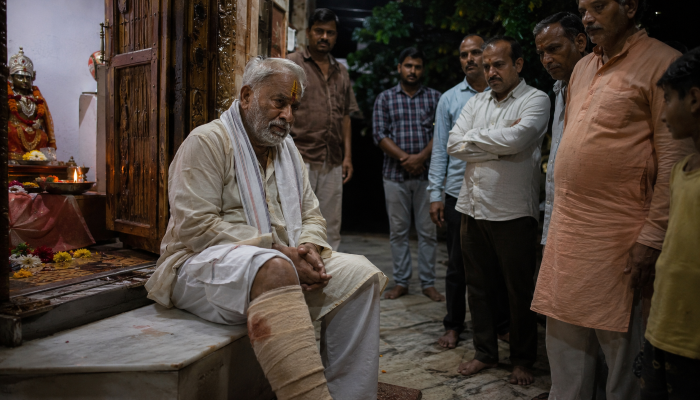
Case Summary
A Hindu temple in Jaitpur Khada area, Kalinidi Kunj, Delhi, was attacked by an illegal Bangladeshi infiltrator who entered the temple premises, extinguished the sacred diya [oil lamp lit as part of Hindu devotional worship], urinated on the Shivling [the sacred stone representation of Bhagwan Shiv, one of the principal deities of Hinduism, worshipped as the supreme consciousness], disrupted the aarti [Hindu devotional ceremony involving the waving of lighted lamps before deity idols] and hawan [sacred fire ritual conducted as part of Hindu worship], and brutally attacked the temple priest, breaking his leg. Police took no action despite repeated complaints from local residents. As per details, the Muslim perpetrator, an illegal Bangladeshi infiltrator residing in an unauthorised settlement in the Jaitpur Khada area, entered the temple on the night of 2 May 2026, extinguished the sacred diya, and desecrated the Shivling by urinating on it. When the elderly temple priest attempted to stop him, the perpetrator abused him, attacked him, and broke his leg. The priest, visibly injured and in a wounded condition, confirmed the details of the attack in a ground report conducted at the scene. Local residents expressed heavy outrage over the attack. One resident stated that illegal outsiders had settled in their localities and were now targeting their temples, while the administration remained completely silent. A local woman stated that Hindus no longer felt safe in their own homes and temples and that the attack on the priest was an attack on the entire Hindu community. Despite repeated complaints, police had taken no action at the time of publication. Local residents demanded the immediate eviction of illegal infiltrators and strict protection of the temple.
Why it is Hate Crime ?
The primary category for this case is "Attack against Hindu religious representations". The sub-category for this case is " Desecration of Hindu religious symbols". Icons and symbols or a religious representation of a spiritual ideal are widely revered in Hinduism. Iconography is of vital significance in the Hindu milieu. It helps connect people’s spiritual beliefs with the real world. Iconography within the Hindu faith takes several shapes and forms. Murtis are of most significance to Hindus, to which daily rituals, prayers and offerings are done. Besides the murtis, there are several other symbols which have deep significance in the Hindu faith – the Om and Swastika for example. Since these Hindu religious symbols hold paramount importance in Hinduism, any desecration of symbols, icons, murtis, religious representations and manifestations, is driven by animosity towards the faith itself which manifests itself through these murtis, icons and symbols. Therefore, any desecration of these Hindu religious symbols and representations is considered religiously motivated hate crimes under this category. Another sub-category for this case is "Breaking rules of place of worship". Sanatan Dharma is not a religion of one book, which is to say that while it has religious scriptures that form the central tenets of the faith, there are several traditions followed through thousands of years, mostly passed from generation to generation orally. One of these oral traditions or written traditions is the rules of specific temples. Certain temples have rules which are traditional rules, dependent on the worship of the presiding deities. These rules and traditions have been followed for thousands of years whether they find scriptural mention or not. Such traditions are based on the nature and rules of worship of the presiding deity of that temple. Any non-compliance of these traditions owing to animosity towards the faith or for the sake of activism stems not only from the lack of faith in the presiding deity but also disregard for the faith of the devotees of that deity/temple and implicit bias against the faith, the tradition and the deity itself. Since these specific traditions are central to the faith of the devotees of that specific temple and presiding deity, any non-compliance with these traditional rules would be considered a religiously motivated hate crime. One other sub-category for this case is "Attack on Temples". In Hinduism, a temple is the abode of the Deity. The Deity in the Temple is consecrated, thereby, making it a real, breathing entity. Hindus believe that not just the Deity but the temple premises itself are sacred to Hindus since Hindus hold the faith that the entire Temple space is an amalgamation of the divine energy of the deity. Given the central significance of Temples in Hindu Dharma, any attack against a Hindu Temple or its peripheral premises is an attack on the faith itself and is born out of animosity towards the faith, of which, the Temple is a central tenet. Any manner of attack against a Temple and/or its premises would therefore be considered a religiously motivated hate crime. Another sub-category that this case qualifies for is "Defliling religious customs". Sanatan Dharma is not a religion of one book, which is to say that while it has religious scriptures that form the central tenets of the faith, there are several traditions followed through thousands of years, mostly passed from generation to generation orally. There are several such customs and traditions that are followed by various Hindus and Hindu sects. Defiling of these traditions and customs is a breach of an individual or group’s religious practices. Such practices can range from dietary restrictions like not eating non-vegetarian food for a certain period of the year, not eating non-vegetarian food at all, not eating beef since the cow is considered holy in Hinduism, the sanctity of religious customs followed in the house (like many ISCKON devotees), etc. Any malicious action leading to the breach of such traditions or defilement of these traditions owing to animosity towards the faith or for the sake of activism stems not only from the lack of faith in the religion itself but also from disregard for the faith of the devotees who follow the customs/traditions and implicit bias against the faith, the tradition itself. Since these specific traditions are central to the faith of the devotees of that specific sect of Hindus, any non-compliance with these traditional rules would be considered a religiously motivated hate crime. The second primary category under which this case has been placed is- Attack not resulting in death, and within this, the subcategory selected is- Attacked for opposing radicals or trying to save victim. In several cases, Hindus are attacked for opposing religiously motivated crimes being committed against a fellow Hindu or simply for voicing an opinion opposing radical elements, who either have in the past or continue to persecute Hindus. In such cases, the initial attack against the victim, against which the Hindu was trying to defend the victim, would also need to be classified as a religiously motivated hate crime. Since the initial crime itself was religiously motivated and the subsequent crime of attempting to save the victim or speaking against the radical elements ends up inviting a violent attack, it would also be classified as a religiously motivated hate crime under this category. The attack on the Hindu temple in Jaitpur Khada was not a random act of criminal damage. It was a systematic and deliberate assault on every dimension of Hindu sacred space simultaneously. The perpetrator extinguished the sacred diya, urinated on the Shivling, disrupted the aarti and hawan, and when the elderly priest attempted to stop him, broke his leg. Each of these acts targeted a specific and irreplaceable dimension of Hindu devotional life within the same sacred space in the same night. The comprehensiveness of the desecration establishes that it was not impulsive or incidental. It was directed and emerged from an intrinsic disrespect stemming from hostility towards the Hindu faith. The urination on the Shivling is the most extreme act of religious desecration documented in this case. The Shivling is not merely a religious object. It is understood within Hindu devotional tradition as the living embodiment of Bhagwan Shiv's divine presence, consecrated through ritual and maintained as the spiritual centre of the temple's sacred life. Urinating on the Shivling is not merely about damaging a stone structure. It is to deliberately introduce ritual impurity into the most sacred object in the temple in the most contemptuous manner available to a human being. This act requires not merely a disregard for Hindu religious sentiment but an active and deliberate hostility toward the specific devotional significance of the object targeted. A person who urinates on a Shivling knows what a Shivling is and knows what they are doing to it. The extinguishing of the sacred diya carries its own religious significance as a deliberate act of desecration. In Hindu devotional practice, the diya is not merely a source of light. It is the embodiment of divine presence, lit as an act of offering and maintained as a symbol of the continuous devotional relationship between the worshipper and the deity. To extinguish a diya in a temple is to deliberately sever that relationship, to impose darkness on a space consecrated to light, and to assert dominance over the sacred atmosphere of the temple. The deliberate extinguishing of the diya alongside the urination on the Shivling and the disruption of the aarti and hawan establishes a sustained and comprehensive campaign of religious desecration rather than a single act of damage. The physical assault on the elderly temple priest and the breaking of his leg represent the human cost of the attack. The priest was not a bystander. He was the custodian of the temple's sacred life, the individual responsible for maintaining the devotional relationship between the deity and the community. When he attempted to fulfil his sacred duty by stopping the desecration, he was attacked and physically broken. The targeting of the priest in his role as the temple's religious custodian establishes that the violence was not merely personal but directed at the institutional Hindu religious authority that the priest represented. An attack on the priest in his temple is an attack on Hindu religious authority itself. The identity of the perpetrator as an illegal Bangladeshi infiltrator residing in an unauthorised settlement in the Jaitpur Khada area provides essential context for the religious character of the targeting. Bangladesh is a country currently experiencing a documented cycle of anti-Hindu persecution in which Hindu temples have been attacked, Hindu idols have been desecrated, and Hindu minority communities have been systematically targeted. The presence of illegal Bangladeshi infiltrators in Delhi's unauthorised settlements and the targeting of Hindu temples in those areas reflects the importation of anti-Hindu hostility from a context of documented ethnic cleansing into the heart of India's national capital. The administration's failure to act on repeated complaints from local residents despite the severity of the attack establishes an institutional indifference that enabled the perpetrator's continued presence and emboldened the attack. This case is being added to the hate crime database of the Hinduphobia Tracker because the attack on the Jaitpur Khada temple was not incidental, opportunistic, or the product of personal grievance. It was a deliberate, comprehensive, and sustained assault on Hindu sacred space, Hindu sacred symbols, and Hindu religious authority conducted by a perpetrator whose presence in India was itself illegal and whose targeting of a Hindu temple reflected a documented pattern of anti-Hindu hostility that has driven the ethnic cleansing of Hindus in Bangladesh and has now manifested within India's national capital. The Hindu community of Jaitpur Khada was targeted specifically because their temple was Hindu, and every act of desecration committed within it was chosen because it would inflict maximum religious harm on the devotional identity of the community that worshipped there.
Victim Details
Total Victim
1
Deceased
0
Gender
- Male 1
- Female 0
- Third Gender 0
- Unknown 0
Caste
- SC/ST 0
- OBC 0
- General 1
- Unknown 0
Age Group
- Minor 0
- Adult 1
- Senior Citizen 0
- Unknown 0


Case Status
Complaint filed


Perpetrators Details
Perpetrators
Muslim Extremists
Perpetrators Range
One Person
Perpetrators Gender
male
 Sources




