Hindu man and his minor brother assaulted and called 'kafirs' over minor parking issue in Agra's Kirawali Mandi, Muslim mob threaten Hindus to leave area
 Agra, Uttar Pradesh, India
  30 April, 2026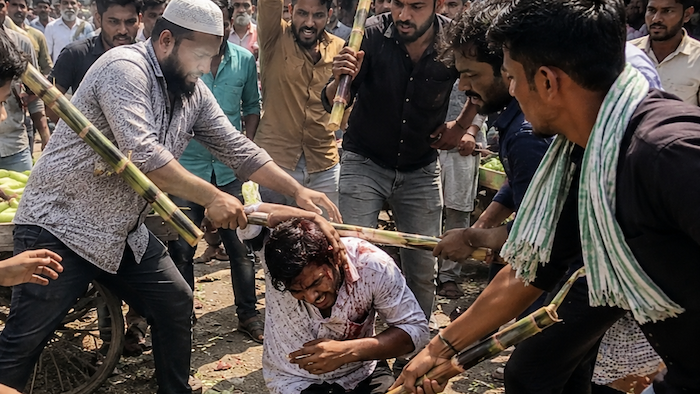
Case Summary
In the Kirawali vegetable market area of Agra, Uttar Pradesh, a Hindu man named Ravi was brutally assaulted by a Muslim mob over a minor parking dispute. During the attack, the perpetrators abused Ravi and his minor brother using communal slurs, called them “kafirs”, and threatened Hindus to leave the area. The Hindu victim sustained severe head injuries and required 14 stitches following the assault. Videos of Ravi’s testimony and the attack later circulated widely on social media. According to Ravi, the incident began when he reached the Sabji Mandi Road and asked his brother to park his bike before entering the market. After noticing another motorcycle parked in his usual spot, he asked his younger brother to move it slightly to the side. Since the vehicle was locked, the minor boy attempted to lift and shift it carefully. At that point, the owner of the motorcycle arrived and began abusing the minor Hindu boy, saying, “Kafir, how dare you touch my bike?” When Ravi intervened to defend his younger brother and questioned the abuse, the Muslim youth further hurled abuses at the brothers. After the verbal confrontation, the Muslim youth left the spot. Soon, he returned with a large group of around 15 to 16 Muslim men. The mob surrounded Ravi inside the crowded vegetable market and launched a violent attack on him in full public view. The attackers picked up sugarcane stalks from nearby carts and used them as weapons. Ravi was repeatedly struck on the head and body while being cornered by the mob. His minor brother was also injured during the assault. Throughout the attack, the perpetrators continued issuing communal abuse and threatened Hindus to leave the market area. Videos recorded by bystanders showed Ravi being surrounded from multiple sides and beaten simultaneously by several men inside the mandi premises. The repeated blows caused severe head injuries, and Ravi later required 14 stitches during treatment. Following the incident, Ravi approached the police and filed a complaint against the perpetrators involved in the mob assault. After videos of the incident went viral online, police initiated an investigation and registered an FIR in connection with the attack. Three accused were arrested, while authorities stated that further legal action would be taken against those involved in the violence and disturbance inside the market area.
Why it is Hate Crime ?
This case has been added to the tracker under the primary category - Attack not resulting in death. Within this, the subcategory selected is - Attacked for Hindu identity. In several cases, Hindus are attacked merely for their Hindu identity without any perceived provocation. A classic example of this category of religiously motivated hate crime is a murder in 2016. 7 ISIS terrorists were convicted for shooting a school principal in Kanpur because they got ‘triggered’ seeing the Kalava on his wrist and tilak that he had put. In this, the Hindu victim had offered no provocation except for his Hindu religious identity. The motivation for the murder was purely religious, driven by religious supremacy. Such cases where Hindus are targeted merely for their religious identity would be documented as a hate crime under this category. The other primary category selected is- Hate speech against Hindus, and the subcategory selected within this is- Anti-Hindu slurs, mocking faith. Anti-Hindu slurs and the deliberate mocking of the Hindu faith owing to religious animosity involve the usage of derogatory terms, stereotypes, or offensive references to religious practices, symbols, or figures. One of the common anti-Hindu slurs used against Hindus is “cow-worshipper” and “cow piss drinker”. The intention of using this term is to demean and mock Hindus as a group and their religious beliefs since Hindus consider the cow holy. Additionally, some symbols and the slurs attached to them have a historical context that exacerbates the insult, hate, stereotyping, dehumanisation and oppression against Hindus. Cow worship has been used for centuries to denigrate Hindus, insult their faith and oppress Hindus specifically as a religious group. There has been overwhelming documentation about how cow slaughter has been used to persecute Hindus with cow meat being thrown in temples and places of worship. There has also been overwhelming documentation where cow meat (beef) has been force-fed to Hindus to either forcefully convert them to Islam or denigrate their faith. Apart from cow worship, the Swastika – which holds deep religious significance for the Hindus – has also been misinterpreted and distorted to use as a slur against Hindus. Similarly, the worship of the Shivling has been used by supremacist ideologies and religions to denigrate Hindus owing to religious animosity. Such slurs and denigration stem out of inherent animosity and hate towards Hindus and their faith, therefore, it is categorised as hate speech targeted at Hindus specifically owing to their religious identity. This case carries clear religious markers because the violence was accompanied by explicit communal abuse and threats directed not just at the Hindu victim individually, but at Hindus as a community. According to Ravi’s own testimony, the assault began over a trivial parking issue but rapidly escalated into a coordinated mob attack in which he and his minor brother were abused as “kafirs” and threatened with expulsion from the area. A major religious marker in this case was the use of the term “kafir” during the confrontation. Ravi stated that when his younger brother attempted to move a locked motorcycle slightly to one side, the owner immediately began abusing the minor boy and said, “Kafir, how dare you touch my bike?” The abuse was not generic anger arising out of a parking dispute. The Muslim youth specifically invoked the Hindu identity of Ravi and his brother while confronting them. In Islamic terminology, “kafir” refers to non believers and is often used in a derogatory or hostile manner against Hindus and other non Muslims. The fact that the minor boy was immediately abused as a “kafir” for merely touching a motorcycle demonstrated that the hostility was rooted not simply in property or personal ego, but in the religious identity of the victims. The scale and nature of the retaliation further reinforced this. Ravi stated that after he intervened to defend his younger brother, the accused left the spot and soon returned with a large group of 15 to 16 Muslim men who collectively surrounded and assaulted him inside the crowded market. The mobilisation of a mob over such a minor disagreement reflected an underlying communal hostility where even ordinary interactions involving Hindus could rapidly escalate into organised violence. Another important religious marker was the threat issued against Hindus as a community during the attack. According to Ravi’s testimony, the perpetrators did not merely threaten him personally. They warned Hindus to leave the market area altogether. This transformed the incident from an individual assault into an act of communal intimidation aimed at creating fear among Hindus present in the locality. Such threats conveyed that Hindus were unwelcome in the area and could face violence for asserting themselves even in routine public interactions. The brutality of the assault also reflected the disproportionate nature of the violence. Ravi was cornered by multiple men and repeatedly beaten with sugarcane stalks on his head and body until he suffered severe injuries requiring 14 stitches. His minor brother was also injured during the attack. The extreme violence inflicted over a negligible parking disagreement highlighted how deeply embedded hostility towards Hindus can turn even insignificant triggers into occasions for collective brutality. The public nature of the attack is also significant. The assault took place openly inside a busy vegetable market in front of bystanders, while the perpetrators continued issuing communal abuse and threats. This reflected not only aggression against the victim, but also an attempt to publicly assert dominance and intimidate Hindus in the area through spectacle violence. Taken together, Ravi’s testimony regarding the communal slurs, the targeting of the victims as “kafirs,” the threats against Hindus as a group, and the coordinated mob assault over a trivial issue established strong religious markers in this case. The conduct reflected hostility directed at the Hindu identity of the victims and demonstrated how communal hatred can transform ordinary disputes into violent attacks against Hindus. Disclaimer: Since the exact date on which the incident began was not specified in the available reports, the article publication date of 1st May 2026 has been used as the incident date for documentation purposes only.
Victim Details
Total Victim
2
Deceased
0
Gender
- Male 2
- Female 0
- Third Gender 0
- Unknown 0
Caste
- SC/ST 0
- OBC 0
- General 0
- Unknown 2
Age Group
- Minor 1
- Adult 1
- Senior Citizen 0
- Unknown 0


Case Status
Case sub-judice


Perpetrators Details
Perpetrators
Muslim Extremists
Perpetrators Range
From 10 to 100
Perpetrators Gender
male
 Sources




