Twenty Hindu villagers converted to Christianity through cash payments in covert night operation in Uttar Pradesh
 Pratapgarh, Uttar Pradesh, India
  19 May, 2026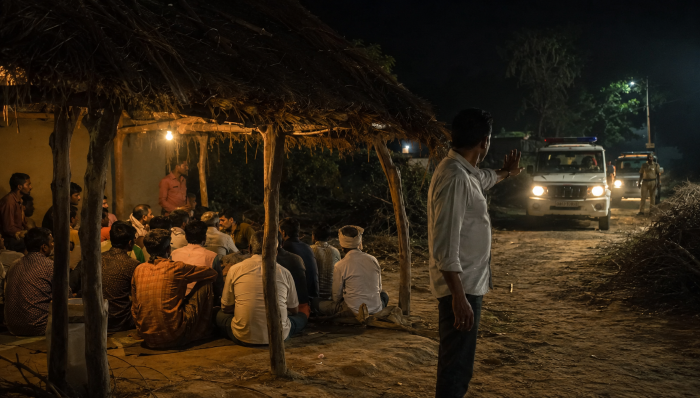
Case Summary
Twenty Hindu villagers from Barhurpur village, Patti Kotwali area, Pratapgarh district, Uttar Pradesh, were converted to Christianity through financial inducement on the night of 20 May 2026, when two Christian missionaries named Sanjay Kumar and Phoolchandra Verma organised a covert prayer meeting under a thatched roof in the village and offered cash payments and promises of future financial security to lure Hindu men and women away from their faith. The operation was exposed when a Hindu villager objected and filed a complaint with the police, leading to the arrest of both missionaries. As per the details, Sanjay Kumar and Phoolchandra Verma gathered approximately 20 Hindu men and women from the village, under a thatched roof outside a house, and conducted a prayer meeting. They offered cash payments and assured the villagers of future financial comfort and security as inducements to accept Christianity and abandon their Hindu faith. The villagers who attended confirmed to a witness that they had accepted another religion in exchange for money and had been promised continued financial support. Bibles and diaries marked with "Yesu Masih" [Jesus Christ] were present at the gathering and recovered by the police. During police interrogation, both accused confirmed their involvement in missionary activity. Rampal Saroj, son of Gurudev, a Hindu resident of Barhurpur village, witnessed the covert gathering while walking through the village that night. When he objected to the conversion operation targeting his Hindu community, Sanjay Kumar and Phoolchandra Verma abused him and issued death threats against him. Rampal Saroj filed a written complaint at the Patti police station in defence of his Hindu community. An FIR was registered under the relevant sections. A police team led by Station In-charge Anand Pal Singh, under the supervision of Additional SP Alok Kumar and Circle Officer Manoj Kumar Singh Raghuvanshi, and on the directions of SP Deepak Bhukar, arrested both Sanjay Kumar and Phoolchandra Verma from Barhurpur village on 21 May 2026. Both accused were produced before the court and sent to judicial custody. A team was constituted to further investigate the matter.
Why it is Hate Crime ?
The primary category for this case is "Predatory Proselytisation". The sub-category for this case is "Conversion.attempts to convert by inducement". Predatory Proselytisation is not just limited to threat, harassment, force and violence, but it also has contours of stealth. In several cases, the Hindu victim is exploited to convert, with non-Hindus taking advantage of their poverty. In such cases, the Hindu victim who is suffering financially is offered monetary benefits, including lucrative offers for jobs, health treatment, education, etc, to induce the victim into changing his/her religion. In such cases, the religious identity of the victim and the aim to disenfranchise him from his faith form the heart of the crime. Also, taking advantage of and exploiting an individual’s economic vulnerabilities is widely acknowledged as exploitation, forms of which are often penalised by law. Such cases therefore are considered religiously motivated hate crimes since the victim’s religious identity forms the very heart of the crime itself. The other subcategory is- Proselytisation by grooming, brainwashing, manipulation or subtle indoctrination. Within this, the tertiary category is- Victim says was brainwashed/groomed. Religious brainwashing essentially means the often subtle and forcible indoctrination to induce someone to give up their religious beliefs to accept contrasting regimented ideas. Religious grooming or brainwashing also involves propaganda and manipulation. It involves the systematic effort, driven by religious malice and indoctrination, to persuade “non-believers’ to accept allegiance, command, or doctrine to and of a contrasting faith. Cases of such grooming or brainwashing are far more nuanced than direct threats, coercion, inducement and violence. In such cases, it is often seen that there is repeated, subtle and continual manipulation of the victim to induce disaffection towards their own faith and acceptance of the contrasting faith of the perpetrator. While subtle indoctrination is widely acknowledged as predatory, an element which is often understated in such conversions or the attempts of such conversion is the role of loyalty and trust which might develop between the perpetrator and the victim. Fiduciary relationships are often abused to affect such religious conversion. For example, an educator transmitting religious doctrine of a competing faith to a Hindu student. The Hindu student is likely to accept what the teacher is transmitting owing to existence of the fiduciary relationship. The exploitation of the fiduciary relationship to religiously indoctrinate victims would also be included in this category. Since the underlying animosity towards the victim’s faith forms the basis of predatory proselytization, such cases are considered religiously motivated hate crimes. The conversion operation conducted in Barhurpur village on the night of 20 May 2026 was not a spontaneous or informal religious gathering. It was a planned and coordinated missionary operation executed under cover of darkness, in a covert location under a thatched roof, targeting economically vulnerable Hindu villagers through a pre-prepared financial offer. Sanjay Kumar and Phoolchandra Verma did not arrive at the gathering unprepared. They arrived with Bibles, diaries marked with Yesu Masih, cash payments, and promises of future financial security. The presence of these materials establishes that the operation was resourced, organised, and executed as part of a structured missionary programme rather than as an individual initiative. The use of financial inducement as the instrument of conversion reflects a deliberate targeting of the economic vulnerability of rural Hindu villagers. The villagers who attended the gathering confirmed that they had accepted Christianity in exchange for money and had been promised continued financial support. This establishes that the conversion was not the product of genuine religious conviction but of material necessity exploited by a well-resourced missionary operation. Rural Hindu communities in Uttar Pradesh represent structurally vulnerable populations whose economic dependence makes them accessible to conversion operations that would be ineffective against economically secure individuals. The selection of Barhurpur village and its Hindu residents as the target of the operation reflects an operational awareness of where financially vulnerable Hindu communities could be most effectively accessed and converted. The death threats issued against Rampal Saroj when he objected to the conversion operation are a further significant marker. A missionary operation that responds to a Hindu villager's objection with abuse and death threats is not merely a religious programme offering an alternative faith. It is an operation that treats Hindu resistance to conversion as a threat to be eliminated through violence. The deployment of lethal threats against a Hindu villager who sought to protect his community from a covert conversion operation reflects the same pattern documented across multiple cases in the tracker's database: predatory proselytisation operations that use financial inducement as the entry point and violence or threats as the retention mechanism when Hindu community members attempt to resist or expose them. Given that this case met the parameters of a religiously motivated hate crime, the conduct of Sanjay Kumar and Phoolchandra Verma reflected more than the exercise of religious freedom. By organising a covert financial conversion operation targeting economically vulnerable Hindu villagers, successfully converting approximately 20 Hindu individuals through cash payments, and issuing death threats against a Hindu villager who objected, their actions demonstrated a deliberate and organised campaign to remove Hindu individuals from their faith through the exploitation of economic vulnerability and the suppression of the Hindu community's resistance through violence. The Hindu villagers of Barhurpur were targeted specifically because they were Hindu and because their economic vulnerability made them accessible to a conversion methodology that treated their faith as an obstacle to be overcome through financial transaction. This reflects an underlying hostility toward Hindu religious identity that cannot be characterised as anything other than religiously motivated. Given that this case met the parameters of a religiously motivated hate crime, it was added to the hate crime database of the tracker.
Victim Details
Total Victim
20
Deceased
0
Gender
- Male 0
- Female 0
- Third Gender 0
- Unknown 20
Caste
- SC/ST 0
- OBC 0
- General 0
- Unknown 20
Age Group
- Minor 0
- Adult 0
- Senior Citizen 0
- Unknown 20


Case Status
Arrested


Perpetrators Details
Perpetrators
Christian Extremists
Perpetrators Range
From 2 To 5
Perpetrators Gender
male
 Sources




