Hindu man converted to Christianity through medical inducement threatened with death after returning to Hinduism in Madhya Pradesh
 Dindori, Madhya Pradesh, India
  20 May, 2026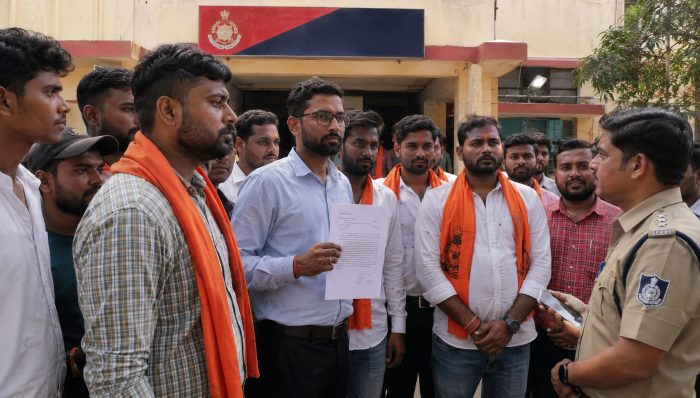
Case Summary
A Hindu man named Rakesh Borkar from Chada village, Bajag police station area, Dindori district, Madhya Pradesh, was lured into converting to Christianity by a pastor who offered Rs 800 for his wife's medical treatment. Upon finding Christianity unsuitable, Rakesh returned to Hinduism. Since his reconversion, the pastor subjected him to sustained death threats, financial extortion, and threats to implicate him in false cases and socially defame him, placing his entire family under severe mental stress. As per details, a few months before the complaint, the pastor had approached Rakesh Borkar and provided Rs 800 for his wife's medical treatment, using this financial inducement to facilitate his conversion to Christianity. After some time, Rakesh found the religion unsuitable and returned to Hinduism through ghar wapsi [the reconversion of individuals back to Hinduism]. Following his return to Hinduism, the pastor began continuously threatening him with death and demanding money. Some villagers also began applying pressure on him. Upon his refusal to pay, the pastor threatened to implicate him in false cases and socially defame him. The sustained harassment placed Rakesh's family under severe mental stress. Rakesh Borkar filed a complaint at the local police station. He subsequently reached the Superintendent of Police [SP] office on 21 May 2026, along with Bajrang Dal members, and submitted a written complaint demanding action. Bajrang Dal district president Devendra Tekam stated that a serious situation was developing regarding conversion cases in rural areas and demanded a fair investigation. SP Ashish Khare assigned the investigation to Sub-Divisional Officer of Police [SDOP] Vivek Gautam. Police were investigating the entire matter at the time of publication.
Why it is Hate Crime ?
The primary category for this case is "Predatory Proselytisation". The sub-category for this case is "Conversion/attempts to convert by inducement". Predatory Proselytisation is not just limited to threat, harassment, force and violence, but it also has contours of stealth. In several cases, the Hindu victim is exploited to convert, with non-Hindus taking advantage of their poverty. In such cases, the Hindu victim who is suffering financially is offered monetary benefits, including lucrative offers for jobs, health treatment, education, etc, to induce the victim into changing his/her religion. In such cases, the religious identity of the victim and the aim to disenfranchise him from his faith form the heart of the crime. Also, taking advantage of and exploiting an individual’s economic vulnerabilities is widely acknowledged as exploitation, forms of which are often penalised by law. Such cases therefore are considered religiously motivated hate crimes since the victim’s religious identity forms the very heart of the crime itself. Another sub-category for this case is "Harassment, threats, coercion for conversion" Harassment covers a wide range of behaviours of an offensive nature. It is commonly understood as behaviour that demeans, humiliates, and intimidates a person, including threats and coercion. Harassment and threats, in this case, find their root on discriminatory grounds which has the effect of nullifying a person’s rights or infringing upon his freedom to exercise his right specifically owing to the victim’s religious identity. Verbal and physical threats and psychological or physical harassment are often used against Hindu victims because they choose to practice their professed religion. Religious harassment also includes forced and involuntary conversions by harassment, threats or coercion. Coercion includes intimidatory tactics like force-feeding a Hindu victim beef to convert to another religion, forceful circumcision etc. In several cases documented, non-Hindu perpetrators or those who harbour specific animosity towards Hinduism, harass victims simply based on their religious identity. Such cases often also include harassment to ensure the Hindu victim abandons his/her professed religion and adopts the religion of the perpetrator. Such cases where Hindu victims are harassed to convert to the perpetrator’s religion are rooted in animosity towards the victim’s religious identity and are therefore documented as religiously motivated hate crimes. The pastor's conduct toward Rakesh Borkar followed a documented two-phase methodology. The first phase was inducement: Rs 800 offered for his wife's medical treatment at a moment of financial vulnerability, used to facilitate conversion to Christianity. The second phase was coercion: death threats, financial extortion, and threats of false implication deployed after Rakesh exercised his right to return to Hinduism. The two phases together establish a conversion operation in which financial vulnerability was the entry point and threatened violence was the retention mechanism. The use of medical assistance as the instrument of conversion in the first phase reflects a deliberate targeting of Rakesh's economic condition. A man whose wife requires medical treatment and who cannot afford it is not in a position to evaluate a religious offer on its merits. The Rs 800 was not charity. It was a transaction, the terms of which became apparent only after Rakesh attempted to leave Christianity. The pastor's subsequent demands for money and threats of false implication establish that the original financial assistance was understood by him as creating an obligation that Rakesh could not exit without consequence. The conversion was purchased, and the pastor treated Rakesh's reconversion as a default on a financial contract. The threats issued following the reconversion are the most explicit religious markers in this case. The pastor did not merely express disappointment at Rakesh's return to Hinduism. He threatened him with death, demanded money, threatened to implicate him in false cases, and threatened social defamation. Each of these threats was directed specifically at Rakesh's decision to return to his Hindu faith. The sustained nature of the threats, combined with the involvement of village community members in applying additional pressure, establishes that the coercion was organised beyond the individual pastor and reflected a community-level effort to prevent Rakesh from remaining Hindu. The broader pattern of predatory proselytisation in rural Madhya Pradesh provides essential context for this case. Bajrang Dal district president Devendra Tekam's statement that a serious situation was developing regarding conversion cases in rural areas reflects a documented regional pattern in which financially vulnerable tribal and rural Hindu communities are targeted through medical, educational, and financial inducements, and subjected to coercion and threats when they attempt to return to Hinduism. Rakesh Borkar's case is not an isolated incident. It is a documented instance of a structured and sustained conversion operation targeting rural Hindu communities in Dindori district. Given that this case met the parameters of a religiously motivated hate crime, the pastor's conduct reflected more than a personal dispute over money. By using financial inducement to convert a financially vulnerable Hindu man, and then deploying death threats, financial extortion, and threats of social destruction to prevent his reconversion to Hinduism, the pastor demonstrated a deliberate and organised campaign to permanently remove a Hindu man from his faith through the sequential exploitation of his economic vulnerability and his fear of violence and social stigma. Rakesh Borkar was targeted specifically because he was Hindu, and the inducement and subsequent threats were chosen because they would be most effective against a financially vulnerable Hindu man in a rural community with limited institutional protection. This reflects an underlying hostility toward Hindu religious identity that cannot be characterised as anything other than religiously motivated. Given that this case met the parameters of a religiously motivated hate crime, it was added to the hate crime database of the tracker. Disclaimer: The Hinduphobia Tracker records incident dates based on when the crime occurred, not when it was reported or published. The exact date on which the harassment and threats began was not confirmed in the source; therefore, 21 May 2026 has been used as the primary incident date, reflecting the confirmed date of the formal complaint submission to the police. This was recorded for documentation purposes only.
Victim Details
Total Victim
1
Deceased
0
Gender
- Male 1
- Female 0
- Third Gender 0
- Unknown 0
Caste
- SC/ST 0
- OBC 0
- General 0
- Unknown 1
Age Group
- Minor 0
- Adult 1
- Senior Citizen 0
- Unknown 0


Case Status
Complaint registered


Perpetrators Details
Perpetrators
Christian Extremists
Perpetrators Range
One Person
Perpetrators Gender
male
 Sources




