Minor Hindu student reprimanded for wearing a tilak, her faith mocked by school authorities in Pali, Rajasthan
 Pali, Rajasthan, India
  17 May, 2026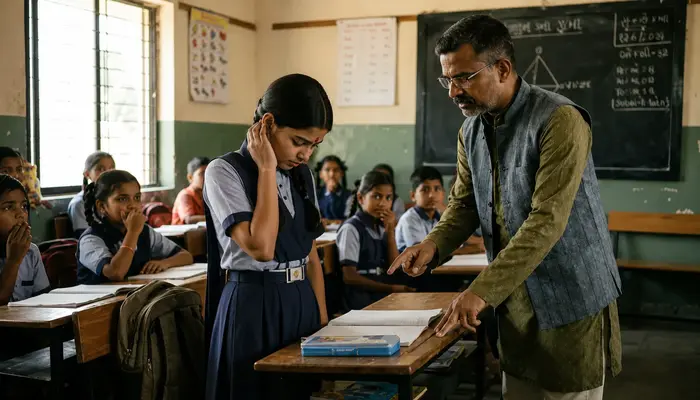
Case Summary
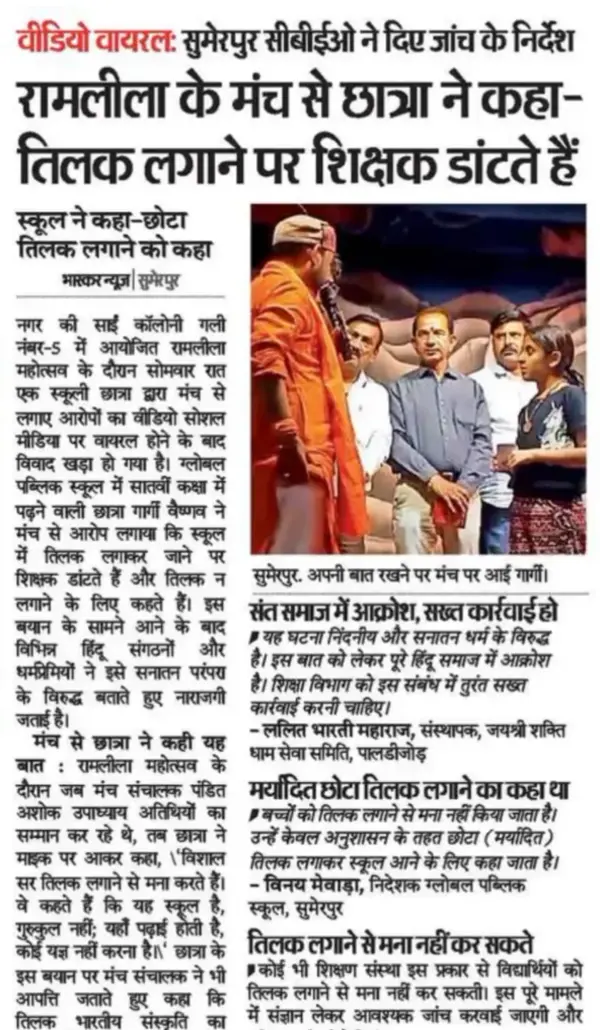
In Sumerpur of Pali district, Rajasthan, a minor Hindu student, Gargi Vaishnav, publicly stated during a Ramleela event that teachers at Global Public School had reprimanded students for wearing a tilak to school during the Ramleela festivities. Speaking from the stage at a Ramleela programme organised in Sai Colony on 18 May 2026, the student, Gargi Vaishnav, said that she and other students were scolded after arriving at school with a tilak applied on their foreheads. She stated that Vice Principal Abhishek told the students that the school was “not a gurukul” and that “studies take place here, not yagyas (religious rituals)”, adding that students should focus on studying instead of applying a tilak. The remarks sparked outrage among Hindu organisations, religious groups, and members of the saint community, who viewed the comments as derogatory towards Hindu customs and an insult to Sanatan traditions. The video of the student’s speech circulated widely on social media, leading to public anger and demands for action against the school authorities. Following the backlash, the vice principal apologised publicly from the stage. Nawal Bharti Maharaj, coordinator of the Jayesh Shakti Dham Seva Samiti, condemned the remarks and stated that such comments amounted to an attack on Hindu faith and traditions, adding that they had caused anger within Hindu society. He urged the education department to take strict action in the matter. Amid the controversy, school director Vishal Bhavsar claimed that students had not been prohibited from wearing a tilak and said that they had only been instructed to wear smaller decorative tilaks in keeping with school discipline guidelines, as large tilaks were considered inappropriate within the school environment. Reports also stated that the Sumerpur CDO ordered an inquiry into the incident after the video went viral.
Case Images
Why it is Hate Crime ?
This case has been added to the tracker under the primary category of - Restriction/ban on Hindu practices. Within it, the sub-category selected is - Restrictions on expression of Hindu identity. An example of the state-affected prejudicial and targeted orders against the Hindu community would be a government denying the right of a Hindu or a group of Hindus to hold a religious procession owing to the animosity of non-Hindu groups. Denial of the religious right of the Hindus to assuage the non-Hindu group which harbours animosity to a point where it could lead to violence against Hindus is not only a failure of law and order but is a prejudicial order against Hindus, denying them their fundamental rights to express their religious identity. An example of a hate crime against Hindus by a non-Hindu would be a non-Hindu institution forcing its Hindu employees to abandon religious symbols that a Hindu would wear as an expression of faith owing to inherent prejudice against the faith professed by the victim or a non-Hindu group of people restricting a Hindu group from constructing a place of worship simply because the demography of the area in which the temple is being built is dominated by non-Hindus. Such actions are driven by religious animosity and/or prejudice against Hindus and their faith and would therefore be categorized as a hate crime. The second primary category selected here is - Hate speech against Hindus. Within it, the sub-category selected is - Anti-Hindu slur, mocking faith. Anti-Hindu slurs and the deliberate mocking of the Hindu faith owing to religious animosity involve the usage of derogatory terms, stereotypes, or offensive references to religious practices, symbols, or figures. One of the common anti-Hindu slurs used against Hindus is “cow-worshipper” and “cow piss drinker”. The intention of using this term is to demean and mock Hindus as a group and their religious beliefs since Hindus consider the cow holy. Additionally, some symbols and the slurs attached to them have a historical context that exacerbates the insult, hate, stereotyping, dehumanisation and oppression against Hindus. Cow worship has been used for centuries to denigrate Hindus, insult their faith and oppress Hindus specifically as a religious group. There has been overwhelming documentation about how cow slaughter has been used to persecute Hindus with cow meat being thrown in temples and places of worship. There has also been overwhelming documentation where cow meat (beef) has been force-fed to Hindus to either forcefully convert them to Islam or denigrate their faith. Apart from cow worship, the Swastika – which holds deep religious significance for the Hindus – has also been misinterpreted and distorted to use as a slur against Hindus. Similarly, the worship of the Shivling has been used by supremacist ideologies and religions to denigrate Hindus owing to religious animosity. Such slurs and denigration stem out of inherent animosity and hate towards Hindus and their faith, therefore, it is categorised as hate speech targeted at Hindus specifically owing to their religious identity. The third primary category selected here is - Attack not resulting in death. Within it, the sub-category selected is - Attacked for Hindu identity. In several cases, Hindus are attacked merely for their Hindu identity without any perceived provocation. A classic example of this category of religiously motivated hate crime is a murder in 2016. 7 ISIS terrorists were convicted for shooting a school principal in Kanpur because they got ‘triggered’ seeing the Kalava on his wrist and tilak that he had put. In this, the Hindu victim had offered no provocation except for his Hindu religious identity. The motivation for the murder was purely religious, driven by religious supremacy. Such cases where Hindus are targeted merely for their religious identity would be documented as a hate crime under this category. This case has been added to the tracker because Hindu students were subjected to hostility, ridicule, and discriminatory treatment for wearing the tilak, a sacred and visible symbol of Hindu religious identity, within an educational institution in Sumerpur, Rajasthan. The incident demonstrated targeted intolerance towards the public expression of Hindu faith, where Hindu children were reprimanded and humiliated not for disruptive behaviour, but for adhering to a peaceful religious custom associated with Hindu traditions and festivals. The remarks made by the school authority, including instructing students not to come to school wearing a tilak and stating that the school was “not a gurukul”, reflected contempt towards visible Hindu religious expression and conveyed that visible expressions of Hindu identity were unwelcome within the school environment. In Hinduism, the tilak holds deep spiritual, religious, and cultural significance. It is commonly worn during prayers, rituals, festivals, and as a daily affirmation of devotion and faith. The tilak symbolises blessings, spiritual discipline, protection, and adherence to Hindu traditions. For many Hindu children and families, wearing a tilak during religious occasions such as Ramleela forms an integral part of their faith and cultural identity. Therefore, publicly ridiculing or discouraging students from wearing the tilak amounts to an attack on their religious expression and creates pressure on Hindu students to suppress visible manifestations of their faith in order to avoid humiliation or punishment. Such actions are not neutral acts of school discipline but expressions of prejudice directed specifically at a Hindu religious symbol. The incident also amounted to mocking and insulting the Hindu faith because the school authority objected specifically to Hindu religious practices such as applying a tilak and dismissively remarked that “studies take place here, not yagyas (religious rituals)”. This statement did not merely discourage a visible Hindu symbol but also mocked Hindu religious and cultural practices by portraying yagyas and associated rituals as inappropriate or inferior within an educational environment. In Hindu tradition, yagyas are sacred acts of worship and spiritual observance that hold deep religious and cultural significance, while the tilak itself is regarded as an auspicious symbol commonly applied after prayers, rituals, temple visits, and religious ceremonies. By trivialising yagyas and objecting to the wearing of the tilak, the remarks conveyed contempt towards visible expressions of Hindu spirituality and cultural identity. Such comments were not neutral observations about school discipline but amounted to the ridicule of Hindu customs, beliefs, and traditions before impressionable Hindu children, thereby normalising disrespect towards Hindu religious practices within a formal educational setting. The victims in this case were minor Hindu children, making the incident especially serious. Children at such an age are still developing their understanding of identity, religion, and self-worth. When school authorities shame, discourage, or mock Hindu religious symbols, it creates fear, embarrassment, and confusion regarding their own traditions. Repeated exposure to such hostility can condition Hindu children into believing that openly practising Hindu customs may invite ridicule, exclusion, or disciplinary action. Over time, this fosters an atmosphere where Hindu students may feel compelled to conceal their religious identity in order to gain acceptance within educational institutions. Since the remarks were made before impressionable Hindu children within a school environment, they normalised ridicule of Hindu practices and reinforced the message that visible expressions of Hindu faith were objects of disapproval and embarrassment. This transformed the incident from mere disciplinary overreach into an act that openly disparaged and insulted Hindu religious sentiments. This incident reflects a broader pattern in which Hindu religious symbols such as tilak, kalava, shikha, tulsi mala, and other visible expressions of faith are singled out for suppression, despite being peaceful and non-disruptive practices. Here, it is important to mention that in 2022, a massive controversy erupted in Karnataka, India, which took a national form, after Muslim women insisted that they should be allowed to wear burqas and hijabs in their schools and classrooms. At that time, the argument given by several politicians, social commentators, Hindu activists, and even the judiciary was that schools have the right to enforce uniform rules, since wearing uniforms brings harmony and equality in the classroom, and therefore, schools not allowing girls to wear hijab in the classroom is not religious discrimination, but merely an enforcement of widely accepted uniform norms. The pseudo-seculars and leftist groups may argue that a similar line of reasoning should be applied in this case. However, it becomes important to mention here that most uniform codes focus on standardising clothing and accessories like shoes, belts, and hair. A tilak does not change the appearance of the uniform itself. This religious symbol is benign and does not cause disruption or harm, raising serious concerns about the motivations behind such enforcement. When an ostensibly secular institution, such as a school, imposes restrictions specifically targeting Hindu religious symbols, it reflects institutional prejudice against Hinduism. This form of targeted suppression echoes broader patterns where Hindu practices are curtailed under the guise of neutrality or discipline, often to appease other religious groups. The actions of the schoolteacher amounted to religious discrimination and are consistent with the framework of a hate crime, where Hindus are penalised solely for adhering to their Hindu religious practices. Since the incident involved the targeting and humiliation of Hindu students specifically for displaying a visible marker of their religious identity, and because it contributed to an atmosphere of fear and suppression surrounding Hindu religious expression within an educational institution, this case satisfies the parameters of a religiously motivated hate incident and has therefore been included in the Hinduphobia Tracker database. Disclaimer: The victim stated that multiple Hindu students were reprimanded for wearing a tilak at the school. However, since only Gargi Vaishnav publicly came forward and made a statement regarding the incident, the victim count has been recorded as 1 for documentation purposes.
Victim Details
Total Victim
1
Deceased
0
Gender
- Male 0
- Female 1
- Third Gender 0
- Unknown 0
Caste
- SC/ST 0
- OBC 0
- General 0
- Unknown 1
Age Group
- Minor 1
- Adult 0
- Senior Citizen 0
- Unknown 0


Case Status
Unknown


Perpetrators Details
Perpetrators
Others
Perpetrators Range
From 2 To 5
Perpetrators Gender
male
 Sources




