Tribal Hindu villagers targeted through organised Christian conversion activities inside Kodagu colony
 Kodagu, Karnataka, India
  20 May, 2026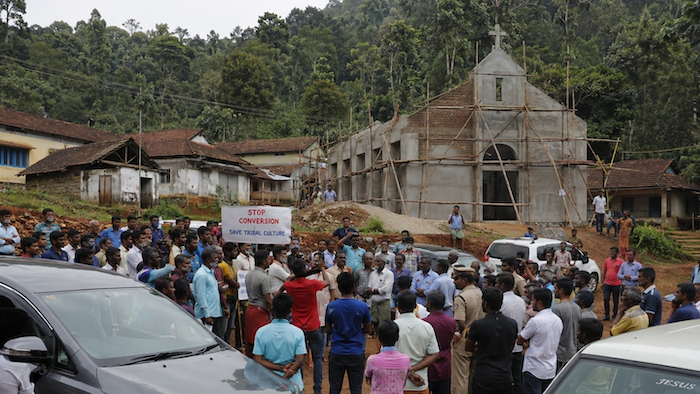
Case Summary
Hindu tribal communities in Herur, Kodagu district, were being targeted for conversion by Christian missionaries from Tamil Nadu. The villagers confirmed that the evangelists had arrived to inaugurate a structure within a tribal colony and have since been using it for Christian preaching and conversion activities. The structure had been constructed on land connected to the Social Welfare Department without approval from the Gram Panchayat or local authorities. Local Hindu residents objected after discovering that the building, initially presented as a residential structure, was functioning as a centre for Christian religious gatherings and conversion activity. Groups of Christian missionaries from Tamil Nadu arrived in Suntikoppa, in Karnataka’s Kodagu district, to inaugurate a building within the tribal settlement in Herur, near Madikeri. Hindu villagers and local community leaders gathered at the site after learning that Christian preaching and conversion activities were being conducted within the premises. The incident triggered tension inside the tribal colony as residents opposed the use of government-linked land for religious conversion activities targeting tribal communities. Former Nakur Shirangala Gram Panchayat president Mandodi Jagannath raised objections and filed a complaint at the Suntikoppa police station. Hindu residents informed authorities that the structure had originally been understood to be a residential house but was later turned into a centre promoting Christianity and facilitating conversions among tribal residents. Villagers also objected to the arrival of outside Christian groups from Tamil Nadu who had entered the colony specifically for religious gatherings and inauguration events connected to the structure. Police officers, including Kushalnagar Circle Inspector Dinesh Kumar and Suntikoppa Police Sub Inspector Mohanraj, reached the area after tensions escalated between villagers and the visiting Christian group. Local officials, including Nakur Shirangala Gram Panchayat Administrative Officer Srikanth and Panchayat Development Officer Asma, later inspected the site. During the inspection, officials found that the structure had been constructed without obtaining approval from the Gram Panchayat or other concerned authorities. The dispute intensified after Hindu residents stated that welfare resources and land intended for Scheduled Tribe communities were being used to establish a Christian religious centre inside the tribal colony. Villagers objected to what they described as organised conversion-related activities targeting vulnerable tribal residents through external missionary involvement. Several local organisations demanded strict action regarding the use of the structure and possible violations of land and construction regulations. Police later took into custody the individuals who had arrived from Tamil Nadu along with their vehicles and shifted them to the police station for questioning. Authorities began examining the legality of the construction, the ownership and use of the land, and the activities being conducted within the building. An inquiry remained underway into the alleged conversion activities and the unauthorised construction inside the tribal settlement.
Why it is Hate Crime ?
This case has been added to the tracker under the primary category - Predatory Proselytisation. Within this, the sub-category selected is - Proselytisation by grooming, brainwashing, manipulation or subtle indoctrination. Under this the tertiary category selected is - Pattern of targeting Hindus. Religious brainwashing essentially means the often subtle and forcible indoctrination to induce someone to give up their religious beliefs to accept contrasting regimented ideas. Religious grooming or brainwashing also involves propaganda and manipulation. It involves the systematic effort, driven by religious malice and indoctrination, to persuade “non-believers’ to accept allegiance, command, or doctrine to and of a contrasting faith. Cases of such grooming or brainwashing are far more nuanced than direct threats, coercion, inducement and violence. In such cases, it is often seen that there is repeated, subtle and continual manipulation of the victim to induce disaffection towards their own faith and acceptance of the contrasting faith of the perpetrator. While subtle indoctrination is widely acknowledged as predatory, an element which is often understated in such conversions or the attempts of such conversion is the role of loyalty and trust which might develop between the perpetrator and the victim. Fiduciary relationships are often abused to affect such religious conversion. For example, an educator transmitting religious doctrine of a competing faith to a Hindu student. The Hindu student is likely to accept what the teacher is transmitting owing to existence of the fiduciary relationship. The exploitation of the fiduciary relationship to religiously indoctrinate victims would also be included in this category. Since the underlying animosity towards the victim’s faith forms the basis of predatory proselytization, such cases are considered religiously motivated hate crimes. This case carries clear religious markers because Christian missionaries from Tamil Nadu entered a Hindu tribal settlement and began using an unauthorised structure inside the colony for Christian preaching and conversion activities targeting vulnerable tribal residents. The objection raised by local Hindu villagers was not against the private practice of Christianity, but against organised efforts to establish a conversion centre within a tribal Hindu locality by misusing a structure that had initially been presented as a residential building. A major religious marker in this case was the deceptive manner in which the structure was introduced into the tribal colony. According to local residents, villagers were initially led to believe that the building was a normal residential structure. Only later did they discover that it was being used for Christian gatherings, preaching, and conversion related activities. The concealment of the structure’s intended religious purpose reflected a calculated attempt to avoid early scrutiny and resistance from the local Hindu community while gradually establishing a missionary presence within the settlement. Another important aspect was the specific targeting of tribal Hindu communities. Tribal populations are often economically and socially vulnerable and therefore become frequent targets for organised missionary activity. The arrival of outside missionary groups from Tamil Nadu into a tribal settlement in Kodagu district showed that the activities were organised and coordinated rather than incidental local worship. The repeated focus on tribal areas reflects a broader pattern where missionaries attempt to penetrate economically vulnerable Hindu communities through sustained religious outreach, social influence, and gradual conversion efforts. The organised arrival of missionary groups from another state for inauguration events and religious gatherings reinforced the operation's coordinated nature. This was not an isolated act of personal faith or private worship. The activities involved external evangelical mobilisation focused specifically on a Hindu tribal area, which proved beyond a reasonable doubt that vulnerable residents were being systematically targeted for conversion. Taken together, the unauthorised establishment of a Christian religious centre inside a Hindu tribal colony, the deceptive presentation of the structure, the involvement of outside missionary groups, and the targeting of vulnerable tribal Hindus for conversion established strong religious markers in this case. The conduct reflected organised proselytisation directed at a Hindu tribal community and demonstrated hostility towards preserving the existing religious and cultural identity of the settlement. Disclaimer: Since the exact date on which the conversion-related activities and construction work first began was not specified in the source material, the article publication date of 21st May 2026 has been used as the incident date for documentation purposes only.


Case Status
Arrested


Perpetrators Details
Perpetrators
Christian Extremists
Perpetrators Range
Unknown
Perpetrators Gender
unknown
 Sources




