Hindu sentiments insulted as Muslim youths mocked Hindu deities and engaged in obscene behaviour inside premises of Hindu temple
 Madaripur District, Bangladesh
  20 May, 2026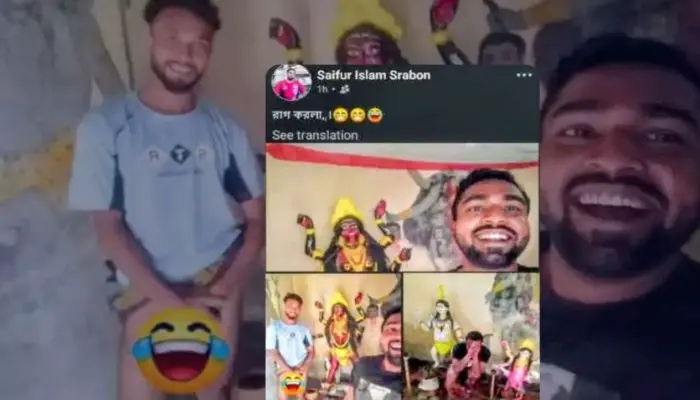
Case Summary
In the Tioband Kendriya Shmashan Ghat area of Nagarkanda Upazila in Madaripur, Bangladesh, Hindu sentiments were insulted after a group of Muslim youths openly consumed drugs, gambled, and engaged in obscene behaviour inside the premises of a Hindu Temple. According to members of the Hindu community, the Muslim youth had been regularly creating a disruptive and intimidating atmosphere in and around the premises of the Kali temple and cremation ground area for an extended period, leaving devotees and residents fearful. The accused were identified as Sumon, son of Janab Ali, and Atik Islam, son of Islam, along with around 15–20 other youths who gathered at the Hindu places of worship frequently. Local residents stated that the Muslim youths entered the temple premises on a daily basis, where they made obscene gestures and remarks and engaged in indecent activities that deeply offended the religious sentiments of Hindu devotees. Residents also revealed that indecent photographs and videos, including naked photos, were recorded on the temple premises and circulated on social media. The activities taking place within the religious premises created a sense of insecurity among women, children, and ordinary residents living in the surrounding area. Hindus from the locality stated that the continuous misconduct around the cremation ground and temple had severely damaged the sanctity of the religious site and disturbed the social and religious atmosphere of the area. Following the incident becoming public, strong reactions emerged from the local Hindu community as well as on social media, where many questioned the lack of visible action by law enforcement authorities despite the seriousness of the incident. Several users remarked that immediate arrests and police action would likely have occurred had such acts taken place at another religious institution. Others described the incident as a direct insult to Hindu religious sentiments and an act of disrespect towards a place of worship. Members of the Hindu community demanded strict legal action against those involved, enhanced security arrangements around the temple and cremation ground, and effective preventive measures to ensure that similar incidents did not recur in the future.
Why it is Hate Crime ?
This case has been added to the tracker under the primary category of - Attack on Hindu religious representation. Within it, the sub-category selected - Breaking rules of places of worship. Sanatan Dharma is not a religion of one book, which is to say that while it has religious scriptures that form the central tenets of the faith, there are several traditions followed through thousands of years, mostly passed from generation to generation orally. One of these oral traditions or written traditions is the rules of specific temples. Certain temples have rules which are traditional rules, dependent on the worship of the presiding deities. These rules and traditions have been followed for thousands of years whether they find scriptural mention or not. Such traditions are based on the nature and rules of worship of the presiding deity of that temple. Any non-compliance of these traditions owing to animosity towards the faith or for the sake of activism stems not only from the lack of faith in the presiding deity but also disregard for the faith of the devotees of that deity/temple and implicit bias against the faith, the tradition and the deity itself. Since these specific traditions are central to the faith of the devotees of that specific temple and presiding deity, any non-compliance with these traditional rules would be considered a religiously motivated hate crime. The other sub-category selected is - Defiling religious customs. Sanatan Dharma is not a religion of one book, which is to say that while it has religious scriptures that form the central tenets of the faith, there are several traditions followed through thousands of years, mostly passed from generation to generation orally. There are several such customs and traditions that are followed by various Hindus and Hindu sects. Defiling of these traditions and customs is a breach of an individual or group’s religious practices. Such practices can range from dietary restrictions like not eating non-vegetarian food for a certain period of the year, not eating non-vegetarian food at all, not eating beef since the cow is considered holy in Hinduism, the sanctity of religious customs followed in the house (like many ISCKON devotees), etc. Any malicious action leading to the breach of such traditions or defilement of these traditions owing to animosity towards the faith or for the sake of activism stems not only from the lack of faith in the religion itself but also from disregard for the faith of the devotees who follow the customs/traditions and implicit bias against the faith, the tradition itself. Since these specific traditions are central to the faith of the devotees of that specific sect of Hindus, any non-compliance with these traditional rules would be considered a religiously motivated hate crime. The second primary category selected here is - Hate speech against Hindus. Within it, the sub-category selected is - Anti-Hindu slurs, mocking faith. Anti-Hindu slurs and the deliberate mocking of the Hindu faith owing to religious animosity involve the usage of derogatory terms, stereotypes, or offensive references to religious practices, symbols, or figures. One of the common anti-Hindu slurs used against Hindus is “cow-worshipper” and “cow piss drinker”. The intention of using this term is to demean and mock Hindus as a group and their religious beliefs since Hindus consider the cow holy. Additionally, some symbols and the slurs attached to them have a historical context that exacerbates the insult, hate, stereotyping, dehumanisation and oppression against Hindus. Cow worship has been used for centuries to denigrate Hindus, insult their faith and oppress Hindus specifically as a religious group. There has been overwhelming documentation about how cow slaughter has been used to persecute Hindus with cow meat being thrown in temples and places of worship. There has also been overwhelming documentation where cow meat (beef) has been force-fed to Hindus to either forcefully convert them to Islam or denigrate their faith. Apart from cow worship, the Swastika – which holds deep religious significance for the Hindus – has also been misinterpreted and distorted to use as a slur against Hindus. Similarly, the worship of the Shivling has been used by supremacist ideologies and religions to denigrate Hindus owing to religious animosity. Such slurs and denigration stem out of inherent animosity and hate towards Hindus and their faith, therefore, it is categorised as hate speech targeted at Hindus specifically owing to their religious identity. This case has been added to the tracker because the objectionable acts were carried out by the Muslims youths inside the premises of a Hindu temple and cremation ground, both of which hold deep religious and cultural significance for the local Hindu community. The repeated use of the temple premises for drug consumption, gambling, obscene behaviour, and the recording of indecent photos and videos represented far more than ordinary anti-social conduct. The deliberate targeting of a Hindu religious site for such activities demonstrated a profound disregard for the sanctity of Hindu places of worship and amounted to an attack on the dignity, security, and religious sentiments of the Hindu community. For Hindus, temples are not merely physical structures but sacred spaces of worship, spiritual refuge, and community life that hold immense religious and cultural significance. Temples serve as centres for daily prayers, religious ceremonies, festivals, and cremation-related rites, and are deeply connected to the collective identity and faith of the Hindu community. Any act of deliberate obscenity, desecration, intimidation, or anti-social behaviour within such premises is therefore not only as an attack on property, but as a direct assault on the sanctity of the religion itself and the dignity of its devotees. In minority contexts such as Bangladesh, where Hindus already face social vulnerability, the violation of temple spaces carries an even deeper psychological impact, fostering fear, insecurity, and a sense of religious marginalisation among the community. The fact that the activities continued openly and repeatedly over a prolonged period further highlighted the targeted nature of the misconduct. The Muslim perpetrators regularly gathered at the temple and cremation ground despite knowing that the site was a sacred religious space frequented by Hindu devotees, families, women, and children. The persistent use of the premises for obscene acts and intimidation created an atmosphere of fear and humiliation for Hindus in the locality, effectively interfering with their ability to practise and observe their faith peacefully. When a religious site is repeatedly desecrated through acts considered morally degrading and socially offensive, the incident transcends ordinary criminality and takes on the character of religiously motivated hostility. The circulation of indecent photos and videos recorded within the temple premises further aggravated the offence, as it extended the humiliation of the sacred site into the public sphere. Such actions contributed to the public degradation of a Hindu religious institution and amplified the psychological impact on the local Hindu population. The incident also reflected a broader pattern in which Hindu religious spaces are treated with impunity and subjected to acts that would likely provoke swift institutional action if committed at places of worship belonging to other communities. This perception of selective inaction was evident in the reactions of local residents and social media users, many of whom questioned why visible legal action had not followed despite the seriousness of the acts committed inside a religious premises. Furthermore, the Muslim perpetrators mocked Hindu idols, demonstrating open contempt towards Hindu religious beliefs and practices. In Hinduism, idols are not viewed as mere objects, but as sacred representations of deities that are worshipped with deep reverence and devotion. Mocking or insulting these idols inside a functioning temple amounted to a direct insult to the faith of Hindu devotees and an intentional violation of the sanctity of the religious space. Such behaviour carried a humiliating and intimidating effect on the local Hindu community, particularly because it occurred in a place meant for worship, mourning, and spiritual peace. The deliberate disrespect shown towards Hindu deities and symbols reinforced the perception that the acts were not random misconduct, but were religiously offensive actions specifically targeting Hindu beliefs and sentiments. In recent years, social media has increasingly emerged as a space where anti-Hindu hate is normalised and amplified through derogatory memes, videos, obscene content, and inflammatory messages targeting Hindu deities, idols, religious symbols, and practices. Within this broader climate of Hinduphobic hostility, the recording and circulation of indecent content from inside a Hindu temple, coupled with the mocking of Hindu idols, carried a deeply offensive and targeted religious dimension. Such acts extended the humiliation of the sacred site beyond the physical premises and transformed it into a form of public degradation of Hindu beliefs and worship. The deliberate disrespect shown towards revered Hindu religious symbols and the dissemination of such content online reinforced the religiously motivated nature of the incident, firmly establishing it as a hate crime directed against the Hindu community. The incident therefore qualified as a hate crime because the conduct specifically targeted a Hindu place of worship in a manner that insulted and violated its sanctity, intimidated Hindu devotees, disrupted the religious environment of the area, and fostered fear and insecurity within a religious minority community in Bangladesh. Disclaimer: Media reports explicitly identified two individuals, Sumon and Atik Islam, as being involved in the incident, while also mentioning the participation of an additional 15–20 youths. Accordingly, for documentation purposes, the perpetrator count in this case has been recorded as 22, comprising 2 named accused individuals and 20 unnamed perpetrators. Disclaimer: The Hinduphobia Tracker records incidents based on when an event occurred or when the victim's ordeal began. It is important to clarify that none of the media sources covering this case has specified the exact date when the Muslim perpetrators posted such offensive content. Therefore, for documentation purposes, we have recorded the date based on when the incident was reported in the media, 21 May 2026.


Case Status
Unknown


Perpetrators Details
Perpetrators
Muslim Extremists
Perpetrators Range
From 10 to 100
Perpetrators Gender
male
 Sources




