Minor Hindu female students pressured to recite Islamic prayers and study Urdu against will, harassed by Muslim men near college gate
 Kaushambi District, Uttar Pradesh, India
  18 May, 2026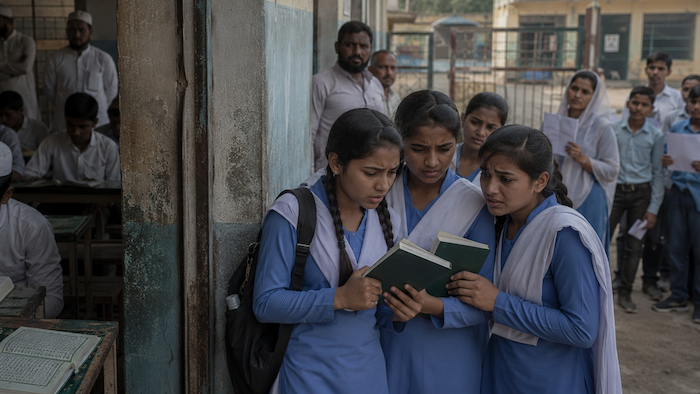
Case Summary
Hindu female students in Kaushambi, Uttar Pradesh, faced sustained religious pressure and harassment inside their educational institution. Muslim individuals connected to an Urdu lecturer targeted Hindu girls through coercive religious practices, intimidation, and repeated harassment near the college premises. The Hindu students stated that they were pressured to recite Islamic prayers and study Urdu despite not choosing the subject. Complaints made within the institution failed to stop the conduct, forcing the Hindu students to escalate the matter publicly. The incident emerged at Government Inter College in Sirathu, Kaushambi district. Hindu female students from classes nine and ten, supported by Akhil Bharatiya Vidyarthi Parishad activists, submitted a memorandum to the District Inspector of Schools at Manjhanpur. The memorandum detailed repeated incidents involving the Urdu lecturer, Shaishta Noor, and the college administration. Hindu students stated that the Urdu lecturer pressured Hindu girls to recite Islamic prayers connected to Islamic religious practices. Hindu students further stated that those who resisted were subjected to harassment and intimidation. The Hindu female students stated that Muslim youths connected to the Urdu lecturer regularly gathered near the college gate and harassed girls while they travelled to and from the institution. The Hindu students stated that these men forcibly demanded mobile numbers, attempted to pressure girls onto motorcycles, and verbally abused students when they resisted. The conduct created fear among the Hindu female students and disrupted their ability to attend classes freely and safely. The Hindu students further stated that the Urdu lecturer invited several of her relatives to the college premises. According to the memorandum, these individuals behaved indecently with female students and repeatedly targeted girls outside the college environment. Hindu students stated that, despite complaints having been raised with the principal, no action was taken to stop the harassment or restrict access by outsiders connected to the lecturer. The Hindu students also stated that pressure was exerted upon them to study Urdu even when they had not opted for the subject academically. They further stated that they were instructed to pray to Allah and participate in Islamic religious recitations inside the educational environment. Hindu students who resisted these demands stated that they faced hostility and harassment in different forms. The complaints submitted by the students described the atmosphere inside the institution as coercive and intimidating for Hindu female students. On 19th May, Tuesday afternoon, Akhil Bharatiya Vidyarthi Parishad activists, accompanied by affected Hindu female students, organised a protest at the district headquarters in Manjhanpur. The students submitted a formal memorandum to the District Inspector of Schools demanding immediate action against the Urdu lecturer and the principal. The protest focused on the harassment of Hindu female students, religious pressure inside the institution, and the conduct of Muslim youths linked to the lecturer near the college gate. District Inspector of Schools Rajesh Singh confirmed that a complaint had been received regarding the matter. Following the complaint, an inquiry was conducted at the college in the presence of the Circle Officer of Sirathu and the station in charge of the local police station. Officials stated that closed-circuit television cameras were installed on the campus and that outsiders, apart from parents, were not permitted entry into the institution. Authorities stated that action would be taken if the allegations against those involved were found to be true.
Why it is Hate Crime ?
This case has been added to the tracker under the primary category - Predatory Proselytisation. Within this, the subcategory selected is - Proselytisation by grooming, brainwashing, manipulation or subtle indoctrination. Under this, the tertiary category selected is - Pattern of targeting Hindus. Religious brainwashing essentially means the often subtle and forcible indoctrination to induce someone to give up their religious beliefs to accept contrasting, regimented ideas. Religious grooming or brainwashing also involves propaganda and manipulation. It involves the systematic effort, driven by religious malice and indoctrination, to persuade “non-believers’ to accept allegiance, command, or doctrine to and of a contrasting faith. Cases of such grooming or brainwashing are far more nuanced than direct threats, coercion, inducement and violence. In such cases, it is often seen that there is repeated, subtle and continual manipulation of the victim to induce disaffection towards their own faith and acceptance of the contrasting faith of the perpetrator. While subtle indoctrination is widely acknowledged as predatory, an element which is often understated in such conversions or the attempts of such conversion is the role of loyalty and trust which might develop between the perpetrator and the victim. Fiduciary relationships are often abused to affect such religious conversion. For example, an educator transmitting religious doctrine of a competing faith to a Hindu student. The Hindu student is likely to accept what the teacher is transmitting owing to existence of the fiduciary relationship. The exploitation of the fiduciary relationship to religiously indoctrinate victims would also be included in this category. Since the underlying animosity towards the victim’s faith forms the basis of predatory proselytization, such cases are considered religiously motivated hate crimes. This case qualified as a religiously motivated hate crime because Hindu female students were subjected to sustained religious pressure, coercive Islamic practices, and targeted harassment inside an educational institution. The conduct described by the students did not involve ordinary academic instruction alone. It centred on compelling Hindu students to participate in Islamic prayers, normalising Islamic religious practices through Urdu imposition, and creating an atmosphere of intimidation for those who resisted. The targeting extended beyond classrooms and continued outside the college premises through harassment by Muslim youths connected to the Urdu lecturer. The repeated focus on Hindu girls, combined with pressure to adopt Islamic linguistic and religious practices, demonstrated deliberate religious targeting of Hindu students within a state educational institution. The primary religious marker in this case was proselytisation through grooming, manipulation, subtle indoctrination, and the imposition of Islamic cultural practices through Urdu and religious recitations. Hindu female students stated that they were pressured to recite Islamic prayers and study Urdu even when they had not chosen the subject academically. In the Indian context, Urdu is widely associated with Islamic cultural identity due to its historical development under Muslim courts, its Nastaliq script, and its continued use in Islamic seminaries, religious discourse, and Muslim religious practices. The imposition of Urdu and Islamic prayers inside a government educational institution, therefore, carried significance beyond language instruction alone. Hindu students experienced this as the introduction of a distinctly Islamic religious and cultural framework into a civic educational environment that should have remained religiously neutral. This was religiously significant because the pressure was not limited to optional cultural exposure or voluntary participation. Hindu students described being compelled by institutional authority figures to participate in Islamic religious practices within a setting where students had limited ability to resist teachers and administrators. The institutional imbalance of power made the students especially vulnerable to coercion and subtle indoctrination. The Urdu lecturer deliberately used her position of authority over minor female students to normalise Islamic practices and create pressure towards acceptance of Islamic religious expressions inside the educational environment. Hindu students who resisted these demands stated that they faced harassment and intimidation, demonstrating that participation was being enforced through fear and social pressure rather than free consent. The repeated insistence on Islamic prayers and Urdu instruction functioned as a gradual mechanism of religious conditioning directed at Hindu students. The conduct went beyond language education and entered the realm of religious influence because the students specifically stated that they were being instructed to pray to Allah and participate in Islamic recitations. The combination of institutional authority, religiously marked linguistic imposition, and pressure to conform to Islamic practices demonstrated an attempt to reshape the cultural and religious environment experienced by Hindu students. This reflected deliberate targeting of Hindu girls through subtle religious indoctrination and coercive cultural imposition inside a state institution. The other religious marker in this case was the pattern of targeting Hindu female students both inside and outside the college premises. Hindu girls stated that Muslim youths connected to the Urdu lecturer regularly harassed female students near the college gate while they travelled to and from classes. The students described repeated incidents involving demands for mobile numbers, attempts to force girls onto motorcycles, verbal abuse, and intimidation when the girls resisted. This was religiously significant because the targeting was not confined to isolated incidents within the classroom. Hindu female students were subjected to pressure, intimidation, and harassment across multiple spaces connected to their educational environment, both during institutional hours and beyond them. The pattern demonstrated coordinated targeting of Hindu girls through both institutional and social pressure. Inside the college, Hindu students faced coercion connected to Islamic prayers, Urdu imposition, and religious influence exercised through authority figures. Outside the institution, Muslim youths associated with the lecturer created an atmosphere of intimidation around the movement and safety of Hindu girls. This combination of religious coercion within the educational system and harassment outside the institution reinforced the pressure placed upon Hindu students and normalised fear among the victims. The conduct, therefore, reflected a sustained pattern of targeting Hindu female students specifically because of their Hindu identity and their resistance to imposed Islamic practices. The failure to stop the harassment despite repeated complaints further intensified the vulnerability of the Hindu students. Hindu girls stated that complaints made to the principal did not result in intervention or protection. This prolonged the atmosphere of fear and reinforced the perception among the victims that resistance to the religious pressure and harassment would not be addressed institutionally. The continued targeting of Hindu girls within and around the college environment, therefore, reflected a broader pattern of intimidation, coercion, and religious pressure directed specifically against Hindu students. This incident was not an isolated occurrence but reflected a broader pattern documented by the Hinduphobia Tracker in which Hindus were targeted through coercive Urdu imposition, religious intimidation, and violence for resisting Islamic cultural practices in two such cases. In Jamalpur village in Bihar’s Gaya district, Hindu schoolteacher Ajay Prasad was beaten by Muslims inside his school after opposing prayers being conducted in Urdu, leading to communal tension in the area. Similarly, in Bijnor, Uttar Pradesh, Hindu children were pressured by a Muslim teacher to learn Urdu, subjected to anti-Hindu indoctrination, and beaten by Muslim students when they refused to comply. These incidents demonstrated a recurring pattern in which Urdu and Islamic practices were imposed within educational environments while Hindus who resisted faced intimidation, harassment, or physical violence. Given that this case met the parameters of a religiously motivated hate crime, it was added to the hate crime database of the tracker. Disclaimer: The exact date on which the harassment, religious pressure, and coercive conduct against the Hindu students began could not be independently confirmed from the available sources. Since the precise incident date was not specified, 19th May 2026, the publication date of the source and reports documenting the complaints and protests was used as the indicative incident date for documentation purposes only. The tracker records dates based on when incidents become identifiable and can be documented through available evidence.


Case Status
Complaint filed


Perpetrators Details
Perpetrators
Muslim Extremists
Perpetrators Range
One Person
Perpetrators Gender
female
 Sources




