Hindu minority woman killed in targeted overnight attack in Bangladesh
 Bogra District, Bangladesh
  21 May, 2026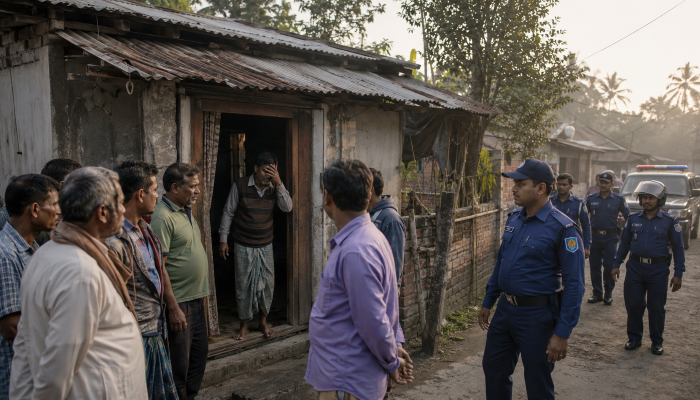
Case Summary
A 45-year-old Hindu housewife named Reeta Rani Majumdar was murdered in her home in Mominhata Dakshinpara area, Bongaon Gabotoli Upazila, Bangladesh, at approximately 12:30am on a Wednesday night. Her throat was slit by unidentified perpetrators who entered the house while she and her husband were sleeping in separate rooms and fled before being detected. As per details, Reeta Rani Majumdar was the wife of Vidhan Chandra Ray. Their son and daughter were residing in Dhaka for educational purposes, leaving only the husband and wife in the home. On the night of the murder, Vidhan Chandra Ray and Reeta had dinner together at around 10pm before retiring to separate rooms. At approximately 12:30am, Vidhan Chandra Ray was awakened by loud banging on his room door. Hearing unusual sounds from his wife's room, he immediately went there and found Reeta Rani Majumdar lying on the bedroom floor with her throat slit. The main door of the house was found open, indicating the perpetrators had entered the home and fled. Neighbours were alerted and police were informed. Police arrived at the scene and recovered the body. Gabotoli Circle Additional Superintendent of Police Humayun Kabir confirmed that police arrived at the scene immediately upon receiving information about the murder. The body was found lying on the bedroom floor with the throat slit. Police stated they were working to unravel the mystery of the incident and identify and arrest the culprits. No arrests were confirmed at the time of publication. "This incident is part of an ongoing pattern of violence against Hindus in Bangladesh, where the community has repeatedly faced persecution and disruptions to their religious festivals and gatherings. Such attacks on Hindu minorities have become increasingly frequent and intensified since August 2024. This escalation of violence against Hindus in Bangladesh has unfolded in three distinct phases: first, following the ouster of Sheikh Hasina’s government in August 2024; second, after the death of Sharif Osman Bin Hadi in December 2025; and third, in the immediate aftermath of the 13th National Parliamentary Election 2026. Following the ouster of Sheikh Hasina, multiple reports documented attacks on Hindu homes, temples, and religious institutions, alongside intimidation campaigns, arson, and mob assaults targeting minority neighbourhoods. The Hinduphobia tracker has recorded 336 such incidents against the Hindu minority, underscoring the scale and persistence of anti-Hindu violence during this period. A further escalation occurred following the death of Sharif Osman Bin Hadi, a Muslim political activist and student leader known for his anti-Hindu and anti-India rhetoric. Hadi had been involved in political unrest after the fall of the Hasina government and was killed in Dhaka on 18 December 2025 during clashes. In the aftermath of his death, Hindu communities were blamed and subsequently targeted in retaliatory violence. Hindu homes were selectively set ablaze in multiple localities, forcing families to flee and leaving many displaced. The attacks appeared patterned rather than sporadic, with Muslim mobs focusing on Hindu neighbourhoods, properties, and religious symbols. Among the victims was Dipu Chandra Das, who was lynched to death and his body was set ablaze by a Muslim mob over false blasphemy allegations. The Hinduphobia tracker documented 51 incidents of anti-Hindu violence in the period following Hadi’s death alone. Such incidents underscore the vulnerability of the Hindu minority amid rising communal hostility and the weaponisation of religious accusations. Reports further indicated that posters and written materials calling for the extermination of Hindus were displayed in public spaces, signalling an alarming normalisation of genocidal rhetoric. When combined with acts of arson, vandalism, assault, and targeted intimidation, these developments suggest a coordinated environment of hostility aimed at terrorising the Hindu community and reinforcing majoritarian dominance. The third phase of violence was unleashed after the 13th National Parliamentary Election 2026. Within days of the announcement of results, Hindu families in districts such as Noakhali, Rangpur, Nilphamari, Sylhet, Thakurgaon, and Dinajpur reported coordinated attacks involving arson, looting, assault, and vandalism of temples and homes. In several instances, Hindu homes were selectively targeted, looted, and families were threatened with displacement."
Why it is Hate Crime ?
The primary category for this case is "Attack resulting in death". The sub-category for the case is "Attacked for Hindu identity". In several cases, Hindus are attacked merely for their Hindu identity without any perceived provocation. A classic example of this category of religiously motivated hate crime is a murder in 2016. 7 ISIS terrorists were convicted for shooting a school principal in Kanpur because they got ‘triggered’ seeing the Kalava on his wrist and tilak that he had put. In this, the Hindu victim had offered no provocation except for his Hindu religious identity. The motivation for the murder was purely religious, driven by religious supremacy. Such cases where Hindus are targeted merely for their religious identity would be documented as a hate crime. Under this category, cases where the attack led to the death of the Hindu victim/s would be documented. The murder of Reeta Rani Majumdar in Bongaon Gabotoli Upazila cannot be examined in isolation from the country in which it occurred. Bangladesh is a Muslim-majority nation with a documented and sustained pattern of targeted violence against its Hindu minority population. Hindu homes have been attacked, Hindu women have been assaulted and killed, and Hindu families have been terrorised into abandoning their properties and migrating across the border into India in patterns that have been documented by human rights organisations, diaspora bodies, and international observers across decades. A Hindu woman found with her throat slit in her own bedroom, with the main door of her house found open after the perpetrators fled, is not an incident that can be assessed without reference to this broader documented context. While the source does not record an explicit religious marker or a statement of religious motive from the perpetrators, the Hinduphobia Tracker applies a contextual presumption in cases of this period. Bangladesh is currently experiencing a documented cycle of anti-Hindu persecution that the tracker has recorded across multiple cases spanning 2024 to 2026. During this period, Hindu minorities in Bangladesh have faced targeted killings, mob violence, property destruction, forced displacement, and sexual violence at a scale and frequency that human rights organisations, diaspora bodies, and international observers have characterised as constituting the ethnic cleansing of the Hindu minority population. During periods of sustained and normalised violence against Hindus based on religious identity, the dehumanisation of Hindu minorities and the routinisation of anti-Hindu hostility can contribute to crimes against them without perpetrators openly stating motive. The absence of an explicit religious statement from unidentified perpetrators does not establish the absence of religious motivation. It reflects the operational reality of communal violence in which the religious identity of the victim is understood by perpetrators and community alike as the basis for targeting without requiring articulation. For the purpose of documenting the 2024 to 2026 ethnic cleansing of Hindus in Bangladesh, the Hinduphobia Tracker records this incident as likely religiously motivated at the point of entry. The victim's Hindu identity, the Muslim majority context of the location, the premeditated and targeted nature of the killing, and the broader pattern of anti-Hindu persecution in Bangladesh during this period collectively support the contextual classification of likely religious hostility, absent contrary evidence. If any credible investigation or court finding establishes that the murder stemmed from motivations other than religious hostility, this case will be revised or removed from the hate crime database accordingly.
Victim Details
Total Victim
1
Deceased
1
Gender
- Male 0
- Female 1
- Third Gender 0
- Unknown 0
Caste
- SC/ST 0
- OBC 0
- General 0
- Unknown 1
Age Group
- Minor 0
- Adult 1
- Senior Citizen 0
- Unknown 0


Case Status
Complaint filed


Perpetrators Details
Perpetrators
Unknown
Perpetrators Range
Unknown
Perpetrators Gender
unknown
 Sources




