Hindu temple land illegally occupied by Muslim goons affiliated to West Bengal's ex-ruling party, used for gambling, alcohol and meat consumption
 Farakka, West Bengal, India
  10 May, 2026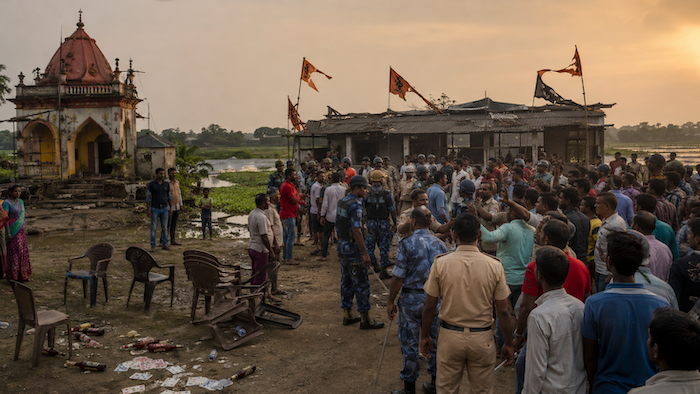
Case Summary
A piece of temple land, registered in the name of Lord Lakshminarayan as Debottar property, had been converted into a politically controlled space under the authority of local Trinamool Congress (TMC) leaders for nearly 15 years. After the BJP came to power in West Bengal, Hindu devotees and local Hindu residents in Bagbari, English Bazar, Malda, mobilised to reclaim temple land. Villagers stated that the temple property had been stripped of its religious sanctity and transformed into a site associated with intimidation, gambling, alcohol consumption, and unlawful gatherings by the Muslim majority supportive of Trinamool Congress. The conflict escalated after local Hindu residents and Bharatiya Janata Party workers gathered to demand restoration of the land to the temple. Police personnel from the English Bazar police station and Central Reserve Police Force personnel were deployed to control tensions in the area. The mobilisation emerged after villagers accused Trinamool Congress strongman Biswajit Sen and his Muslim associates of forcibly occupying approximately 24 bighas of land belonging to the deity. According to local residents, the land in question had historically remained dedicated to Lord Lakshminarayan as Debottar property. Villagers stated that prior political administrations, including those led by the Communist Party of India (Marxist) and the Congress, had not interfered with the temple land. They stated that the occupation began after the Trinamool Congress came to power in the state. Residents of the area stated that Biswajit Sen, a member of the English Bazar Panchayat Samiti and husband of a local representative, gradually took control of the temple land along with his associates. Villagers stated that the occupation lasted for 10 to 15 years and that a political party office and a club structure had been established on the premises. Hindu residents further stated that the occupied land was used for activities involving gambling, alcohol consumption, meat consumption, and gatherings that created fear among local women and devotees. Local villager Nilkamal Das stated that Hindu residents who objected to the occupation faced threats and intimidation. He stated that villagers were unable to protest freely under the Trinamool Congress administration due to fear and political pressure. According to residents, the atmosphere surrounding the occupied temple land deteriorated to the point where women felt unsafe moving through the area after dark. Villagers further stated that ponds situated on the Debottar land had been leased to Muslims for cultivation and commercial use. Hindu residents stated that the land dedicated to Lord Lakshminarayan had been commercially exploited while its religious identity and sanctity were ignored. Local residents repeatedly demanded that the property remain exclusively dedicated to the deity and not be controlled by any political organisation. Samir Mondal, husband of a Bharatiya Janata Party Panchayat member, stated that villagers had united after the political change in the state and collectively moved to reclaim the land. Residents gathered across the locality and demanded the removal of all political structures from the temple property. Villagers insisted that no party flags, including those of the Bharatiya Janata Party, Trinamool Congress, Congress, or Communist Party of India (Marxist), should remain on the land because it belonged solely to the deity. As tensions escalated, police personnel and Central Reserve Police Force units arrived at the site and dispersed the gathering. Officers held discussions with local residents and requested that no one take the law into their own hands. Police informed villagers that the matter would be examined through legal channels and urged them to maintain peace while the administration reviewed the dispute. Trinamool Congress leader Biswajit Sen denied the allegations, stating that he had leased the land from the owner of a brick kiln for farming purposes. He stated that the structure on the property served as a club for local youths and denied that any unlawful activities took place there. He further stated that the opposition was attempting to demolish the structure after the political transition in the state. Despite the denial, local Hindu residents continued to demand the restoration of the Debottar property to the temple authorities and the Hindu community. Villagers maintained that the land had been forcibly occupied for years under political protection and that the property's religious identity had been deliberately undermined through sustained encroachment, commercial exploitation, and activities deemed to desecrate the sanctity of the land dedicated to Lord Lakshminarayan.
Why it is Hate Crime ?
This case has been added to the tracker under the primary category - Attack on Hindu religious representations. The subcategory selected within this is - Encroachment or illicit takeover of temple land/land near temple. In Hinduism, a temple is the abode of the Deity. The Deity in the Temple is consecrated, thereby, making it a real, breathing entity. Hindus believe that not just the Deity but the temple premises itself are sacred to Hindus since Hindus hold the faith that the entire Temple space is an amalgamation of the divine energy of the deity. Not only the Temple but the Temple premises in its entirety are considered sacred by Hindus. In several cases, the premises of the Temple and/or religious centre are illicitly taken over by institutions belonging to other faiths – like the Waqf board or the Church. Other times, the temple property, land or the property of religious centres are illicitly encroached by non-Hindu groups. Any illicit take over or encroachment is a crime an initio, however, when non-Hindu groups illicitly take over or encroach the sacred land of Hindus, it is an affront to the Hindu community and is therefore classified as a religiously motivated hate crime under this category. The other sub-category selected for this case is - Breaking rules at place of worship. Sanatan Dharma is not a religion of one book, which is to say that while it has religious scriptures that form the central tenets of the faith, there are several traditions followed through thousands of years, mostly passed from generation to generation orally. One of these oral traditions or written traditions is the rules of specific temples. Certain temples have rules which are traditional rules, dependent on the worship of the presiding deities. These rules and traditions have been followed for thousands of years whether they find scriptural mention or not. Such traditions are based on the nature and rules of worship of the presiding deity of that temple. Any non-compliance of these traditions owing to animosity towards the faith or for the sake of activism stems not only from the lack of faith in the presiding deity but also disregard for the faith of the devotees of that deity/temple and implicit bias against the faith, the tradition and the deity itself. Since these specific traditions are central to the faith of the devotees of that specific temple and presiding deity, any non-compliance with these traditional rules would be considered a religiously motivated hate crime. Another sub-category selected for this case is - Defiling religious customs. Sanatan Dharma is not a religion of one book, which is to say that while it has religious scriptures that form the central tenets of the faith, there are several traditions followed through thousands of years, mostly passed from generation to generation orally. There are several such customs and traditions that are followed by various Hindus and Hindu sects. Defiling of these traditions and customs is a breach of an individual or group’s religious practices. Such practices can range from dietary restrictions like not eating non-vegetarian food for a certain period of the year, not eating non-vegetarian food at all, not eating beef since the cow is considered holy in Hinduism, the sanctity of religious customs followed in the house (like many ISCKON devotees), etc. Any malicious action leading to the breach of such traditions or defilement of these traditions owing to animosity towards the faith or for the sake of activism stems not only from the lack of faith in the religion itself but also from disregard for the faith of the devotees who follow the customs/traditions and implicit bias against the faith, the tradition itself. Since these specific traditions are central to the faith of the devotees of that specific sect of Hindus, any non-compliance with these traditional rules would be considered a religiously motivated hate crime. This case qualified as a religiously motivated hate crime because the targeting of Debottar land dedicated to Lord Lakshminarayan demonstrated sustained interference with Hindu religious property and Hindu religious practice. Local Hindu residents stated that land belonging to the deity had been forcibly occupied for political and personal use for nearly 10 to 15 years. The dispute centred specifically on the occupation and misuse of property legally and religiously associated with a Hindu deity and intended for Hindu religious purposes. Villagers further stated that the temple land had been turned into a space associated with intimidation, gambling, alcohol consumption, meat consumption, and political activity, which they viewed as incompatible with the sanctity of land dedicated to Lord Lakshminarayan. The primary religious marker in this case was the encroachment and illicit takeover of temple land dedicated to Lord Lakshminarayan. The entire dispute centred on approximately 24 bighas of Debottar land registered in the name of the Hindu deity. Local residents repeatedly stated that the land had remained under the control of Trinamool Congress leader Biswajit Sen and his associates for nearly 10 to 15 years. This was religiously significant because the land was not ordinary private property, but religious endowment land associated with Hindu worship and temple functions. The occupation diverted the land away from its intended Hindu religious purpose and transformed it into a politically controlled space. The prolonged takeover of land belonging to a Hindu deity demonstrated deliberate disregard for the sanctity and protected status traditionally attached to Debottar property. The use of temple land for political structures and personal control showed intentional interference with Hindu religious space and Hindu community rights connected to the deity. Another religious marker was the breaking of rules and sanctity associated with a Hindu place of worship. Local residents stated that gambling, alcohol consumption, meat consumption, political operations and late-night gatherings were taking place on land dedicated to Lord Lakshminarayan. Villagers further stated that ponds situated on the temple property had been leased to Muslims for cultivation and commercial use. This was religiously significant because the land had historically been associated with Hindu religious customs, temple activity, and the sanctity attached to property dedicated to a Hindu deity. The activities described by villagers directly conflicted with the religious expectations and norms associated with Hindu sacred space. The continued use of temple land for activities viewed by devotees as degrading and inappropriate demonstrated conscious disregard for Hindu religious sensitivities. The transformation of religious land into a site associated with gambling, alcohol, intimidation, and political dominance reflected the deliberate erosion of the sanctity attached to Hindu worship spaces and Hindu devotional practices. The other religious marker was the defiling of Hindu religious customs and the degradation of the sanctity attached to land dedicated to Lord Lakshminarayan. The continued operation of activities considered incompatible with Hindu religious values on temple land demonstrated disregard towards the sanctity of Hindu traditions attached to the property. The occupation, therefore, did not merely interfere with ownership rights but also undermined the religious identity and spiritual significance of land dedicated to Hindu worship and Sanatan traditions. This incident was not an isolated land dispute but part of a broader pattern of interference with Hindu religious spaces and properties dedicated to Hindu deities. The prolonged occupation of Debottar land belonging to Lord Lakshminarayan, its use for political control, for gambling, alcohol consumption, meat consumption, intimidation, and political operations reflected hostility towards the religious character of the property and the sentiments of the local Hindu community. Such actions targeted not merely physical land, but the sacred identity, religious customs, and communal significance attached to Hindu religious spaces. Given that this case met the parameters of a religiously motivated hate crime, it was added to the hate crime database of the tracker. Disclaimer: The exact date on which the occupation and misuse of the land began could not be independently confirmed from the available sources. Local residents stated that the temple land had remained under occupation for nearly 10 to 15 years. Since the precise incident date was not specified, 11th May 2026, the publication date of the source video documenting the dispute and villagers’ mobilisation was used as the indicative incident date for documentation purposes only. Disclaimer: The primary individual identified in the occupation of the Debottar land was Trinamool Congress leader Biswajit Sen. However, local residents repeatedly stated that Muslim individuals were among those using and benefiting from the occupied temple property, including use of the ponds and participation in activities taking place on the premises. References to Muslim extremists in the documentation reflected the accounts of villagers regarding the broader group involved in disturbing and degrading the sanctity of the Hindu religious space, while Biswajit Sen remained the principal named perpetrator in the case.


Case Status
Complaint not filed


Perpetrators Details
Perpetrators
Muslim Extremists
Perpetrators Range
Unknown
Perpetrators Gender
unknown
 Sources




