Hindu woman trapped into marriage by Muslim man posing as Hindu, forced to convert, read kalma and peform namaz; beaten and pressured to discard Hindu idols
 Ghaziabad, Uttar Pradesh, India
  19 May, 2026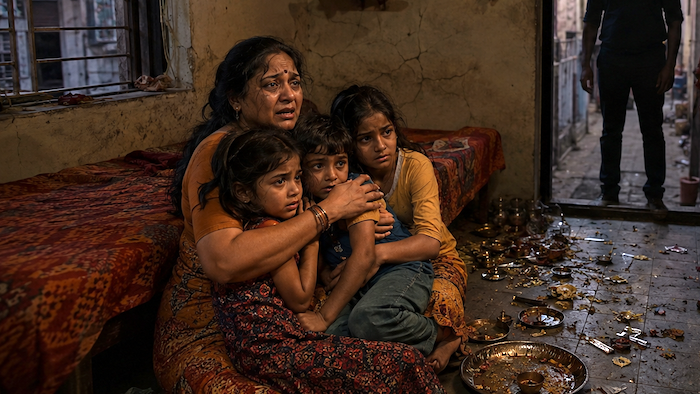
Case Summary
A Hindu woman in Ghaziabad, Uttar Pradesh, was deceived into marriage by a Muslim man who concealed his religious identity and presented himself as a Hindu named Raj Kumar. To sustain the deception, he wore a kalava on his wrist, applied a tilak on his forehead, and regularly accompanied the woman to Hindu temples. After the birth of their first child, his true identity as Altaf Haidar came to light, following which he subjected the woman and her three children to years of physical abuse, religious coercion, confinement, and pressure to abandon Hinduism and adopt Islam. After enduring years of suffering, the victim finally came forward publicly, narrated her ordeal to the media, and demanded justice. She further stated that Altaf was a repeat offender who had similarly targeted two other Hindu women. According to the victim, she met the Muslim man when she visited her sister's house in the DLF area, located in the North West of Ghaziabad, near the Delhi-Dehradun Expressway. He presented himself as Raj Kumar, a Hindu. The friendship culminated in marriage in 2006, with the belief that he was a Hindu man. She stated that he had carefully cultivated this false identity in order to enter into a relationship with her and continued the deception even after their marriage. He wore Hindu religious symbols, including a kalava and tilak, and participated in Hindu religious activities to avoid arousing suspicion. The truth emerged after the birth of their first daughter in 2007, when the woman discovered that her husband was a Muslim who had concealed his real identity at the time of marriage. According to her account, this revelation marked the beginning of a prolonged period of abuse, during which she and her children were subjected to sustained pressure to renounce Hinduism and embrace Islam. The case gained wider public attention after a video connected to the incident circulated online on 20 May 2026 and has since resurfaced. In the video, the woman recounted her experience and stated that the accused, after trapping her into a relationship, married her at an Arya Samaj Mandir according to Hindu rituals. To substantiate her claims, she presented her marriage certificate and photographs of the wedding ceremony to the media. According to the victim, the abuse intensified after his true identity became known. She stated that her husband repeatedly pressured her to convert to Islam and resorted to violence whenever she resisted. She was prevented from performing puja and other Hindu religious practices and was instead compelled to follow Islamic customs. The victim stated that her husband frequently insulted Hindu deities and forbade her from keeping Hindu idols in the house. On one occasion, he reportedly threw away a Shivling that she worshipped and warned her not to keep any idols in the home. She stated that she was forced to wear a burqa, read the Quran and Kalma, and perform namaz. She further stated that her mother-in-law cut off her hair, that she was regularly beaten, and that she was largely confined to the house. According to her account, she was permitted to leave the house only on limited occasions, while wearing a burqa and accompanied by her husband. The pressure extended beyond the victim herself. Over the years, she gave birth to another daughter and a son, after which the efforts to impose Islamic practices shifted to her three children as well. The accused gave the children Muslim names and compelled them to read the Quran, perform namaz, and observe fasting during Ramadan. The woman further stated that the children were subjected to physical abuse and molestation by their father. The situation came to light after the eldest daughter informed her friends about the abuse and coercion taking place inside the household. The information eventually reached members of the Hindu Raksha Dal, who intervened and assisted in removing the woman and her three children from the accused's control. The woman and her children were subsequently rescued with the assistance of Hindu Raksha Dal members in the Sahibabad area of Ghaziabad. Following the rescue, details concerning the concealment of religious identity, the Hindu marriage ceremony, the pressure to convert, and the abuse within the household became public. Police later stated that the matter fell within the jurisdiction of the Seemapuri police station in Delhi. At the time the case was documented, the victim stated that she had been approaching the police for the previous nineteen days but that no action had yet been taken against the accused. She appealed for justice and expressed hope that those responsible for her ordeal would be held accountable.
Why it is Hate Crime ?
This case has been added to the tracker under the primary category - Crimes against women in relationships and other sexual crimes. Within this, the subcategory selected is - Man pretends to be Hindu. Under this, the tertiary categories selected are - Name changed, and marries as per Hindu rituals. When a non-Hindu man pretends to be a Hindu to deceive a Hindu woman into a relationship, the act is seen as triggered by malafide intentions. In some cases, the woman eventually accepts the man’s original religious identity and converts after the man’s identity is revealed. These cases could be argued as cases of religious brainwashing and a result of the pressure a woman feels after getting into a relationship with a man. The woman, it can be argued, also changed her religious identity because of the stigma she believes she might face if she chooses to walk out of a deceptive relationship. However, for the purpose of documenting hate crimes, the cases in this subcategory are limited to those where there is explicit violence aimed at religious conversion against the wishes of the victim (force-feeding beef, blackmailing with intimate videos, rape on refusal to convert, etc), or if the woman herself complains of the man’s religious deception. In such cases, it is established that the deception of the non-Hindu man had a specific aim of religious conversion or targeting of the victim due to her Hindu religious identity, therefore, making it a religiously motivated hate crime. The other subcategory selected in this case is - Brainwashed and/or groomed. Under this, the tertiary categories selected are - Conversion of minor and Family claims grooming and pattern of targeting Hindus. In our database, we have not added incidents where women have converted to another religion of their free will and no allegations of forced/involuntary conversion have been made. However, there are certain cases of conversion where the consent itself is a result of the brainwashing or grooming of a minor by the non-Hindu perpetrator trying to victimise a woman for her Hindu religious identity. The phenomenon of grooming points to non-Hindu perpetrators identifying their Hindu victims’ vulnerabilities and exploiting them over months and sometimes years, to extract the supposed ‘consent’ in order to convert their religion. In most cases of grooming, the victims are minors or the grooming started when the victim was a minor. In other cases of grooming, the non-Hindu perpetrator brainwashes and grooms a minor victim to extract their trust and then proceeds to rape them repeatedly with the intent of converting them to their faith. It is pertinent to understand here that when the victim is a minor, the ‘consent’ to convert or enter into a romantic relationship with an adult itself is redundant – addressed by POCSO. While every case of conversion of a minor and incidents of establishing a physical relationship with a minor by an adult is a crime, for the purpose of this database, a case would be considered a hate crime only if there is a distinct religious angle to the grooming. For example, in the UK, if a Hindu minor is targeted by Pakistani grooming gangs, it would be considered a hate crime because the victims are specifically targeted owing to their non-Muslim religious identity with the perpetrators being Muslim. In other cases, if a Hindu minor is brainwashed into entering a physical relationship with the non-Hindu adult perpetrator and the family alleges grooming/brainwashing of the minor to convert her religion, it would form a part of this database. If the victim is a Hindu adult, the case would form a part of this database only if the victim herself says that she was brainwashed/groomed to convert her religion. However, if the victim is deceased (murdered or otherwise), the case would form a part of this database if her family/friends provided testimony that the victim was brainwashed/groomed to convert her religion. Since these crimes have a distinct religious angle where the victim is being targeted owing to her Hindu religious identity, these cases are considered a hate crime. The other subcategory selected in this case is - Forced conversion after marriage. In such cases, a non-Hindu man marries a Hindu woman, and the force/pressure to convert to any Abrahamic faith, like Islam, begins after marriage. In such cases, typically, two patterns emerge. First, when the relationship is consensual, and the religious identity of the perpetrator is known to the Hindu woman in the relationship. The marriage could be under the Special Marriages Act, where neither parties are required to convert their religion for the marriage to be considered legitimate. While the victim in such cases enters matrimony assuming that religious identity is not a barrier, the non-Hindu man starts to pressure the woman to convert her religion after marriage. The second is when the woman gets into a marriage with the man, pretending to share her faith. Later, when the truth is revealed, the man starts pressuring the woman to convert her religion and give up her religious identity. In both situations, there is application of force by the perpetrator, including the denial of the woman’s religious rights. Some of the means by which the woman is forced/pressured to convert include force-feeding beef, being forced to read the Kalma, being forced to wear a hijab, forced to undergo Halala, etc. There are several instances where, after marriage, the woman voluntarily converts to Islam. Such cases are often argued to be a result of religious brainwashing, however, for the purpose of documenting religiously motivated hate crimes, in the absence of the victim complaining of forced conversion, such cases do not form a part of the database. The other subcategory selected in this case is - Assault or threat upon refusal to convert. When Hindu women are in a relationship with non-Hindu men, there are cases where the woman faces threats or assault after she refuses to convert and change her religious identity owing to pressure/force by the non-Hindu man. Such relationships may be consensual with the religious identity of the non-Hindu man known to the victim. Somewhere along the relationship, the non-Hindu man starts pressurizing the Hindu woman to convert to Islam and upon her refusal, assaults or threatens the victim. Such cases are driven by specific religious motivations and against the religious identity of the victim and are therefore qualified as hate crimes. Cases where the Hindu woman converts to Islam and does not file a complaint about the force or threat, are not considered a part of the hate tracker, even though, it may be argued that the woman was brainwashed or threatened to convert to Islam. The other primary category relevant here is- Predatory Proselytisation. Under this, the first subcategoru selected is- Harassment, threats, coercion for conversion. Harassment covers a wide range of behaviours of an offensive nature. It is commonly understood as behaviour that demeans, humiliates, and intimidates a person, including threats and coercion. Harassment and threats, in this case, find their root on discriminatory grounds which has the effect of nullifying a person’s rights or infringing upon his freedom to exercise his right specifically owing to the victim’s religious identity. Verbal and physical threats and psychological or physical harassment are often used against Hindu victims because they choose to practice their professed religion. Religious harassment also includes forced and involuntary conversions by harassment, threats or coercion. Coercion includes intimidatory tactics like force-feeding a Hindu victim beef to convert to another religion, forceful circumcision etc. In several cases documented, non-Hindu perpetrators or those who harbour specific animosity towards Hinduism, harass victims simply based on their religious identity. Such cases often also include harassment to ensure the Hindu victim abandons his/her professed religion and adopts the religion of the perpetrator. Such cases where Hindu victims are harassed to convert to the perpetrator’s religion are rooted in animosity towards the victim’s religious identity and are therefore documented as religiously motivated hate crimes. The other subcategory is- Attempting to convert/converting by denigrating Hinduism. In several cases, Hindus are converted or an attempt is made to convert Hindus by denigrating their faith, Hinduism. In such cases, the Hindus associate with the non-Hindu perpetrators often by choice and then, the attempt to convert them by insulting their faith, showing the faith down etc begins. An example of this would be a non-Hindu gathering where the Hindus are attending the gathering of their own free will. However, once they attend the gathering, there is an explicit attempt to convert them by abusing their faith and hailing the faith of the perpetrator. The denigration of the Hindu faith is often based on misrepresentation of the Hindu faith, its doctrine and scriptures and insult to espoused traditions if not blatant lies about Hindu beliefs and ways. Such conversions or attempts at conversions are driven by animosity towards the Hindu faith and are therefore documented as religiously motivated hate crimes. The other subcategory is- Proselytisation by grooming, brainwashing, manipulation or subtle indoctrination, and under this, the tertiary category selected is- Conversion of minor. Religious brainwashing essentially means the often subtle and forcible indoctrination to induce someone to give up their religious beliefs to accept contrasting regimented ideas. Religious grooming or brainwashing also involves propaganda and manipulation. It involves the systematic effort, driven by religious malice and indoctrination, to persuade “non-believers’ to accept allegiance, command, or doctrine to and of a contrasting faith. Cases of such grooming or brainwashing are far more nuanced than direct threats, coercion, inducement and violence. In such cases, it is often seen that there is repeated, subtle and continual manipulation of the victim to induce disaffection towards their own faith and acceptance of the contrasting faith of the perpetrator. While subtle indoctrination is widely acknowledged as predatory, an element which is often understated in such conversions or the attempts of such conversion is the role of loyalty and trust which might develop between the perpetrator and the victim. Fiduciary relationships are often abused to affect such religious conversion. For example, an educator transmitting religious doctrine of a competing faith to a Hindu student. The Hindu student is likely to accept what the teacher is transmitting owing to existence of the fiduciary relationship. The exploitation of the fiduciary relationship to religiously indoctrinate victims would also be included in this category. Since the underlying animosity towards the victim’s faith forms the basis of predatory proselytization, such cases are considered religiously motivated hate crimes. This case qualified as a religiously motivated hate crime because the Muslim perpetrator deliberately concealed his religious identity, adopted a false Hindu name, and married the Hindu woman through Hindu rituals in order to gain access to her and integrate himself into her religious and social environment. He maintained the deception until after the marriage had taken place and the Hindu woman had become emotionally and socially dependent upon him. The abuse that followed focused specifically on forcing the Hindu woman and later her children to abandon Hindu practices and adopt Islamic ones. The sustained coercion, religious targeting, and violence inside the household demonstrate that the Hindu identity of the victims was central to the abuse they faced. The primary religious marker in this case was the perpetrator's deliberate adoption of a false Hindu identity in order to secure the marriage. He concealed his real religious identity, assumed a Hindu name, wore a kalava and tilak, visited temples, and ultimately married the victim according to Hindu rituals at an Arya Samaj Mandir. This was religiously significant because the deception specifically exploited the trust associated with a shared Hindu identity. The perpetrator understood that the Hindu woman would not have entered the marriage had she known his true identity. His deliberate use of Hindu customs, symbols, and institutions as tools of deception demonstrates premeditated religious fraud designed to gain long-term access and control over a Hindu woman. The prolonged grooming and manipulation that followed the marriage constitute another important religious marker. After securing the relationship through deception, the perpetrator gradually isolated the Hindu woman from her religious practices and subjected her to sustained pressure to abandon Hindu customs. This coercion continued for years and targeted her daily worship, religious identity, and family environment. The abuse was not directed merely towards obtaining obedience from a spouse. Rather, it aimed to weaken her attachment to Hinduism and replace it with Islamic conformity. The prolonged nature of the pressure reveals a deliberate effort to erode the victim's Hindu identity over time. Another significant religious marker was the active suppression of Hindu worship within the household. The perpetrator did not merely pressure the Hindu woman to adopt Islamic practices. He simultaneously sought to eliminate her ability to practise Hinduism. The victim was prevented from performing puja, forbidden from keeping Hindu idols in the house, and subjected to hostility whenever she attempted to continue her religious observances. Particularly revealing was the incident in which he threw away a Shivling worshipped by the victim and warned her against keeping idols in the home. Such conduct demonstrates more than a desire for conformity. It reflects contempt towards Hindu beliefs, symbols, and forms of worship and reveals a deliberate effort to erase Hindu religious identity from the family environment. Equally significant was the imposition of Islamic religious practices upon the Hindu woman and her children. The victim was compelled to wear a burqa, read the Quran and Kalma, and perform namaz, while the children were pressured to adopt Muslim names, read the Quran, perform namaz, and observe fasting during Ramadan. This demonstrates that the objective was not merely control over the family but religious transformation. The perpetrator sought to replace the family's Hindu way of life with an Islamic one, indicating a sustained effort to alter the religious identity of the victims rather than simply exercise authority within the household. The targeting of the children further strengthens the religious dimension of the case. The perpetrator pressured the children to abandon their inherited Hindu identity and subjected them to abuse when they resisted. This is particularly significant because the victims were minors. Children are not fully developed cognitively, emotionally, or psychologically and are therefore especially vulnerable to coercion, fear, manipulation, and parental authority. The perpetrator exploited this imbalance of power to shape the children's religious identity through pressure, intimidation, and violence. The use of abuse to compel compliance demonstrates that the process was not one of free religious choice but one of coercive religious conditioning. The forced conversion pressure imposed after the marriage is also highly significant. After concealing his identity and securing the marriage through Hindu rituals, the perpetrator began compelling the victim to abandon Hindu customs and adopt Islamic practices. He later extended the same pressure to the children. The concealment of identity before marriage and the conversion pressure after marriage form one continuous pattern of conduct. The false Hindu identity enabled the marriage, while the subsequent abuse was directed towards transforming the religious identity of the family. This demonstrates that the deception was not incidental but formed part of a broader effort to facilitate religious coercion. The physical violence inflicted upon the Hindu woman and her children further reinforces the religious motive. The victim was beaten when she resisted conversion and attempted to continue practising Hindu customs. The children were similarly subjected to abuse when they resisted the pressure to conform to Islamic practices. The violence was therefore directly linked to the victims' refusal to abandon their Hindu identity. Assault, intimidation, and fear were used as tools to suppress Hindu worship and compel religious submission, demonstrating that the violence itself was tied to the victims' continued adherence to their faith. The victim's statement that the perpetrator had similarly targeted two other Hindu women is also significant. If multiple Hindu women were approached through the same method of religious concealment, deception, and subsequent conversion pressure, it suggests a recurring pattern rather than an isolated incident arising from personal circumstances. The repeated use of a false Hindu identity to gain the trust of Hindu women strengthens the inference that Hindu identity itself played a role in victim selection and that the deception formed part of a broader pattern of targeting Hindu women through religious fraud and coercion. This incident is not an isolated occurrence but forms part of a broader pattern in which Hindu women are targeted through religious deception, coercion, and sustained pressure to abandon their faith. The perpetrator did not merely deceive the victim about his identity. He weaponised Hindu trust, exploited Hindu religious customs to secure the marriage, suppressed Hindu worship within the household, imposed Islamic practices upon the victims, and used violence against those who resisted. The cumulative effect of these actions demonstrates a deliberate attempt to erase the Hindu identity of the victim and her children and replace it with an Islamic one. For these reasons, the case meets the threshold of a religiously motivated hate crime and has been added to the hate crime database of the tracker. Disclaimer: The initial contact and marriage between the Hindu woman and the Muslim perpetrator took place many years before the incident became public, but the exact date was not specified in the available sources. The tracker records incident dates based on when the crime occurred, not when it was publicly reported. Since the precise starting date of the coercion and religious targeting could not be independently confirmed, 20th May 2026, the date on which the case entered the public domain, was used as the indicative incident date for documentation purposes only.
Victim Details
Total Victim
4
Deceased
0
Gender
- Male 1
- Female 3
- Third Gender 0
- Unknown 0
Caste
- SC/ST 0
- OBC 0
- General 0
- Unknown 4
Age Group
- Minor 3
- Adult 1
- Senior Citizen 0
- Unknown 0


Case Status
Complaint not filed


Perpetrators Details
Perpetrators
Muslim Extremists
Perpetrators Range
From 2 To 5
Perpetrators Gender
both
 Sources




