Hindu man arrested, his house vandalised by Muslim mob on mere accusation of blasphemy in Bangladesh
 Mymensingh District, Bangladesh
  18 May, 2026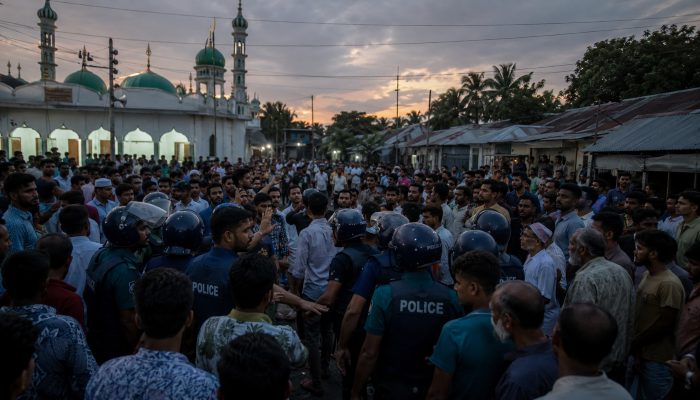
Case Summary
A 23-year-old Hindu youth named Shawan Chandra Das, son of Sadhan Chandra Das, from Majipara area, Gauripur, Mymensingh district, Bangladesh, was arrested on blasphemy charges on 20 May 2026 on the basis of a mere accusation that an objectionable image related to the Quran had been posted from his IMO [an international instant messaging and video calling platform] account on the evening of 19 May 2026. The accusation triggered immediate and widespread outrage among local Muslims, an agitated crowd gathering near Gauripur municipality mosque, and a police hunt that ended with Shawan Chandra Das being arrested from Dhaka the following day. According to reports, the accusation emerged on the evening of 19 May 2026 when an image allegedly related to the Quran was claimed to have been posted from Shawan Chandra Das's IMO account. The exact nature of the image was not disclosed by police. Police did not share the precise legal sections under which he was charged. Following the circulation of the alleged post on social media, local Muslims gathered in large numbers in front of the large mosque near Gauripur municipality in a state of agitation. They also vandalised and demolished the house of the victim. Gauripur Upazila Nirbahi Officer Afia Amin Panna arrived at the scene. Police personnel reached the location and attempted to calm the crowd, assuring them that the accused would be brought under the law. Subsequently, on 20 May 2026, Shawan Chandra Das was arrested by Tejgaon police. Mymensingh Superintendent of Police Mohammed Kamrul Hasan confirmed the arrest. An investigation was stated to be underway. Local administration appealed for calm and urged people to refrain from rumours and inflammatory propaganda. Police confirmed that necessary legal action was being taken and that the investigation was underway. At the time of publication, the exact nature of the alleged post, the legal sections applied against Shawan Chandra Das, and whether he had any knowledge of or involvement in the posting remained unconfirmed.
Why it is Hate Crime ?
The primary category for this case is "Attack not resulting in death". The sub-category for this case is 'Attacked over "Blasphemy' ". Blasphemy essentially refers to the desecration of anything which is held sacred/holy to a group of people. However, for religious supremacist groups, the elements of ‘blasphemy’ are ever-changing, shifting and expanding – leading to infringement on the rights of other religious groups, freedom of speech and expression, threats and even physical violence. There are instances where blasphemy is also used as a dog whistle to target Hindus owing to intrinsic animosity towards Hinduism. There are several instances where stating truths as mentioned in the non-Hindu doctrine itself has led to unmitigated violence against Hindus. There have also been instances where non-Hindus have themselves created a ‘blasphemous’ situation, like placing a Quran in a temple, to use it as an excuse to attack Hindus. Essentially, Blasphemy charges are often made up and/or are used to shut down any form of criticism of non-Hindu faiths and as a tool to target Hindus. Any physical violence over Blasphemy charges against Hindus are foundationally based on animosity for Hindus and their faith owing to religious supremacist ideologies, therefore, such attacks would be documented as religious motivated hate crimes under this category. Another sub-category for this case is "Attacked for Hindu identity". In several cases, Hindus are attacked merely for their Hindu identity without any perceived provocation. A classic example of this category of religiously motivated hate crime is a murder in 2016. 7 ISIS terrorists were convicted for shooting a school principal in Kanpur because they got ‘triggered’ seeing the Kalava on his wrist and tilak that he had put. In this, the Hindu victim had offered no provocation except for his Hindu religious identity. The motivation for the murder was purely religious, driven by religious supremacy. Such cases where Hindus are targeted merely for their religious identity would be documented as a hate crime under this category. The arrest of Shawan Chandra Das on blasphemy charges in Mymensingh district, Bangladesh, must be understood within the context of how blasphemy accusations function against Hindu minorities in Muslim majority nations. The accusation itself, regardless of whether it is proven or substantiated, is the instrument of persecution. In Bangladesh, a blasphemy allegation against a Hindu individual does not require evidence to trigger its consequences. It requires only circulation. Once the alleged post spread through social media, the outcome for Shawan Chandra Das was determined: a mob gathered, police were mobilised, and a Hindu youth was hunted across cities and placed in custody. The accusation did the work that evidence was never required to do. The pattern of blasphemy accusations targeting Hindu minorities in Bangladesh is documented and recurring. It follows a consistent sequence: an alleged post or act of desecration is attributed to a Hindu individual, the accusation spreads rapidly through Muslim networks, a crowd gathers in a state of religious outrage, and the Hindu individual is arrested by police who respond to the mob's demands rather than to the evidentiary merits of the accusation. Whether the accused Hindu individual actually made the post, whether his account was hacked, or whether the accusation was fabricated entirely are questions that receive no institutional scrutiny, while the accused is arrested and subjected to threats and harassment. The arrest itself is the institutional validation of the mob's demands. Muslim extremist groups have historically exploited blasphemy accusations to intimidate religious minorities, particularly Hindus, silence dissent, and reinforce social control. Hindus in Bangladesh remain particularly vulnerable because blasphemy allegations involving Islam frequently trigger collective outrage and public vigilantism, regardless of whether evidence exists or not. Such accusations have repeatedly led to Muslim mob attacks, destruction of Hindu homes and temples, forced displacement, arrests, and long-term persecution across Bangladesh. Furthermore, the response of the police exposed the systemic vulnerability faced by Hindus in Bangladesh. Instead of taking action against the Muslim crowd that surrounded, threatened, and harassed the Hindu youth following an unsubstantiated allegation, the police ultimately arrested the Hindu victim himself. The authorities failed to protect him from public intimidation and mob coercion. By acting against the accused Hindu man rather than those engaging in intimidation and vigilantism, the police effectively appeared to side with the hostile Muslim crowd. This reflected a broader pattern in Bangladesh where law enforcement often bends under pressure from Islamist groups and Muslim mob outrage, particularly in cases involving allegations of insulting Islam. Such responses reinforce an atmosphere of fear and insecurity for Hindus, who remain highly vulnerable to anti-Hindu hostility and communal targeting. When police respond to mob pressure by detaining or penalising the minority victim instead of restraining those issuing threats and engaging in harassment, it sends a message that Muslim mobs can act with impunity. This emboldens the Muslim perpetrators and encourages the use of blasphemy accusations as a weapon to intimidate, silence, and persecute Hindus. The handling of this case demonstrated how accusations alone, even over an entirely innocuous statement, can become sufficient for public humiliation, harassment, and police action against a Hindu individual in Bangladesh. Furthermore, the broader context of Mymensingh district further establishes the religious character of this case. Earlier in 2026, Hindu businessman Sushen Chandra Sarkar, aged 60, was killed by unidentified individuals in the Trishal area of the same district. The killing of a Hindu businessman and the arrest of a Hindu youth on blasphemy charges in the same district within the same year reflects a sustained and directional pattern of anti-Hindu targeting in the region. Mymensingh is not an isolated location where individual criminal acts happen to affect Hindus. It is a district where Hindu minorities face a documented pattern of violence, persecution, and state action directed at their community specifically. The use of blasphemy accusations as a tool to target Hindu minorities in Bangladesh reflects a religious supremacist methodology in which the shifting and expanding definition of blasphemy is deployed to infringe on the rights, freedom, and physical safety of Hindus. There have been documented instances in Bangladesh where non-Hindus have themselves created blasphemous situations, such as placing a Quran in a temple, to manufacture a pretext for attacking Hindus. The accusation against Shawan Chandra Das may represent a similar manufactured pretext. Whether it does or not, the consequence for a Hindu minority youth in Mymensingh district was identical: arrest, custody, and the targeting of his Hindu identity through the instrument of a blasphemy charge. The house of Shawan Chandra Das was also destroyed by the Muslim mob. The Muslim mob did not wait for police investigation, judicial process, or any form of institutional verification before destroying the house of the victim. The accusation alone was sufficient. This is the defining characteristic of blasphemy accusations as they operate against Hindu minorities in Bangladesh: the accusation is not a complaint awaiting resolution. It is an instrument of immediate communal violence in which the Hindu individual's guilt is assumed from the moment the accusation is made, and punishment is administered by the mob before any institution has examined the evidence. The destruction of the Das family home reflects not individual criminal conduct but a structured communal response in which blasphemy accusations are understood by Islamist networks as authorisation to target Hindu property, Hindu families, and Hindu lives without consequence or accountability. Given that this case met the parameters of a religiously motivated hate crime, the arrest of Shawan Chandra Das reflected more than a routine law enforcement response to a social media complaint. By arresting a Hindu youth on an unverified blasphemy accusation in response to mob pressure, without disclosing the exact nature of the alleged post or the legal sections applied, Bangladeshi police validated and institutionalised the mob's religiously motivated demand for the persecution of a Hindu individual. Shawan Chandra Das was targeted specifically because he was Hindu, and the blasphemy accusation was the instrument chosen because it is the most effective tool available in a Muslim-majority nation for mobilising state power against a Hindu minority individual without requiring evidence. This reflects an underlying hostility toward Hindu religious identity that cannot be characterised as anything other than religiously motivated. Given that this case met the parameters of a religiously motivated hate crime, it was added to the hate crime database of the tracker.
Victim Details
Total Victim
1
Deceased
0
Gender
- Male 1
- Female 0
- Third Gender 0
- Unknown 0
Caste
- SC/ST 0
- OBC 0
- General 0
- Unknown 1
Age Group
- Minor 0
- Adult 1
- Senior Citizen 0
- Unknown 0


Case Status
Unknown


Perpetrators Details
Perpetrators
Muslim Extremists
Perpetrators Range
Unknown
Perpetrators Gender
unknown
 Sources




