Hindu teacher humiliated, publicly punished, and arrested on allegations of blasphemy amidst ongoing persecution of Hindus in Bangladesh
 Satkhira District, Bangladesh
  12 May, 2026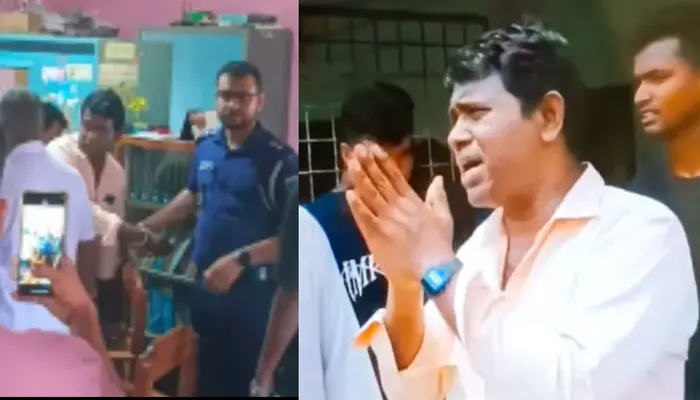
Case Summary
In Satkhira district of Bangladesh, a Hindu school teacher was humiliated, publicly punished, and arrested after he was accused of blasphemy and insulting Islam. According to reports, the Hindu teacher, identified as Gourab Sarkar, also referred to in some reports as Gauranga Sarkar, taught mathematics at Bongshi Mohammad Mujibur Rahman Secondary School in Satkhira Sadar Upazila. The controversy began during a Class 9 mathematics lesson on 13 May 2026, when students falsely accused the victim of making remarks regarding Prophet Muhammad and Islam. Students alleged that he told them that “Allah and God are one,” after which several Muslim students informed residents and religious figures. Students further accused him of describing the Azaan from nearby mosques as “noise” and saying that the Islamic call to prayer should be banned in Bangladesh. They also claimed that the teacher made remarks concerning the personal life of Prophet Muhammad. As news of the classroom remarks spread, protests erupted in the area, with local Muslims, guardians, and religious leaders gathering and condemning the teacher. Demonstrations were organised demanding action against him, while religious figures and local leaders described the remarks as an insult to Islam During the escalation, the Hindu teacher was forced to perform sit-ups while holding his ears in front of others as a form of public humiliation before being handed over to the police. The incident created a tense atmosphere in the locality, prompting police intervention. Following complaints from students and pressure from local Muslim residents, the school administration informed law enforcement authorities. Police subsequently detained Gourab Sarkar from his residence on the afternoon of 19 May 2026 and took him to Satkhira Sadar Police Station for questioning. The acting headmaster of the school, Abdur Rahman Mukul, confirmed that the matter was reported to the authorities after students informed the administration about the remarks made during class. Police later stated that an investigation into the matter was underway and that additional personnel had been deployed in the area to maintain order following the communal tension sparked by the incident. This is not an isolated incident, but part of a pattern of targeting of Hindus in Bangladesh. This escalation against Hindus in Bangladesh has unfolded in three distinct phases: first, following the ouster of Sheikh Hasina’s government in August 2024; second, after the death of Sharif Osman Bin Hadi in December 2025; and third, in the immediate aftermath of the 13th National Parliamentary Election 2026. Following the ouster of Sheikh Hasina, multiple reports documented attacks on Hindu homes, temples, and religious institutions, alongside intimidation campaigns, arson, and mob assaults targeting minority neighbourhoods. The Hinduphobia tracker has recorded 336 such incidents against the Hindu minority, underscoring the scale and persistence of anti-Hindu violence during this period. A further escalation occurred following the death of Sharif Osman Bin Hadi, a Muslim political activist and student leader known for his anti-Hindu and anti-India rhetoric. Hadi had been involved in political unrest after the fall of the Hasina government and was killed in Dhaka on 18 December 2025 during clashes. In the aftermath of his death, Hindu communities were blamed and subsequently targeted in retaliatory violence. Hindu homes were selectively set ablaze in multiple localities, forcing families to flee and leaving many displaced. The attacks appeared patterned rather than sporadic, with Muslim mobs focusing on Hindu neighbourhoods, properties, and religious symbols. Among the victims was Dipu Chandra Das, who was lynched to death and his body was set ablaze by a Muslim mob over false blasphemy allegations. The Hinduphobia tracker documented 51 incidents of anti-Hindu violence in the period following Hadi’s death alone. Such incidents underscore the vulnerability of the Hindu minority amid rising communal hostility and the weaponisation of religious accusations. Reports further indicated that posters and written materials calling for the extermination of Hindus were displayed in public spaces, signalling an alarming normalisation of genocidal rhetoric. When combined with acts of arson, vandalism, assault, and targeted intimidation, these developments suggest a coordinated environment of hostility aimed at terrorising the Hindu community and reinforcing majoritarian dominance. The third phase of violence was unleashed after the 13th National Parliamentary Election 2026. Within days of the announcement of results, Hindu families in districts such as Noakhali, Rangpur, Nilphamari, Sylhet, Thakurgaon, and Dinajpur reported coordinated attacks involving arson, looting, assault, and vandalism of temples and homes. In several instances, Hindu homes were selectively targeted, looted, and families were threatened with displacement.
Why it is Hate Crime ?
This case has been added to the tracker under the primary category of: Attack not resulting in death. Within it, the sub-category selected is: Attacked over 'Blasphemy. Blasphemy essentially refers to the desecration of anything which is held sacred/holy to a group of people. However, for religious supremacist groups, the elements of ‘blasphemy’ are ever-changing, shifting and expanding – leading to infringement on the rights of other religious groups, freedom of speech and expression, threats and even physical violence. There are instances where blasphemy is also used as a dog whistle to target Hindus owing to intrinsic animosity towards Hinduism. There are several instances where stating truths as mentioned in the non-Hindu doctrine itself has led to unmitigated violence against Hindus. There have also been instances where non-Hindus have themselves created a ‘blasphemous’ situation, like placing a Quran in a temple, to use it as an excuse to attack Hindus. Essentially, Blasphemy charges are often made up and/or are used to shut down any form of criticism of non-Hindu faiths and as a tool to target Hindus. Any physical violence over Blasphemy charges against Hindus is fundamentally based on animosity for Hindus and their faith, owing to religious supremacist ideologies; therefore, such attacks would be documented as religiously motivated hate crimes under this category. This case has been added to the tracker because it involved the public humiliation, targeting, and arrest of a Hindu teacher in Bangladesh following accusations of insulting Islam and hurting religious sentiments. The incident demonstrated how allegations linked to blasphemy or perceived criticism of Islam are frequently weaponised against religious minorities, particularly Hindus, in Muslim-majority societies such as Bangladesh. In this case, the Hindu teacher, Gourab Sarkar, was not only arrested but was also subjected to public degradation by being forced to perform sit-ups holding his ears before being handed over to the police. The humiliation and subsequent detention reflected the vulnerability of Hindus to mob pressure and communal hostility once accusations of religious offence emerge. Blasphemy laws, particularly in Muslim-majority countries like Bangladesh and Pakistan, are routinely weaponised to persecute Hindus. These laws frequently result in false or exaggerated accusations, enabling state-sanctioned or mob-led persecution. Even unverified verbal remarks or classroom discussions can rapidly escalate into organised protests, public outrage, and police action when the accused belongs to the Hindu community. The reaction in this case, where local Muslims, religious leaders, and Islamist figures mobilised demonstrations and demanded punitive action, highlighted the deeply unequal environment in which minorities are often denied the benefit of due process or impartial scrutiny. Instead, accusations themselves become sufficient grounds for public punishment, arrest, and social ostracism. Islamists have historically used blasphemy charges as a pretext to incite violence, settle personal scores, or intimidate Hindus into silence and submission. The disproportionate targeting of Hindus under these laws is not accidental but driven by deep-rooted religious prejudice, with blasphemy allegations serving as a tool of social control and communal suppression. The incident further illustrated how Islamist pressure groups and radical religious elements exert influence over public discourse and law enforcement in Bangladesh. The fact that the Hindu teacher was publicly humiliated before police intervention indicated the normalisation of vigilante-style punishment against minorities accused of offending Islam. Such actions reinforce a climate of fear in which Hindus remain under constant threat of communal retaliation for perceived religious transgressions. In many such cases across Bangladesh and Pakistan, blasphemy accusations have historically led to mob violence, destruction of Hindu property, forced displacement, and long-term social persecution, even before any formal investigation is completed. This case also reflected the worsening atmosphere for minorities in Bangladesh amid the growing assertiveness of Islamist groups and rising anti-Hindu hostility in the country. The ability of local religious leaders and mobs to rapidly escalate allegations into a law-and-order issue demonstrated how accusations involving Islam can be transformed into instruments of coercion and communal control. The arrest and humiliation of Gourab Sarkar therefore represented more than an isolated controversy; it formed part of a broader pattern in which Hindus in Bangladesh face systemic vulnerability, intimidation, and disproportionate punishment under the pretext of protecting religious sentiments.
Victim Details
Total Victim
1
Deceased
0
Gender
- Male 1
- Female 0
- Third Gender 0
- Unknown 0
Caste
- SC/ST 0
- OBC 0
- General 0
- Unknown 1
Age Group
- Minor 0
- Adult 1
- Senior Citizen 0
- Unknown 0


Case Status
Arrested


Perpetrators Details
Perpetrators
State and Establishment
Perpetrators Range
N/A
Perpetrators Gender
unknown
 Sources




