Hindu community targeted: Muslims in Bangladesh issue genocidal threats against Hindus, call for Islamisation of India
 Bangladesh
  15 May, 2026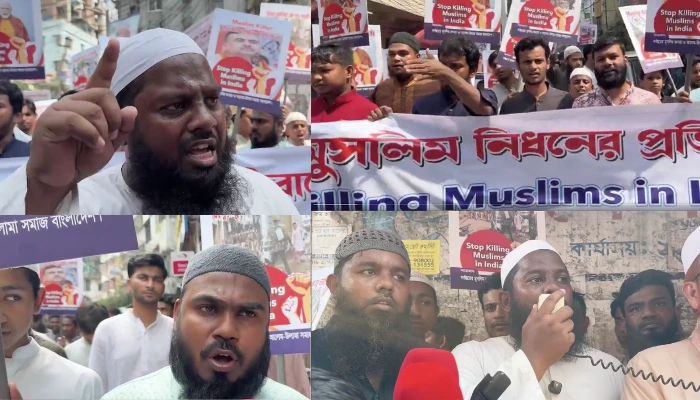
Case Summary
Following the Bharatiya Janata Party’s (BJP) electoral victory in West Bengal, anti-Hindu protests erupted in Bangladesh targeting newly elected West Bengal Chief Minister Suvendu Adhikari and Prime Minister Narendra Modi. Several videos circulated on social media on 16 May 2026 showing Bangladeshi Muslims taking to the streets and issuing violent threats against Hindus in both India and Bangladesh. The speakers threatened retaliation, warned of war against India, and openly spoke about Islamising India. The rhetoric also included calls invoking Ghazwa-e-Hind and threats to annihilate Hindus. The rhetoric intensified after Suvendu Adhikari announced measures relating to border fencing and security along the India–Bangladesh border, as well as regulations governing the use of loudspeakers at all religious sites, including both temples and mosques, in West Bengal. He also issued directives to end cow slaughter, reopen cases related to Hindu victims of the 2021 post-poll violence in West Bengal, end the selective state-funded honorariums previously given to Islamic maulanas under the earlier TMC government, and stated that namaz would not be allowed on public roads by blocking traffic or thoroughfares. Despite the fact that the directives applied broadly to law and order, border security, illegal slaughter, and uniform regulation of public religious practices across communities, several Muslim speakers and protesters portrayed them as a targeted attack on Muslims alone. Measures such as regulating loudspeaker use at all religious sites, preventing public road blockades during namaz, and curbing illegal cow slaughter were selectively framed as “anti-Muslim” actions, while comparable restrictions applicable to all communities were ignored. Using this narrative, protesters took to the streets calling for retaliatory and tit-for-tat action against Hindus in both India and Bangladesh. Several Muslim leaders openly threatened that if Muslims faced restrictions, Hindus would also be prevented from practising their religious customs. The speeches escalated into calls for collective Muslim mobilisation, violent retaliation, and threats directed specifically at Hindus. Reacting to the directives, one Muslim man in Bangladesh threatened that if Indian Muslims are not allowed to perform azaan through loudspeakers, then Bangladeshi Hindus will also face consequences and will not be allowed to use microphones in temples. The Muslim man further threatened that if Muslims are stopped from slaughtering cows in India, then Hindus will not be allowed to sacrifice goats in Bangladesh. Several Muslim perpetrators openly called for all Muslims to unite against Hindus and India. One Muslim man declared that Muslims must collectively protest against Hindus and warned that if the Modi government did not stop its 'anti-Muslim' actions, Muslims would wage war against India, after which chants of “Inshallah” erupted. Another Muslim man falsely claimed that mosques and Muslim houses were being demolished in India and stated that, in retaliation, Bangladeshi Muslims were prepared to wage war against India and Hindus. He stated that this was the order of Allah and the Prophet Muhammad. The speeches also contained direct threats against Hindus. One protestor declared that Muslims would raise slogans of “Allahu Akbar”, unite collectively, and retaliate against Hindus in India and Bangladesh. Threats were issued that all Hindus would be killed and thrown into the Bay of Bengal. “This side is the Bay of Bengal, that side is India. In the end, all of them (Hindus) will be thrown into the Bay of Bengal,” one Muslim man warned. Another threat was that if Muslims united, the BJP and even India itself would collapse under the force of Muslim resistance. In another video, a Muslim man falsely claimed that after the BJP's victory in West Bengal, Muslims were forcibly made to chant “Jai Shri Ram”. In the same video, another Muslim man stated that it was their divine commandment from Allah to wage war against India and Hindus. He said that Muslims would turn India into an Islamic state ruled by Islamic law (Sharia). Another Muslim man in the crowd also made similar comments, stating that they would carry out Ghazwa-e-Hind against India. Notably, Ghazwa-e-Hind means “the military conquest of India” and refers to a supposed prophecy attributed to Prophet Muhammad, recorded in multiple hadiths, stating that Muslims would win a military battle against kafirs (non-believing Hindus) and establish the rule of Islam in India. This military conquest calls for the forced conversion of Hindus and the destruction of their temples and religion as a whole. Another video showed a Muslim man saying, “When Modi called Israel the fatherland and India the motherland during his visit to Israel, I understood they were going to run bulldozers over Muslim homes and mosques. If the butcher Modi and India run bulldozers over Muslims, they should remember that 1,400 years ago, Allah and the Prophet Muhammad told us that we must wage war against India and Hindus. We Muslims will do that. We are just waiting for the right opportunity.” The overall rhetoric framed Hindus and India as enemies and openly threatened violent retaliation and communal mobilisation in response to political developments in West Bengal and actions taken by the BJP government led by Suvendu Adhikari. This is not an isolated incident; in fact, such escalation of violence against Hindus in Bangladesh has unfolded in three distinct phases: first, following the ouster of Sheikh Hasina’s government in August 2024; second, after the death of Sharif Osman Bin Hadi in December 2025; and third, in the immediate aftermath of the 13th National Parliamentary Election 2026. Following the ouster of Sheikh Hasina, multiple reports documented attacks on Hindu homes, temples, and religious institutions, alongside intimidation campaigns, arson, and mob assaults targeting minority neighbourhoods. The Hinduphobia tracker has recorded 336 such incidents against the Hindu minority, underscoring the scale and persistence of anti-Hindu violence during this period. A further escalation occurred following the death of Sharif Osman Bin Hadi, a Muslim political activist and student leader known for his anti-Hindu and anti-India rhetoric. Hadi had been involved in political unrest after the fall of the Hasina government and was killed in Dhaka on 18 December 2025 during clashes. In the aftermath of his death, Hindu communities were blamed and subsequently targeted in retaliatory violence. Hindu homes were selectively set ablaze in multiple localities, forcing families to flee and leaving many displaced. The attacks appeared patterned rather than sporadic, with Muslim mobs focusing on Hindu neighbourhoods, properties, and religious symbols. Among the victims was Dipu Chandra Das, who was lynched to death and his body was set ablaze by a Muslim mob over false blasphemy allegations. The Hinduphobia tracker documented 51 incidents of anti-Hindu violence in the period following Hadi’s death alone. Such incidents underscore the vulnerability of the Hindu minority amid rising communal hostility and the weaponisation of religious accusations. Reports further indicated that posters and written materials calling for the extermination of Hindus were displayed in public spaces, signalling an alarming normalisation of genocidal rhetoric. When combined with acts of arson, vandalism, assault, and targeted intimidation, these developments suggest a coordinated environment of hostility aimed at terrorising the Hindu community and reinforcing majoritarian dominance. The third phase of violence was unleashed after the 13th National Parliamentary Election 2026. Within days of the announcement of results, Hindu families in districts such as Noakhali, Rangpur, Nilphamari, Sylhet, Thakurgaon, and Dinajpur reported coordinated attacks involving arson, looting, assault, and vandalism of temples and homes. In several instances, Hindu homes were selectively targeted, looted, and families were threatened with displacement.
Why it is Hate Crime ?
The primary category selected in this case is- Hate Speech against Hindus. The subcategory selected is- Violent Threats. Violent threats, explicit, implicit or implied, is the most dangerous form of hate speech since it goes beyond discriminatory and prejudicial language to express the intent of causing harm to an individual or a group of people based on their religious identity and faith. There could be several different kinds of threats that are issued to Hindus based on religious animosity. An explicit threat would mean the direct threat of violence towards an individual Hindu, a group of Hindus or Hindus at large. Physical violence, death threats, threats of destruction of property belonging to Hindus and threats of genocide would mean explicit threats against Hindus for their religious identity. Implicit threats may not be a direct threat but implied through the use of symbols of actions – for example – in the Nupur Sharma case, other than explicit threats, there were also implicit threats when Islamists took to the streets to burn and beat her effigies. It implies that they want to do the same to Nupur Sharma – thereby is considered an implicit threat. Violent threats can be delivered in person, through letters, phone calls, graffiti, or increasingly through social media and other online platforms. It would be important to understand that a threat – explicit or implicit, online or offline – to an individual who happens to be a Hindu does not qualify as a religiously motivated threat. Such a threat, while vile and dangerous, could be owing to non-religious reasons and/or personal animosity. To qualify as a religiously motivated threat, it would need to exhibit an indication that the individual is being targeted for religious reasons and/or owing to his/her religious identity as a Hindu. The other subcategory selected is- Anti-subversion and prejudice. Hate speech is defined as any speech, gesture, conduct, writing, or display that is prejudicial against a specific individual and/or group of people, which is leading to or may lead to violence, prejudicial action or hate against that individual and/or group. Media plays a specific and overarching reach in perpetuating prejudicial attitudes towards a community owing to unfair, untrue coverage and/or misrepresentation/misinterpretation, selective coverage and/or omission of facts of/pertaining to issues affecting a specific religious group. This type of bias can dehumanise the victim group, making it easier for others to justify harmful actions against them, which aligns with the objectives of hate speech laws aimed at preventing such harm. It is often observed that the media takes a prejudicial stand against the Hindu community driven by their need to shield the aggressor community which happens to be a numeric minority, however, is the one perpetrating violence against Hindus. For example, the media is often quick to contextualise religiously motivated crimes against Hindus, omit or misrepresent facts that point towards religiously motivated hate crimes, justify and/or downplay religiously motivated hate crimes or simply present fake news to stereotype Hindus. Such media bias leads to the denial of persecution and is often used to dehumanise Hindus, leading to justification for violence against them. For example, the media covered several fake allegations of Hindus targeting Muslims and forcing them to chant Jai Shree Ram. Most of these cases were proved false and fabricated after police investigation. These fake news reports were subsequently never retracted or clarified. Such fake news led to the justification of violence and dehumanisation of Hindus based on the argument that since Hindus targeted Muslims and forced them to chant Jai Shree Ram, the dehumanisation of Hindus and violence against them was par for the course and merely a retaliation. Such media bias leads to prejudicial portrayal of Hindus and offers a justification for violence against them and therefore, is considered hate speech under this category. This case was a clear instance of a religiously motivated hate crime, as the Bangladeshi Muslim perpetrators were seen participating in anti-Hindu protests, issuing violent and genocidal threats against the Hindu community, and targeting Hindus, India, and political parties perceived as pro-Hindu. Several Muslims openly threatened to wage war against India, a Hindu-majority country, and declared their intention to turn it into an Islamic state through the mobilisation of Muslim mobs and calls for “Ghazwa-e-Hind”. The repeated threats of violence, communal mobilisation, and targeting of Hindus on the basis of their religious identity demonstrated clear anti-Hindu animosity and constituted an overt expression of Hinduphobic hatred. The context surrounding these protests further exposed the communal nature of the rhetoric being used. The protests erupted after West Bengal Chief Minister Suvendu Adhikari introduced a series of governance measures that were religiously neutral in nature. These included calls to regulate the use of loudspeakers in both temples and mosques, restrictions on cow slaughter without banning animal sacrifice as a whole, reopening cases related to post-poll violence against Hindus, and strengthening border security between India and Bangladesh. None of these measures directly targeted Muslims or Islam. However, the Muslim perpetrators in Bangladesh used these policies as a pretext to spread narratives of Muslim victimhood, mobilise Muslim crowds against Hindus and India, and justify threats of violence and communal retaliation. By portraying neutral administrative actions as “Islamophobia”, the perpetrators attempted to legitimise open anti-Hindu rhetoric and incite hostility against Hindus under the guise of defending Muslim rights. The hostility directed towards Suvendu Adhikari and the Bharatiya Janata Party (BJP) also reflected the perception among the perpetrators that the BJP is a “pro-Hindu” or “Hindutva” political party. In the minds of the radical Muslims, any political formation seen as advocating for Hindu concerns or refusing minority appeasement becomes a legitimate target of hostility. Although the BJP-led government publicly positions itself as religiously neutral and maintains policies applicable to all communities, the refusal to provide preferential treatment to any particular minority group, here, Muslims, was portrayed by the accused as “Islamophobia” and anti-Muslim governance. This perception fuelled collective anger against the BJP’s electoral victory in West Bengal and transformed a political event into a communal mobilisation targeting Hindus and those perceived as supporting Hindu interests. The targeting of a party viewed as sympathetic towards Hindu rights further demonstrated the anti-Hindu animosity underlying the protests and rhetoric. The overall tenor of the protests centred on open calls for war against India and Hindus, repeatedly justified through religious rhetoric and references to the commands of Allah and the Prophet Muhammad. Such calls for violence against Hindus demonstrated deep-seated religious hostility and framed Hindus not merely as political opponents, but as enemies to be collectively targeted on the basis of faith. The repeated threats to wage war against India also reflected how Muslim extremists viewed India as a Hindu civilisational collective. References to “Ghazwa-e-Hind” carried explicit implications of religious conquest, including the destruction of Hindu temples, the imposition of Islamic rule, and the forced conversion or killing of those who refused to submit. By invoking such rhetoric publicly and threatening violent action against Hindus and India alike, the perpetrators sought to intimidate Hindus on the basis of their religious identity and promote fear through communal mobilisation. It is pertinent to note that Muslim extremists harbour specific animosity towards Hindus and their faith and also view India as a Hindu collectivity. The very basis of the partition of India and creation of Pakistan (including modern-day Bangladesh/ East Pakistan) was that Muslims believed that Islam was a nation unto itself, which could not survive alongside a Hindu collectivity like India. Further, Muslims also believe in transnational unity, or the Ummah, which holds that all Muslims worldwide are a nation unto themselves and, therefore, loyalty, as far as the nation-state is concerned, lies with the Muslim collectivity rather than with a Hindu collectivity like India. Therefore, even in this case, the fact that Bangladeshi Muslims were showcasing solidarity with Indian Muslims over supposed anti-Muslim attacks in India showcased this same global Muslim Ummah at play, where they believed only in showcasing brotherhood and loyalty towards Muslims, thereby automatically showcasing hostility towards non-Muslims, particularly Hindus. This would also mean that the threats against India were about hailing a Muslim collectivity and expressing transnational loyalty and anti-Hindu sentiments. For that reason, any remarks expressing transnational loyalty and faith in the Ummah can also be interpreted as rhetoric directed against Hindus and the Hindu collectivity. The statements made by the Muslim perpetrators regarding azaan and loudspeakers further exposed how false narratives of “Islamophobia” are weaponised to target Hindus and justify hostility towards Hindu religious practices. One perpetrator threatened that if Muslims were not allowed to perform azaan through loudspeakers, Hindus in Bangladesh would also not be allowed to use microphones in their temples. However, the policies introduced under Suvendu Adhikari in West Bengal were religiously neutral and applied equally to both mosques and temples. The restrictions were not directed specifically at Muslims or Islamic practices, but were administrative measures applicable to all religious institutions irrespective of faith. Despite this, the perpetrators deliberately attempted to portray the policy as anti-Muslim in order to spread false anti-Hindu rhetoric and inflame communal hostility against Hindus. By falsely depicting the Bharatiya Janata Party government, which they perceived as a “Hindu” government, as selectively targeting Muslims, the perpetrators manufactured a narrative of Muslim victimhood in order to legitimise retaliatory threats against Hindus and Hindu places of worship. The threat that Hindu temples in Bangladesh would be denied the use of microphones was therefore not a response to discrimination, but an act of communal intimidation rooted in anti-Hindu prejudice. This demonstrated how fabricated claims of “Islamophobia” were used as a pretext to vilify Hindus community, malign their religious identity, and justify attacks on Hindu religious practices and institutions. The rhetoric revealed a deliberate attempt to transform a religiously neutral governance measure into communal propaganda aimed at inciting hatred and fear against Hindus. The statements made by the perpetrators regarding cow slaughter similarly reflected deep-seated anti-Hindu animosity disguised as a defence of religious rights. One perpetrator declared that if Muslims were prevented from slaughtering cows, Hindus would not be allowed to sacrifice goats either. While both Hinduism and Islam contain traditions involving animal sacrifice, the issue of cow slaughter carries exceptional religious significance in Hinduism because the cow is widely regarded as sacred and deeply revered within the Hindu faith. Across Hindu traditions, the cow symbolises purity, motherhood, divinity, and non-violence, and harming or slaughtering cows is viewed by Hindus as a grave desecration of something holy. In contrast, while Islam contains traditions relating to animal sacrifice, Islamic practices do not universally mandate the slaughter of cows specifically, and sacrifices may involve various animals. Furthermore, in several Hindu traditions, particularly among certain sections of the Bengali Hindu community, ritual animal sacrifice involving goats has historically been associated with deities such as Goddess Kali and Lord Bhairava. However, unlike the cow, these animals do not occupy the same sacred and inviolable status within Hindu belief systems. The insistence by the perpetrators on specifically defending cow slaughter, despite fully knowing the profound religious pain and offence it causes to Hindus, therefore went beyond a mere assertion of religious freedom. It reflected a deliberate assertion of dominance over Hindu religious sensitivities and a willingness to weaponise practices offensive to Hindus in order to intimidate and provoke the Hindu community. Historically, Muslim extremist elements have repeatedly used cow slaughter as a means to humiliate Hindus, psychologically terrorise them, desecrate spaces associated with the Hindu faith, carry out forceful conversions by force-feeding beef to Hindus and inflame communal tensions. In this case as well, the rhetoric surrounding cow slaughter functioned as an expression of hostility towards Hindu beliefs and sacred symbols rather than a neutral defence of religious practice. By threatening retaliation against Hindu rituals if cow slaughter faced restrictions, the perpetrators attempted to equate ordinary ritual practices with the slaughter of an animal considered sacred by Hindus, thereby deliberately targeting Hindu faith and identity. The rhetoric demonstrated not only insensitivity towards Hindu beliefs but also a clear pattern of anti-Hindu animosity in which Hindu sacred values were mocked, challenged, and used as instruments for communal intimidation. One Muslim perpetrator also issued chilling and explicit threats against Hindus by declaring that Muslims would kill all Hindus and throw them into the Bay of Bengal. Such statements went far beyond political rhetoric or communal provocation and constituted direct calls for mass violence against Hindus on the basis of their religious identity. The threat specifically targeted Hindus as a collective religious community and openly advocated their extermination and disposal, thereby demonstrating severe anti-Hindu animosity and genocidal intent. The rhetoric reflected an attempt to terrorise Hindus through threats of collective violence and conveyed that Hindus, merely because of their faith, were viewed as legitimate targets for elimination. Such language showcased glaring Hinduphobia, as the perpetrators openly dehumanised Hindus and promoted violent hatred against them solely on the basis of their religious identity. The explicit invocation of killing Hindus and throwing them into the Bay of Bengal also functioned as a tool of communal intimidation designed to create fear and insecurity among Hindus in both Bangladesh and India. Such communally charged remarks are rooted in anti-Hindu animosity, amounting to a religiously driven hate speech. One Muslim perpetrator also spread false rhetoric claiming that Muslims in West Bengal were being forcibly made to chant “Jai Shri Ram” under the Suvendu Adhikari government. However, there is no evidence or factual basis to support claims of forced chanting of “Jai Shri Ram” under the Bharatiya Janata Party rule in West Bengal. Despite this, the perpetrators deliberately propagated this fabricated narrative in order to vilify Hindus and portray political parties perceived as pro-Hindu as oppressors of Muslims. This false rhetoric was then used to justify threats, communal mobilisation, and calls for violence against Hindus and India. The deliberate spreading of fabricated claims about Hindus forcing religious slogans upon Muslims demonstrated a broader attempt to manufacture anti-Hindu propaganda and create a false image of Hindus as aggressors in order to legitimise retaliatory hatred and violence against them. Such conduct reflected deep-rooted anti-Hindu prejudice, where misinformation and communal propaganda were weaponised to incite hostility towards Hindus and rationalise violent threats against the Hindu community. The repeated use of fabricated victimhood narratives further exposed how the perpetrators attempted to convert ordinary political developments into communal grievances aimed at targeting Hindus collectively. In the same gathering where these false claims were made, other Muslim perpetrators openly called for violence against India and Hindus, demanded the Islamisation of India, and invoked the slogan of “Ghazwa-e-Hind”. As stated earlier, such rhetoric reflected deep-seated religious hostility and an overtly supremacist mindset rooted in the belief that India, viewed by the perpetrators as a Hindu collectivity, should be conquered and brought under Islamic rule. The invocation of “Ghazwa-e-Hind” carried explicit connotations of religious conquest and communal violence directed against Hindus. The doctrine has historically been associated with narratives advocating the subjugation of non-Muslims, destruction of Hindu temples, imposition of Islamic rule, and forced conversion or killing of those refusing to submit. By publicly calling for the Islamisation of India and invoking “Ghazwa-e-Hind”, the perpetrators were not merely expressing political dissatisfaction but openly advocating religious domination over Hindus and the eradication of Hindu civilisational identity. The repeated calls for Islamic rule over India, accompanied by threats of violence against Hindus, showcased profound anti-Hindu animosity and reflected an extremist worldview in which Hindus were treated as enemies to be subdued through fear, violence, and religious aggression. Another Muslim perpetrator falsely claimed that Muslim homes and mosques were being bulldozed in India under the rule of Suvendu Adhikari and the Bharatiya Janata Party. These claims were presented in a highly distorted and communalised manner in order to portray Hindus and a government perceived by the perpetrators as “pro-Hindu” as enemies of Muslims. The rhetoric deliberately ignored the fact that demolition drives and administrative actions in India are legal actions against illegal encroachments or unlawful constructions and are not directed at Muslims as a religious community. Despite this, the perpetrators attempted to spread a fabricated narrative of systematic anti-Muslim persecution in order to inflame communal passions and justify hostility against Hindus. By falsely portraying India and Hindus as collectively oppressing Muslims, the perpetrators manufactured a sense of Muslim victimhood and communal grievance that could then be used to legitimise threats, communal mobilisation, and violent rhetoric against Hindus and India. Similar to the fabricated claims regarding the forced chanting of “Jai Shri Ram”, the allegations regarding the bulldozing of Muslim homes were weaponised as propaganda to vilify Hindus and spread anti-Hindu hatred under the guise of defending Muslim rights. The same perpetrator then used these false and exaggerated claims to invoke slogans surrounding “Ghazwa-e-Hind” and justify calls for the forceful takeover of India in the name of Allah and the Prophet Muhammad. By presenting violent action against India and Hindus as a supposed religious duty, the perpetrators transformed fabricated grievances into justification for Islamist threats and communal hostility against an entire religious community. The repeated calls to wage war against India and Hindus, impose Islamic rule, and carry out “Ghazwa-e-Hind” demonstrated that the issue was not merely political disagreement, but a deeply religiously charged hostility directed towards Hindus as a collective community. The invocation of divine sanction for violence against India and Hindus reflected a mindset rooted in Islamic supremacist beliefs, where Hindus were viewed as enemies to be subdued, conquered, or eliminated. The fact that fabricated allegations of anti-Muslim oppression were immediately followed by calls for violent Islamic conquest revealed how such narratives were being deliberately used to incite anti-Hindu animosity and justify communal hatred. Rather than expressing concern for justice or coexistence, the rhetoric openly promoted religious aggression, communal intimidation, and hostility towards Hindus and the Hindu civilisational identity associated with India. Overall, the large-scale mobilisation of sections of the Muslim community in Bangladesh against the electoral victory of a party perceived as “pro-Hindu” in West Bengal reflected deep-rooted communal hostility towards Hindus and Hindu identity. This mobilisation becomes even more significant in the context of Bangladesh’s long-standing record of violence and persecution against Hindus, where Hindu temples have repeatedly been vandalised, Hindu homes and shops attacked or burnt, and Hindus subjected to killings, forced conversions, sexual violence, mob assaults, and brutal murders, often under accusations of so-called blasphemy. In such an environment, the collective mobilisation of Muslim crowds against Hindus and against a political development in neighbouring India demonstrated how anti-Hindu narratives and communal hostility were being amplified on a mass scale. The repeated calls for violence, “Ghazwa-e-Hind”, Islamic conquest, and retaliation against Hindus revealed not merely political anger, but a broader pattern of religiously charged hostility directed at Hindus as a collective community. The mobilisation in this case showcased how communal rhetoric, false victimhood narratives, and Islamist slogans were used to consolidate Muslim crowds against Hindus, thereby reflecting deep-seated anti-Hindu animosity and an atmosphere of intimidation directed towards the Hindu community. Also, this mobilisation cannot be viewed in isolation from the broader pattern of anti-Hindu violence and persecution that has repeatedly unfolded in Bangladesh in recent years. Bangladesh has already witnessed repeated attacks on Hindu temples, killings of Hindus, destruction of Hindu homes and businesses, sexual violence against Hindu women, forced conversions, mob assaults, and large-scale intimidation of the Hindu minority community. The continuing exodus and insecurity faced by Hindus in Bangladesh have already led many observers and organisations to describe the situation as a systematic persecution or slow-moving genocide of Hindus in the country. Against this backdrop, the fact that a democratic electoral victory of a political party in neighbouring India provoked such violent anti-Hindu mobilisation in Bangladesh is deeply revealing. There was no logical or proportionate connection between the administrative measures announced in West Bengal and the genocidal threats issued against Hindus in Bangladesh and India. The directives relating to loudspeakers, border fencing, cow slaughter, public roads, or reopening cases of violence against Hindus did not target Muslims as a community, yet they were deliberately communalised to justify hatred against Hindus. The speed with which sections of the Muslim crowd escalated from political criticism to threats of “Ghazwa-e-Hind”, calls for Islamic conquest, threats to kill Hindus, and declarations about throwing Hindus into the Bay of Bengal demonstrated that the hostility towards Hindus predated the immediate political developments. The electoral victory merely became a pretext or trigger for the public expression of already existing anti-Hindu animosity. The rhetoric revealed a mindset in which Hindus were not viewed as equal human beings or neighbours, but as a collective enemy to be threatened, humiliated, conquered, or eliminated whenever an opportunity or justification presented itself. The repeated calls for violence against Hindus, Islamisation of India, and collective Muslim mobilisation, therefore, reflected far more than temporary political anger. They exposed a deep-rooted and ideological hostility towards Hindus and Hindu identity itself, where even neutral governance measures or democratic outcomes were enough to provoke genocidal rhetoric and communal threats against Hindus as a religious community.


Case Status
Unknown


Perpetrators Details
Perpetrators
Muslim Extremists
Perpetrators Range
Unknown
Perpetrators Gender
male
 Sources




