Hindu sanitaion worker and her son physically assaulted and abused with casteist slurs by Muslim man in Chalisgaon, Maharashtra
 Chalisgaon, Maharashtra, India
  13 May, 2026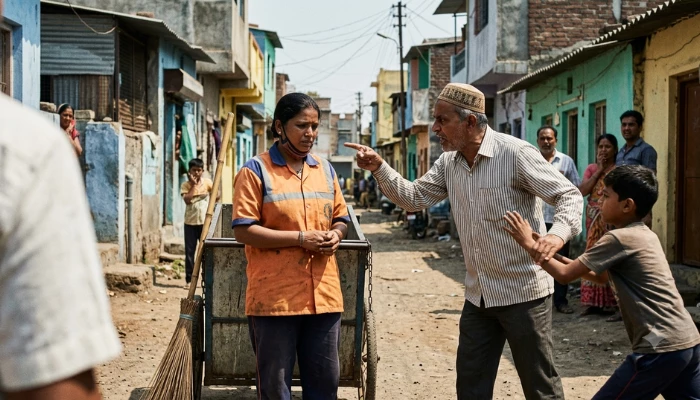
Case Summary
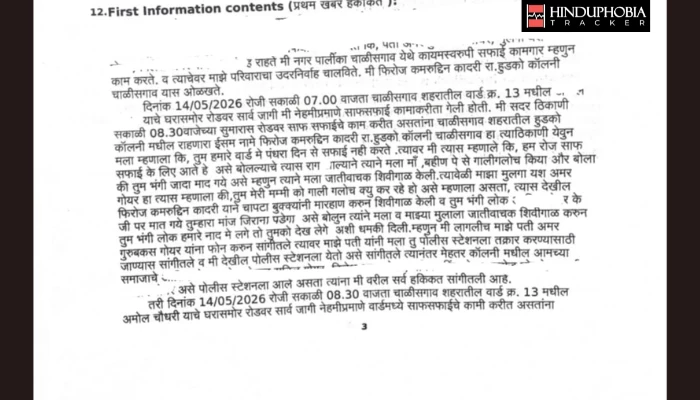
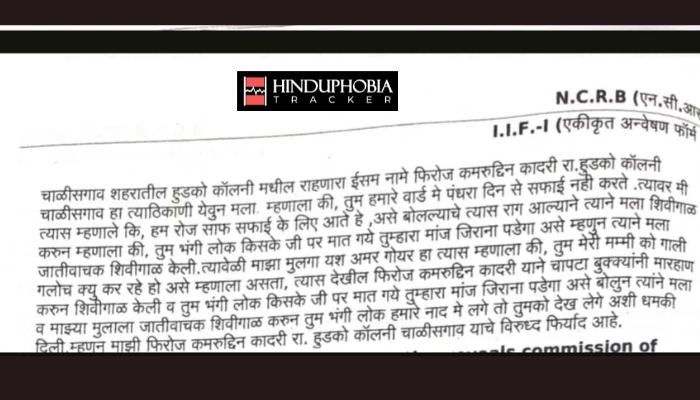
In Chalisgaon, Jalgaon district of Maharashtra, a Hindu Valmiki sanitation worker was subjected to caste-based abuse, threats, and physical assault by a Muslim man while carrying out municipal cleaning work on 14 May 2026. According to the FIR, the victim worked as a contractual sanitation worker with the Chalisgaon Municipal Council and was assigned cleaning duties in Ward No. 13 near the residence of Amol Chaudhary. At around 8:30 a.m., while she was sweeping the road as part of her regular duties, Firoz Kamruddin Kadri, a resident of Indko Colony, approached her and objected to the cleaning work. He told her that their ward had not been cleaned properly for fifteen days. When the woman replied that sanitation workers visited daily for cleaning duties, the accused became aggressive and began verbally abusing her. As per the FIR, Firoz Kamruddin Kadri hurled casteist slurs at the woman and insulted her based on her Valmiki identity. He told her, “तुम भंगी लोग किसके जी पर मात गये, तुम्हारा मांज जिराना पडेगा,” (You Bhangi people are riding high on whose backing? Your pride/arrogance needs to be stripped down). He further abused and humiliated her publicly, using derogatory caste-based language. During the confrontation, the victim’s son, Yash Amar Goyar, intervened after seeing his mother being abused. According to the complaint, when he objected to the accused insulting his mother, Firoz Kamruddin Kadri assaulted him by slapping and beating him. The FIR further stated that the accused continued issuing threats and warned the family that “भंगी लोग हमारे नाद मे लगे तो तुमको देख लेंगे,” implying that if people from their community interfered with them, they would face consequences. Following the assault and threats, the victim informed her husband, Amar Purushottam Goyar, over the phone. Her husband advised her to approach the police station and file a complaint. The victim subsequently reached the police station and narrated the entire sequence of events before the authorities.
Case Images
Why it is Hate Crime ?
This case has been added to the tracker under the primary category - Attack resulting in death. Within this, the subcategory selected for this case is "Attacked for Hindu identity". In several cases, Hindus are attacked merely for their Hindu identity without any perceived provocation. A classic example of this category of religiously motivated hate crime is a murder in 2016. 7 ISIS terrorists were convicted for shooting a school principal in Kanpur because they got ‘triggered’ seeing the Kalava on his wrist and the tilak that he had put. In this, the Hindu victim had offered no provocation except for his Hindu religious identity. The motivation for the murder was purely religious, driven by religious supremacy. Such cases where Hindus are targeted merely for their religious identity would be documented as a hate crime. Under this category, cases where the attack led to the death of the Hindu victim/s would be documented. The other selected subcategory is "Attacked for opposing radicals or trying to save a victim." In several cases, Hindus are attacked for opposing religiously motivated crimes being committed against a fellow Hindu or simply for voicing an opinion opposing radical elements, who either have in the past or continue to persecute Hindus. In such cases, the initial attack against the victim, against which the Hindu was trying to defend the victim, would also need to be classified as a religiously motivated hate crime. Since the initial crime itself was religiously motivated and the subsequent crime of attempting to save the victim or speaking against the radical elements ends up inviting a violent attack, it would also be classified as a religiously motivated hate crime under this category. Another primary category selected is- Hate speech against Hindus. The selected subcategory is - Anti-Hindu slurs, mocking faith. Anti-Hindu slurs and the deliberate mocking of the Hindu faith owing to religious animosity involve the usage of derogatory terms, stereotypes, or offensive references to religious practices, symbols, or figures. One of the common anti-Hindu slurs used against Hindus is “cow-worshipper” and “cow piss drinker”. The intention of using this term is to demean and mock Hindus as a group and their religious beliefs since Hindus consider the cow holy. Additionally, some symbols and the slurs attached to them have a historical context that exacerbates the insult, hate, stereotyping, dehumanisation and oppression against Hindus. Cow worship has been used for centuries to denigrate Hindus, insult their faith and oppress Hindus specifically as a religious group. There has been overwhelming documentation about how cow slaughter has been used to persecute Hindus, with cow meat being thrown in temples and places of worship. There has also been overwhelming documentation where cow meat (beef) has been force-fed to Hindus to either forcefully convert them to Islam or denigrate their faith. Apart from cow worship, the Swastika – which holds deep religious significance for the Hindus – has also been misinterpreted and distorted to use as a slur against Hindus. Similarly, the worship of the Shivling has been used by supremacist ideologies and religions to denigrate Hindus owing to religious animosity. Such slurs and denigration stem from inherent animosity and hate towards Hindus and their faith; therefore, it is categorised as hate speech targeted at Hindus specifically owing to their religious identity. This case has been added to the tracker because the attack went beyond an ordinary altercation and reflected targeted hostility towards a Hindu Valmiki woman and her family while she was performing her civic duties. The victim was not engaged in any confrontation or unlawful act. She was carrying out municipal sanitation work assigned to her when the accused singled her out, publicly humiliated her, and abused her using caste-specific slurs intended to degrade her identity and social standing. The attack was directed at her identity as a Hindu Valmiki woman, making the targeting identity-based rather than incidental. The abuse used in this incident was not generic anger or routine verbal aggression. The accused specifically used the expression “भंगी लोग” in a demeaning and threatening manner to humiliate the victim based on her caste identity. Such language has historically been used to degrade Dalit Hindu communities engaged in sanitation work and carries deep social hostility and stigma. The statement that their “arrogance needed to be stripped down” conveyed an assertion of dominance and an attempt to intimidate and socially subordinate the victim because of her identity. Here, it can be argued that the caste-specific slurs used against the victim were aimed at her micro identity as a member of the Valmiki community and not at her Hindu identity specifically. However, as far as Abrahamic religious hostility towards Hindus is concerned, the micro identities of caste, region, and language often become secondary, while the religious identity of the Hindu victim remains central to the animosity. In this case, the Hindu Valmiki sanitation worker was publicly abused and humiliated by the accused while performing her civic duties, and the casteist insults were used as a means to degrade and intimidate her as a vulnerable Hindu woman. The expression “भंगी लोग” was not used in a neutral or incidental manner but as a targeted insult rooted in contempt and social hostility. Further, when the victim’s son attempted to protect his mother from the abuse and intimidation, he too was violently assaulted by the accused. This demonstrated that the hostility extended beyond a verbal altercation and turned into targeted violence against a Hindu family that resisted humiliation. Therefore, while the immediate abuse took the form of casteist slurs, the animosity and intimidation involved in the incident were intrinsically tied to hostility towards the Hindu identity of the victims. Moreover, the victim’s son intervened only after witnessing his mother being publicly abused, humiliated, and threatened based on her caste identity while she was carrying out sanitation work. Rather than stopping the confrontation, the accused escalated the violence and physically assaulted the son as well. The attack on him occurred solely because he attempted to protect his mother from the ongoing abuse and intimidation. This showed that even a basic attempt to defend a vulnerable Hindu family member from public humiliation invited further violence and threats from the accused. Additionally, the threats issued during the altercation strengthened the targeted and intimidating nature of the incident. The accused warned the family that if people from their community interfered, they would “see the consequences.” Such statements were designed to instil fear not only in the immediate victims but also within the wider Valmiki Hindu community. The incident, therefore, carried a broader message of intimidation aimed at a socially vulnerable Hindu group already exposed to discrimination and insecurity. Taken together, the public humiliation, caste-targeted abuse, violent assault, and threats against both the sanitation worker and her son demonstrated a pattern of identity-based hostility directed at vulnerable Hindus. The incident was not a spontaneous disagreement over civic work but an act of intimidation and violence rooted in contempt for the victims’ identity, thereby warranting inclusion in the Hinduphobia Tracker. Disclaimer: The Hinduphobia Tracker records incident dates based on when the victim's ordeal began, rather than when the media reported it. Thus, 14 May 2026 has been chosen as the date of the incident, as per the FIR report.
Victim Details
Total Victim
2
Deceased
0
Gender
- Male 1
- Female 1
- Third Gender 0
- Unknown 0
Caste
- SC/ST 2
- OBC 0
- General 0
- Unknown 0
Age Group
- Minor 0
- Adult 1
- Senior Citizen 0
- Unknown 1


Case Status
Complaint filed


Perpetrators Details
Perpetrators
Muslim Extremists
Perpetrators Range
One Person
Perpetrators Gender
male
 Sources




