Dalit Hindu woman raped and threatened with death after refusing Muslim man's demands to convert to Islam and conduct nikah
 Muzaffarnagar, Uttar Pradesh, India
  13 May, 2025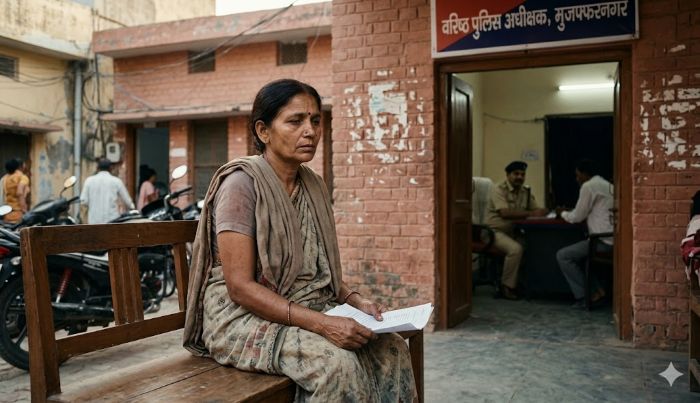
Case Summary
In Muzaffarnagar, Uttar Pradesh, a Dalit Hindu woman was lured with the assurance of getting her work, raped at gunpoint, subjected to sustained conversion pressure, threatened with death, and humiliated with casteist slurs by Firoz, a Muslim man from Nirana village, Sikheda police station area. When the victim, who earned her living through domestic cleaning work, sought justice at the local police station, her complaint was ignored. Justice came only after she approached the Senior Superintendent of Police [SSP] directly. As per the details, Firoz had met the victim several years ago and had harboured wrong intentions toward her from the beginning. Approximately one year before the complaint, he lured her to Roorkee, Uttarakhand, under the pretext of getting her a job. There, he introduced her to an unknown person and subjected her to heavy pressure to convert from Hinduism to Islam and conduct a nikah [Islamic marriage ceremony]. When she strongly resisted, Firoz brought her back to Muzaffarnagar. In the Khalapaar new settlement area of the Kotwali zone, Firoz held her hostage and raped her at the point of an illegal pistol. Following the rape, he threatened to kill her, her husband, and her entire family. Out of fear and social shame, the victim remained silent, which further emboldened Firoz. He continued to pressure her to convert and conduct nikah, and upon her refusal, issued repeated threats to her life, property, and honour. Throughout this period, he subjected her to continuous casteist slurs, inflicting sustained mental and social humiliation. The victim first approached the Kotwali police station, but her complaint was not taken seriously, and no action was taken. She subsequently submitted a prayer letter directly to the SSP on 14 May 2026. The SSP immediately directed the Kotwali in charge to take necessary legal action. An FIR [First Information Report] was registered against Firoz on 17 May 2026 under relevant sections. SI Sonu Kumar was appointed as the investigating officer. Police stated that further action would be taken based on forensic evidence, witness statements, and technical investigation. The victim was given full assurance of security by the police.
Why it is Hate Crime ?
The primary category for this case is "Predatory Proselytisation". The sub-category for this case is "Conversion/attempts to convert by inducement. Predatory Proselytisation is not just limited to threat, harassment, force and violence, but it also has contours of stealth. In several cases, the Hindu victim is exploited to convert, with non-Hindus taking advantage of their poverty. In such cases, the Hindu victim who is suffering financially is offered monetary benefits, including lucrative offers for jobs, health treatment, education, etc, to induce the victim into changing his/her religion. In such cases, the religious identity of the victim and the aim to disenfranchise him from his faith form the heart of the crime. Also, taking advantage of and exploiting an individual’s economic vulnerabilities is widely acknowledged as exploitation, forms of which are often penalised by law. Such cases therefore are considered religiously motivated hate crimes since the victim’s religious identity forms the very heart of the crime itself. The other subcategory selected is- "Harassment, threats, coercion for conversion". Harassment covers a wide range of behaviours of an offensive nature. It is commonly understood as behaviour that demeans, humiliates, and intimidates a person, including threats and coercion. Harassment and threats, in this case, find their root on discriminatory grounds which has the effect of nullifying a person’s rights or infringing upon his freedom to exercise his right specifically owing to the victim’s religious identity. Verbal and physical threats and psychological or physical harassment are often used against Hindu victims because they choose to practice their professed religion. Religious harassment also includes forced and involuntary conversions by harassment, threats or coercion. Coercion includes intimidatory tactics like force-feeding a Hindu victim beef to convert to another religion, forceful circumcision etc. In several cases documented, non-Hindu perpetrators or those who harbour specific animosity towards Hinduism, harass victims simply based on their religious identity. Such cases often also include harassment to ensure the Hindu victim abandons his/her professed religion and adopts the religion of the perpetrator. Such cases, where Hindu victims are harassed to convert to the perpetrator’s religion, are rooted in animosity towards the victim’s religious identity and are therefore documented as religiously motivated hate crimes. Another sub-category for this case is "Proselytisation by grooming, brainwashing, manipulation or subtle indoctrination". The tertiary category for this case is "Rape and sexual assault/harassment". Religious brainwashing essentially means the often subtle and forcible indoctrination to induce someone to give up their religious beliefs to accept contrasting regimented ideas. Religious grooming or brainwashing also involves propaganda and manipulation. It involves the systematic effort, driven by religious malice and indoctrination, to persuade “non-believers’ to accept allegiance, command, or doctrine to and of a contrasting faith. Cases of such grooming or brainwashing are far more nuanced than direct threats, coercion, inducement and violence. In such cases, it is often seen that there is repeated, subtle and continual manipulation of the victim to induce disaffection towards their own faith and acceptance of the contrasting faith of the perpetrator. While subtle indoctrination is widely acknowledged as predatory, an element which is often understated in such conversions or the attempts of such conversion is the role of loyalty and trust which might develop between the perpetrator and the victim. Fiduciary relationships are often abused to affect such religious conversion. For example, an educator transmitting religious doctrine of a competing faith to a Hindu student. The Hindu student is likely to accept what the teacher is transmitting owing to existence of the fiduciary relationship. The exploitation of the fiduciary relationship to religiously indoctrinate victims would also be included in this category. Since the underlying animosity towards the victim’s faith forms the basis of predatory proselytisation, such cases are considered religiously motivated hate crimes. The other primary category within which this case has been added is- Hate speech against Hindus. Within this, the subcategory selected is- Anti-Hindu slurs, mocking faith. Anti-Hindu slurs and the deliberate mocking of the Hindu faith owing to religious animosity involve the usage of derogatory terms, stereotypes, or offensive references to religious practices, symbols, or figures. One of the common anti-Hindu slurs used against Hindus is “cow-worshipper” and “cow piss drinker”. The intention of using this term is to demean and mock Hindus as a group and their religious beliefs since Hindus consider the cow holy. Additionally, some symbols and the slurs attached to them have a historical context that exacerbates the insult, hate, stereotyping, dehumanisation and oppression against Hindus. Cow worship has been used for centuries to denigrate Hindus, insult their faith and oppress Hindus specifically as a religious group. There has been overwhelming documentation about how cow slaughter has been used to persecute Hindus with cow meat being thrown in temples and places of worship. There has also been overwhelming documentation where cow meat (beef) has been force-fed to Hindus to either forcefully convert them to Islam or denigrate their faith. Apart from cow worship, the Swastika – which holds deep religious significance for the Hindus – has also been misinterpreted and distorted to use as a slur against Hindus. Similarly, the worship of the Shivling has been used by supremacist ideologies and religions to denigrate Hindus owing to religious animosity. Such slurs and denigration stem out of inherent animosity and hate towards Hindus and their faith, therefore, it is categorised as hate speech targeted at Hindus specifically owing to their religious identity. The case carries clear religious markers because the Hindu Dalit woman was first lured under the false pretext of employment and then subjected to sustained pressure to convert to Islam and undergo nikah. She was also subjected to caste-based abuse, adding another layer to the religious angle of the crime. The use of inducement in the form of promised work to isolate and manipulate a vulnerable Hindu woman demonstrates a pattern of predatory proselytisation, where economic vulnerability and trust are exploited to facilitate religious coercion. The next religious marker in this case was the sustained pressure exerted on the victim to abandon Hinduism and accept Islam. According to the complaint, after taking her to Roorkee on the assurance of arranging work, Firoz introduced her to individuals who pressured her to convert and undergo nikah. The pressure did not end after she resisted. Instead, the accused continued threatening, intimidating, and coercing her over a prolonged period in an attempt to force religious submission. This demonstrates that the objective was not merely personal exploitation, but also the erosion and replacement of the victim’s Hindu religious identity. The violence and threats became instruments of religious coercion. The victim was raped at gunpoint, held hostage, and repeatedly threatened with death along with her family if she refused to comply. Such acts created an atmosphere of fear in which the victim’s safety, dignity, and survival were tied to pressure to abandon her faith. Religious conversion obtained through intimidation, sexual violence, confinement, or threats cannot be viewed as voluntary because the victim’s ability to exercise free choice is destroyed through terror and coercion. The caste-based abuse directed at the Hindu Dalit woman further strengthened the religiously motivated nature of the targeting. The accused repeatedly humiliated the victim using caste slurs while simultaneously pressuring her to abandon Hinduism and accept Islam. While caste abuse may appear directed at the victim’s caste identity specifically, caste itself exists within the broader framework of Hindu identity and social belonging. In this case, the caste humiliation formed part of the wider pattern of domination and degradation directed at the victim as a Hindu Dalit woman. The abuse reflected contempt not only towards her social background but also towards the religious identity and community she represented. The path the accused took further demonstrates that the conduct was not motivated by a genuine relationship or voluntary companionship. The victim was deceived through false assurances of work, removed from familiar surroundings, subjected to conversion pressure, sexually assaulted, and then threatened into silence. The progression from inducement to coercion and violence reflects a deliberate pattern of exploitation aimed at overpowering the victim physically, emotionally, and religiously. Taken together, the inducement through false promises of work, sustained conversion pressure, threats of violence, sexual assault, caste-based abuse, and intimidation directed at the victim because she refused to abandon her Hindu faith demonstrate a clear pattern of religiously motivated targeting. The case, therefore, carried strong markers of coercive religious conversion, identity-based humiliation, and hostility towards the victim’s Hindu faith and social identity. Disclaimer: The exact date of when the Hindu victim and the Muslim perpetrator first came into contact was not specified in the available sources. However, this case involved a sustained course of conduct spanning approximately one year, beginning with the luring of the victim to Roorkee and the rape, which occurred approximately one year prior to the complaint. The tracker records incident dates based on when the crime occurred, not when it was reported or published. In this case, therefore, 14th May 2025 has been used as the indicative incident date, derived by aligning the known year with 14 May, the date on which the victim filed a complaint with the SSP, since this is the earliest available reference date. This date has been recorded for documentation purposes only.
Victim Details
Total Victim
1
Deceased
0
Gender
- Male 0
- Female 1
- Third Gender 0
- Unknown 0
Caste
- SC/ST 1
- OBC 0
- General 0
- Unknown 0
Age Group
- Minor 0
- Adult 1
- Senior Citizen 0
- Unknown 0


Case Status
Complaint registered


Perpetrators Details
Perpetrators
Muslim Extremists
Perpetrators Range
From 2 To 5
Perpetrators Gender
male
 Sources




