Hindu temple caves in Karnataka desecrated as Muslim woman wears footwear inside sacred complex
 Bagalkot, Karnataka, India
  19 May, 2026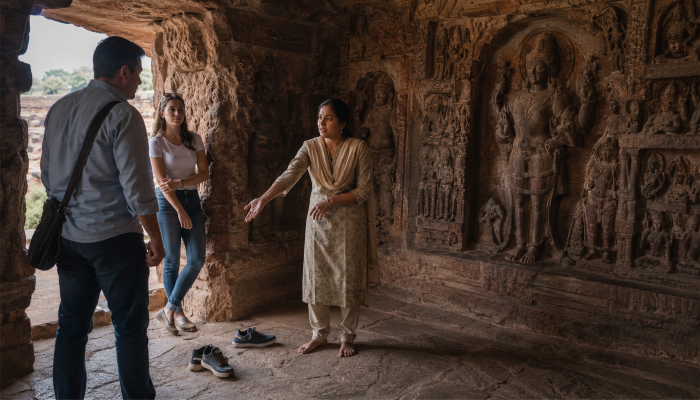
Case Summary
A controversy erupted at Karnataka’s Badami Cave Temples after a Muslim staff member was seen entering the sacred temple premises wearing footwear, triggering outrage among Hindu devotees who viewed the act as disrespectful towards Hindu religious customs and temple sanctity. A video of the incident went viral on social media, showing a female tourist confronting the staff member, identified as Roshani Mustafi, over the issue. The tourist questioned why footwear was worn inside a Hindu temple complex, pointing out that devotees are expected to remove their footwear before entering sacred religious spaces out of reverence and adherence to purity norms deeply rooted in Hindu tradition. During the exchange, the tourist challenged whether being a staff member gave anyone the right to disregard temple customs. She further remarked that people would never consider entering a dargah wearing footwear, questioning why Hindu religious sensitivities were being treated differently. The confrontation reflected a broader sentiment among many Hindus that basic norms of respect associated with Hindu places of worship are often ignored, trivialised, or inconsistently enforced. The Badami Cave Temples are not merely archaeological structures but sacred spaces dedicated to Hindu deities and Jain Tirthankaras, with deep civilisational and religious significance for devotees. In Hindu tradition, removing footwear before entering temple premises symbolises humility, purity, and reverence before the divine. Wearing footwear inside such sacred areas is widely considered disrespectful because shoes are associated with impurity in Hindu religious practice. Following the incident, some social media users attempted to justify the act by arguing that the cave temples are protected heritage monuments under the Archaeological Survey of India (ASI) and are not “functional temples.” However, many Hindus rejected this distinction, asserting that even if a site is protected as a heritage monument, its religious sanctity and sacred character do not cease to exist. For devotees, the Badami Cave Temples remain living symbols of Hindu faith, history, and worship, and are therefore deserving of the same respect accorded to other Hindu religious spaces.
Why it is Hate Crime ?
The primary category for this case is "Attack on Hindu religious representations". The sub-category for this case is "Breaking rules of place of worship". Sanatan Dharma is not a religion of one book, which is to say that while it has religious scriptures that form the central tenets of the faith, there are several traditions followed through thousands of years, mostly passed from generation to generation orally. One of these oral traditions or written traditions is the rules of specific temples. Certain temples have rules which are traditional rules, dependent on the worship of the presiding deities. These rules and traditions have been followed for thousands of years whether they find scriptural mention or not. Such traditions are based on the nature and rules of worship of the presiding deity of that temple. Any non-compliance of these traditions owing to animosity towards the faith or for the sake of activism stems not only from the lack of faith in the presiding deity but also disregard for the faith of the devotees of that deity/temple and implicit bias against the faith, the tradition and the deity itself. Since these specific traditions are central to the faith of the devotees of that specific temple and presiding deity, any non-compliance with these traditional rules would be considered a religiously motivated hate crime. Another sub-category for this case is "Defiling religious customs". Sanatan Dharma is not a religion of one book, which is to say that while it has religious scriptures that form the central tenets of the faith, there are several traditions followed through thousands of years, mostly passed from generation to generation orally. There are several such customs and traditions that are followed by various Hindus and Hindu sects. Defiling of these traditions and customs is a breach of an individual or group’s religious practices. Such practices can range from dietary restrictions like not eating non-vegetarian food for a certain period of the year, not eating non-vegetarian food at all, not eating beef since the cow is considered holy in Hinduism, the sanctity of religious customs followed in the house (like many ISCKON devotees), etc. Any malicious action leading to the breach of such traditions or defilement of these traditions owing to animosity towards the faith or for the sake of activism stems not only from the lack of faith in the religion itself but also from disregard for the faith of the devotees who follow the customs/traditions and implicit bias against the faith, the tradition itself. Since these specific traditions are central to the faith of the devotees of that specific sect of Hindus, any non-compliance with these traditional rules would be considered a religiously motivated hate crime. The incident carries clear religious markers because it involved the violation of long-established Hindu norms of reverence and purity within a sacred Hindu temple space. The Badami Cave Temples are not merely tourist monuments or archaeological structures. They are sacred sites dedicated to Hindu deities and remain deeply significant to Hindu devotees as living symbols of worship, faith, and civilisational heritage. Entering such spaces wearing footwear is widely regarded in Hindu tradition as disrespectful because footwear is associated with impurity and is removed as a mark of humility and devotion before the divine. A key religious marker in this case was the blatant disregard shown towards Hindu religious customs after the act was questioned. The Hindu tourist objected specifically because Hindu tradition requires removing footwear before entering sacred temple premises. Instead of acknowledging or respecting this sentiment, the response reportedly suggested that no one had the “right to make rules,” reflecting open dismissal of the customs and sensitivities associated with a Hindu place of worship. This was not merely a disagreement over site protocol, but a rejection of the expectation that Hindu religious practices deserve respect within a Hindu sacred space. The conduct also reflected a broader pattern in which Hindu religious sensitivities are often trivialised or treated casually in ways that would likely be considered unacceptable in relation to other religious communities. The tourist’s comparison with entering a dargah wearing footwear highlighted this perceived double standard. For Hindu devotees, the refusal to follow even the most basic norm of temple reverence inside a sacred Hindu shrine amounted to blatant disrespect towards the Hindu faith and the sanctity attached to temple spaces. Another significant religious marker was the subsequent attempt to justify the conduct by arguing that the Badami Cave Temples are “non-functional” or merely ASI-protected heritage structures. For Hindu devotees, the sacred character of a temple does not disappear simply because the site is historically protected or visited by tourists. Ancient cave shrines and deity spaces continue to hold spiritual sanctity irrespective of administrative classification. Reducing sacred Hindu spaces to “just monuments” strips them of their living religious significance and diminishes the devotional relationship Hindus continue to maintain with such sites. Taken together, the entry into a sacred Hindu temple space while wearing footwear, the dismissal of objections raised by Hindu devotees, and the subsequent attempts to trivialise the site's sanctity reflected a broader disregard for Hindu religious customs and devotional sentiments. Such acts reflect a profound disregard for the faith and its practices, stemming from underlying animosity toward Hinduism. This incident exemplifies an intentional effort to insult religious sentiments, warranting its inclusion as a serious offence motivated by hatred. Disclaimer: The Hinduphobia Tracker records incident dates based on when the crime occurred, not when it was reported or published. The exact date of the incident was not confirmed in the source. 19 May 2026 has been used as the primary incident date, derived from the source's publication date. This was recorded for documentation purposes only.


Case Status
Unknown


Perpetrators Details
Perpetrators
Muslim Extremists
Perpetrators Range
One Person
Perpetrators Gender
female
 Sources




