Hindu transgenders tortured, forced to drink urine and convert to Islam by Muslim transgenders in Fatehabad, Haryana
 Fatehabad, Haryana, India
  17 May, 2026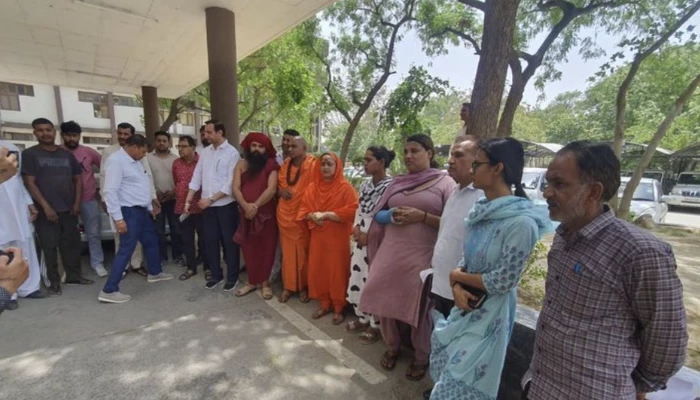
Case Summary
In Fatehabad district of Haryana, members of the Mangalmukhi community were brutally tortured by the Muslim members of the community to convert to Islam. The victims also accused the perpetrators of physical assault and inhuman treatment during the dispute. The incident came to light when members of the Mangalmukhi, a group led by Satyam Deva, who runs the Chandi Devi Temple on Barsin Road, approached the Superintendent of Police’s office and submitted a complaint. The complaint was against Pradeep alias Shashi Mahant and her associates. The complainants stated that Shashi Mahant had converted to Islam and was continuously pressuring other members of the Mangalmukhi community to undergo religious conversion as well. They further stated that this was not merely a territorial dispute over the collection of ceremonial offerings but had become a matter of religion. The complainants stated that threats were issued that if they did not convert, the accused would illegally acquire the Chandi Devi Temple, construct a mosque there, and ensure that the victims could no longer live in Fatehabad. One victim, identified as Golu Bhakt, stated that he, along with his guru, was confined in a room and brutally assaulted by five to six men called by Shashi Mahant. He further stated that he was attacked with a pointed ice-breaking tool and subjected to inhuman treatment, including being forced to drink urine. Satyam Deva warned the administration that if action was not taken against the accused, they would be compelled to resort to self-immolation. Meanwhile, supporters of Shashi Mahant from Sirsa and Hansi denied the charges.
Why it is Hate Crime ?
The primary category selected in this case is Predatory Proselytisation. The sub-category selected is: Harassment, threats, coercion for conversion. Harassment covers a wide range of behaviours of an offensive nature. It is commonly understood as behaviour that demeans, humiliates, and intimidates a person, including threats and coercion. Harassment and threats, in this case, find their root on discriminatory grounds, which has the effect of nullifying a person’s rights or infringing upon his freedom to exercise his right specifically owing to the victim’s religious identity. Verbal and physical threats and psychological or physical harassment are often used against Hindu victims because they choose to practice their professed religion. Religious harassment also includes forced and involuntary conversions by harassment, threats or coercion. Coercion includes intimidatory tactics like force-feeding a Hindu victim beef to convert to another religion, forceful circumcision, etc. In several cases documented, non-Hindu perpetrators or those who harbour specific animosity towards Hinduism, harass victims simply based on their religious identity. Such cases often also include harassment to ensure the Hindu victim abandons his/her professed religion and adopts the religion of the perpetrator. Such cases, where Hindu victims are harassed to convert to the perpetrator’s religion, are rooted in animosity towards the victim’s religious identity and are therefore documented as religiously motivated hate crimes. The other primary category included in this case is: Attack not resulting in death. The sub-category is: Attacked for refusal to convert. When there is pressure, threat or coercion employed upon the Hindu victim to convert to a different religion, in several cases, the victim refuses to succumb to the pressure/threats. Once the victim refuses, the perpetrator proceeds to attack/assault the victim owing to his/her refusal to convert. In such cases, the pressure/threat/intimidation/coercion/violence itself is driven by animosity towards the victim’s Hindu faith. The violence, then, is another hate crime driven by the victim’s refusal to abandon his professed faith, Hinduism, and convert to the religion of a non-Hindu perpetrator. Since the victim’s faith is at the heart of the pressure to convert and the ensuing violence towards the victim, such cases are considered religiously motivated hate crimes. This case carries clear religious markers because the Hindu victims were subjected to intimidation, threats, and violence in connection with pressure to convert to Islam. The actions described by the victims were not isolated acts of personal hostility or ordinary community tensions. The coercion was directly tied to forcing vulnerable Hindus to abandon their religious identity and accept another faith through fear, humiliation, and sustained intimidation. A key religious marker in this case was the use of threats and violence to compel religious conformity. The victims were made to fear that refusal to convert would result in assault, social displacement, and continued targeting. Such conduct specifically attacked the victims’ right to continue practising and identifying as Hindus freely and safely. Conversion obtained through fear, confinement, degradation, or physical violence cannot be considered voluntary because the victim’s consent is overwhelmed by intimidation and coercive pressure. Another significant religious marker was the targeting of Hindu religious space itself. The accused threatened that if the victims refused to convert, their place of worship would be illegally taken over and replaced with a mosque, and the victims would no longer be allowed to live in the area. Threats aimed at seizing or transforming a Hindu religious space carry deep religious significance because temples and places of worship are not merely physical structures for devotees. They are centres of faith, identity, and communal continuity. Threatening to erase or replace such spaces directly attacks the religious security of the Hindu community connected to them. The vulnerability of the victims also played an important role in the coercion. The accused exploited the victims’ social and economic vulnerability to create dependence, fear, and helplessness. Such conduct reflects predatory proselytisation, where intimidation and power imbalance are weaponised to weaken attachment to one’s existing faith and force religious submission. The overall pattern of threats, humiliation, religious pressure, and violence demonstrated hostility directed specifically at the victims because they were Hindu and refused to abandon their faith. The objective was not merely to intimidate individuals personally, but to break resistance and reshape their religious identity through coercive means. Since the acts sought to suppress Hindu religious identity and impose religious conformity through fear and violence, the case has been documented as a religiously motivated hate crime. Disclaimer: Media reports stated that multiple Hindu victims were targeted by Muslim perpetrators. However, the exact number of victims was not specified. Only two victims were mentioned in the report, Bhola and Satyam Deva. Therefore, the victim count has been recorded as two (2). This remains a conservative estimate, as the actual number of victims could be higher. The Hinduphobia Tracker records incident dates based on when the victim’s ordeal began, rather than when the media reported the incident. In this case, the reports did not mention when the victims’ ordeal began. Therefore, 18 May 2026, the date of publication of the report, has been selected as the indicative incident date. This date is being recorded strictly for documentation purposes only.
Victim Details
Total Victim
2
Deceased
0
Gender
- Male 0
- Female 0
- Third Gender 2
- Unknown 0
Caste
- SC/ST 0
- OBC 0
- General 0
- Unknown 2
Age Group
- Minor 0
- Adult 2
- Senior Citizen 0
- Unknown 0


Case Status
Complaint filed


Perpetrators Details
Perpetrators
Muslim Extremists
Perpetrators Range
One Person
Perpetrators Gender
male
 Sources




