Dalit Hindu women threatened, forced to wear burqas and recite Islamic verses at swordpoint by Muslim men in Bidar, Karnataka
 Bidar, Karnataka, India
  13 May, 2026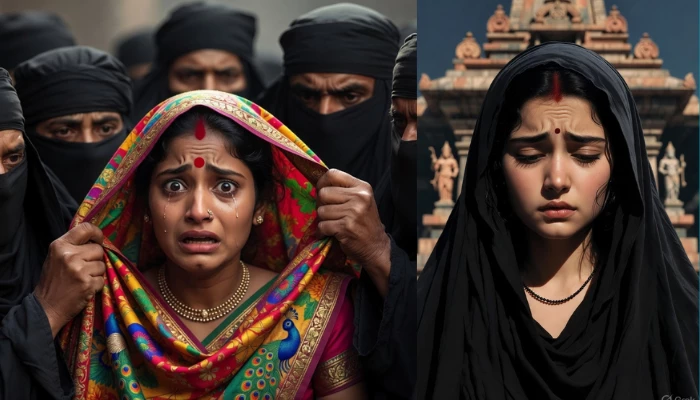
Case Summary
In the Chitaguppa taluk of Bidar district in Karnataka, Dalit Hindu women were threatened by a group of Muslim men and were forced to wear burqas. The victims were also coerced into reciting Islamic verses under threats of murder if they refused to comply. According to media reports, the incident occurred in Govind Tanda in Chitaguppa taluk, within the Bidar South constituency. A group of Muslim men threatened local Hindu residents and forced Hindu women to wear burkhas and recite Islamic verses. During an interaction with Karnataka minister and Bharatiya Janata Party leader R. Ashoka, one of the victims stated that the accused threatened Hindu women, forcibly made them wear burqas, and compelled them to recite religious verses associated with Islam. The victim further stated that the accused warned they would murder her if she refused to comply with their demands. The woman described the ordeal as one involving fear, coercion and intimidation. The matter gained wider attention after a video of the victims narrating the incident circulated on social media. In the videos, the victims recounted that the accused arrived carrying swords, issued threats to their lives, and forced them into religious acts against their will. Following the incident, Bharatiya Janata Party leaders demanded strict action against the accused. R. Ashoka, a BJP politician, publicly condemned the incident and called upon the Karnataka government and police authorities to take stringent legal action against those involved. In a post on X on 14 May 2026, R. Ashoka said: “Outrage by Muslim fanatics is increasing in the state. Such incidents are happening because the Congress government is encouraging appeasement politics instead of taking strict action against radical forces that threaten social harmony." He further stated that the incident in Bidar was serious and should not be treated lightly by the authorities. “Threatening innocent people with weapons and attempting to impose religious practices through fear and intimidation is completely unacceptable in a democratic society,” he said. Ashoka urged the Karnataka government and the police department to immediately arrest those involved and ensure that stringent legal action is initiated. “The government must act without delay. Those responsible should be arrested and put behind bars. The police must conduct a fair and transparent investigation and ensure that law and order are maintained in the region,” he added. The BJP leader also accused the Congress government of remaining silent whenever incidents involving radical Islamic groups surface. According to him, failure to take timely action could further disturb communal harmony in sensitive areas. “The government should stand with law-abiding citizens and not with those trying to create fear in society. Any attempt to disturb peace in the name of religion must be crushed firmly,” Ashoka said. Reports also confirmed that the police began an investigation into the incident. Police sources stated that the authorities were assessing whether there had been any organised attempt to provoke communal tension in the area.
Why it is Hate Crime ?
This case has been added to the tracker under the primary category- Predatory Proselytisation. Within this, the subcategory selected is- Harassment, threats, coercion for conversion. Harassment covers a wide range of behaviours of an offensive nature. It is commonly understood as behaviour that demeans, humiliates, and intimidates a person, including threats and coercion. Harassment and threats, in this case, find their root on discriminatory grounds, which has the effect of nullifying a person’s rights or infringing upon his freedom to exercise his right specifically owing to the victim’s religious identity. Verbal and physical threats and psychological or physical harassment are often used against Hindu victims because they choose to practice their professed religion. Religious harassment also includes forced and involuntary conversions by harassment, threats or coercion. Coercion includes intimidatory tactics like force-feeding a Hindu victim beef to convert to another religion, forceful circumcision, etc. In several cases documented, non-Hindu perpetrators or those who harbour specific animosity towards Hinduism, harass victims simply based on their religious identity. Such cases often also include harassment to ensure the Hindu victim abandons his/her professed religion and adopts the religion of the perpetrator. Such cases, where Hindu victims are harassed to convert to the perpetrator’s religion, are rooted in animosity towards the victim’s religious identity and are therefore documented as religiously motivated hate crimes. The other subcategory selected is- Proselytisation by grooming, brainwashing, manipulation or subtle indoctrination. Religious brainwashing essentially means the often subtle and forcible indoctrination to induce someone to give up their religious beliefs to accept contrasting, regimented ideas. Religious grooming or brainwashing also involves propaganda and manipulation. It involves the systematic effort, driven by religious malice and indoctrination, to persuade “non-believers’ to accept allegiance, command, or doctrine to and of a contrasting faith. Cases of such grooming or brainwashing are far more nuanced than direct threats, coercion, inducement and violence. In such cases, it is often seen that there is repeated, subtle and continual manipulation of the victim to induce disaffection towards their own faith and acceptance of the contrasting faith of the perpetrator. While subtle indoctrination is widely acknowledged as predatory, an element which is often understated in such conversions or the attempts of such conversion is the role of loyalty and trust which might develop between the perpetrator and the victim. Fiduciary relationships are often abused to affect such religious conversion. For example, an educator transmitting religious doctrine of a competing faith to a Hindu student. The Hindu student is likely to accept what the teacher is transmitting owing to the existence of the fiduciary relationship. The exploitation of the fiduciary relationship to religiously indoctrinate victims would also be included in this category. Since the underlying animosity towards the victim’s faith forms the basis of predatory proselytisation, such cases are considered religiously motivated hate crimes. In this case, Dalit Hindu women were threatened at swordpoint by Muslim men, forcibly made to wear burqas and compelled to recite Islamic verses against their will. The victims were threatened with murder if they refused to comply. The nature of the acts committed against the women makes this a clear case of a religiously motivated hate crime rooted in hostility towards the victims because of their Hindu religious identity. The perpetrators did not merely intimidate or harass the victims. They specifically targeted them as Hindu women and attempted to force Islamic practices upon them through fear, coercion and violence. The deliberate targeting of Hindu women for the purpose of imposing Islamic customs and religious expressions upon them demonstrates deep-seated religious animosity and amounts to a Hinduphobic hate crime. The act of forcibly threatening the victims into wearing burqas was not simply the imposition of a piece of clothing. The burqa is an Islamic attire traditionally worn by Muslim women in accordance with Islamic religious practices. Forcing Hindu women to wear a religious attire associated with Islam demonstrates an attempt to impose Islamic norms, dress codes and lifestyle practices upon individuals who do not belong to that faith. Such coercion amounts to far more than humiliation or intimidation. It reflects an attempt to erase or suppress the victims’ own religious and cultural identity by compelling them to externally conform to Islamic customs. Forcing Hindu women to adopt Islamic attire under threat of violence effectively becomes an act of forced religious imposition and symbolic conversion. Pressuring Hindus to forcibly adopt Islamic practices showcases hostility directed at them specifically because of their religious identity and reveals the religious motivation behind the crime. The use of weapons, intimidation and threats of murder to impose Islamic attire upon the victims further highlights the severity of the hostility involved in the incident. The perpetrators arrived armed with swords and used fear to psychologically overpower the women into submission. This demonstrates that the acts were deliberate attempts to dominate, intimidate and humiliate the victims on religious grounds. Imposing Islamic attire such as burqas upon Hindu women can also be viewed as an attempt to gradually strip them of their visible religious and cultural identity through subtle yet forceful religious indoctrination. The coercive enforcement of Islamic symbols, customs and outward practices upon Hindu victims reflects an effort to pressure them into adopting another religious identity against their will. Such forced proselytisation through intimidation and coercion reveals the depth of religious hostility held by the perpetrators and makes the hate-driven character of the crime unmistakably clear. Similarly, forcing the Hindu women to recite Islamic verses against their will further establishes the religious motivation behind the incident. Religious verses hold deep spiritual significance within any faith tradition, and compelling individuals from another religion to recite them under threat constitutes a grave attack upon their freedom of conscience and religious autonomy. Making Hindu victims recite Islamic verses was not an act of ordinary intimidation. It symbolised an attempt to psychologically dominate them and gradually sever them from their own religious identity by forcing participation in practices associated with another faith. Such acts amount to coercive religious indoctrination and violate the victims’ fundamental right to freely practise and preserve their own religion. Forced conversion or forced participation in religious rituals through threats and violence constitutes a serious violation of human dignity and religious freedom and clearly falls within the framework of a religiously motivated hate crime. The overall nature of the crime demonstrates an attempt to impose psychological and religious domination upon the victims. Through threats, weapons and forced participation in Islamic practices, the perpetrators sought to create fear and send a message that the victims’ Hindu identity, traditions and beliefs could be suppressed at any time through force. The deliberate assertion of Islamic attire, customs and religious verses upon Hindu women illustrates a targeted attempt to undermine and erase their existing religious identity while pressuring them towards Islam. Such acts are not isolated instances of intimidation, but reflect a broader pattern of hostility aimed at humiliating individuals because of their faith and coercing them into religious conformity. This makes the religious motivation behind the crime evident and firmly establishes it as a hate crime directed against the victims due to their Hindu identity. Given that this case meets the parameters of a religiously motivated hate crime, it is being added to the hate crime database of the Hinduphobia Tracker. Disclaimer: The Hinduphobia Tracker records incident dates based on when the victim’s ordeal began, rather than when the media reported the incident. In this case, the reports did not mention when the victims’ ordeal began. Therefore, 14 May 2026, the date on which the incident first came to public attention through a post by R. Ashoka on X, has been selected as the indicative incident date. This date is being recorded strictly for documentation purposes only. Media reports stated that multiple Hindu victims were targeted by Muslim perpetrators. However, the exact number of victims was not specified. Only one woman was visible in the circulating video. Therefore, the victim count has been recorded as one (1). This remains a conservative estimate, as the actual number of victims could be higher.
Victim Details
Total Victim
1
Deceased
0
Gender
- Male 0
- Female 1
- Third Gender 0
- Unknown 0
Caste
- SC/ST 1
- OBC 0
- General 0
- Unknown 0
Age Group
- Minor 0
- Adult 1
- Senior Citizen 0
- Unknown 0


Case Status
Unknown


Perpetrators Details
Perpetrators
Muslim Extremists
Perpetrators Range
Unknown
Perpetrators Gender
male
 Sources




