Hindu temple targeted, sacred idols of Hindu deities desecrated by Muslims in Dewas, Madhya Pradesh
 Dewas, Madhya Pradesh, India
  14 May, 2026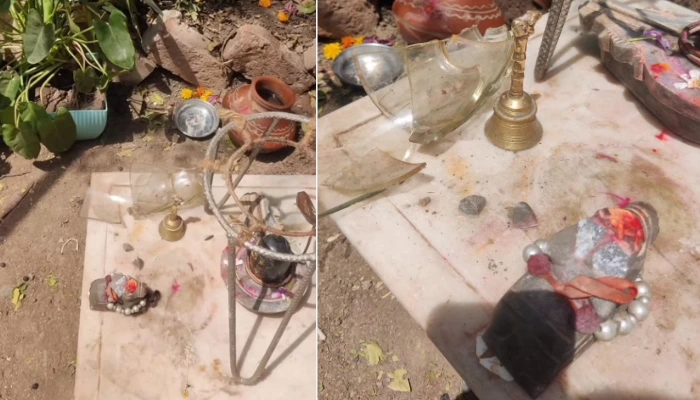
Case Summary
In Dewas, Madhya Pradesh, a Hindu temple dedicated to Lord Shiva was targeted, and sacred idols kept inside it were desecrated by three Muslim youths. The accused were identified as Bablu Shaikh and his two accomplices, Shahrukh and Shahju. According to media reports, this occurred on 15 May 2026 at around 2 p.m. A temple of Lord Shiva existed in the Bank Note Press (BNP) complex near the State Bank of India (SBI) in Dewas. The contractor of that area was Bablu Shaikh, a Muslim man. The accused and his two accomplices, Shahrukh and Shahju, damaged the sacred temple idols of Lord Nandi and the Shivling with stones. After carrying out this desecration, they fled the spot. A video of a Hindu activist regarding this incident went viral on social media, in which he stated that this occurred on the same date that the Madhya Pradesh High Court (Indore Bench) delivered its verdict on the Bhojshala complex. Notably, the Bhojshala complex in Dhar, Madhya Pradesh, has long been the subject of a dispute between Hindus and Muslims. Hindus regard Bhojshala as an ancient temple and gurukul dedicated to Goddess Saraswati, also known as Vagdevi, which was desecrated during the Islamic invasions, after which a mosque and dargah structure were constructed over the site. Following a prolonged legal battle, the Madhya Pradesh High Court, on the basis of archaeological findings, historical records, and other evidence, ruled that the site was originally a Hindu temple. The verdict went in favour of the Hindu side, with the land being handed over to the temple authorities and the offering of namaz at the site being prohibited. The Hindu activists also said that attempts were made to file a complaint and submit an application in the matter, but pressure was exerted to prevent the application from being accepted. This incident, which occurred in a sensitive and centrally secured complex, raised serious questions about the security system and administrative functioning. Hindu organisations expressed strong outrage over the desecration and demanded an impartial investigation into the matter, along with strict action against the culprits. They also warned that if the police failed to take action against the perpetrators, they would launch protests against the administration.
Why it is Hate Crime ?
The primary category selected in this case is- Attack on Hindu religious representations. The subcategory selected is- Desecration of Hindu religious symbol. Icons and symbols or a religious representation of a spiritual ideal are widely revered in Hinduism. Iconography is of vital significance in the Hindu milieu. It helps connect people’s spiritual beliefs with the real world. Iconography within the Hindu faith takes several shapes and forms. Murtis are of most significance to Hindus, to which daily rituals, prayers and offerings are done. Besides the murtis, there are several other symbols which have deep significance in the Hindu faith – the Om and Swastika for example. Since these Hindu religious symbols hold paramount importance in Hinduism, any desecration of symbols, icons, murtis, religious representations and manifestations, is driven by animosity towards the faith itself which manifests itself through these murtis, icons and symbols. Therefore, any desecration of these Hindu religious symbols and representations is considered religiously motivated hate crimes under this category. The other subcategory selected is- Attack on Temples. In Hinduism, a temple is the abode of the Deity. The Deity in the Temple is consecrated, thereby, making it a real, breathing entity. Hindus believe that not just the Deity but the temple premises itself are sacred to Hindus since Hindus hold the faith that the entire Temple space is an amalgamation of the divine energy of the deity. Given the central significance of Temples in Hindu Dharma, any attack against a Hindu Temple or its peripheral premises is an attack on the faith itself and is born out of animosity towards the faith, of which, the Temple is a central tenet. Any manner of attack against a Temple and/or its premises would therefore be considered a religiously motivated hate crime. This incident was a clear example of a religiously motivated hate crime, as sacred idols of Nandi and a Shivalinga were desecrated by Muslim perpetrators in Dewas, Madhya Pradesh. The accused did not target a random public structure or property. They specifically targeted sacred Hindu religious symbols housed inside a Hindu temple. Such acts are not merely instances of vandalism or damage to property, but deliberate attacks on the faith, identity, and religious sentiments of the Hindu community. The intentional desecration of revered Hindu idols inside a place of worship amounted to a direct assault on the religious dignity of Hindus and therefore constituted a hate crime motivated by hostility towards Hindu beliefs and practices. In Hinduism, idols of deities are not viewed as mere artistic representations or decorative objects. They are regarded as sacred manifestations of the divine and are worshipped with deep devotion and reverence by devotees. For practising Hindus, the deity resides spiritually within the consecrated idol, making it an object of immense religious sanctity. Nandi, the sacred bull, holds profound significance in Hindu tradition as the divine vehicle and foremost devotee of Lord Shiva. Nandi symbolises devotion, loyalty, strength, and righteousness, and his idol is traditionally placed facing the Shivalinga in Shiva temples as a mark of eternal devotion to Lord Shiva. Similarly, the Shivalinga is among the holiest symbols in Hinduism and represents Lord Shiva himself. It is worshipped as a cosmic symbol of creation, destruction, spiritual energy, and divine consciousness. For millions of Hindus, the Shivalinga is not merely an object of worship but one of the most sacred embodiments of the divine. Hence, the desecration of the Shivalinga and the idol of Nandi amounted to the desecration and vandalism of sacred Hindu religious symbols. Such acts cause deep emotional and spiritual hurt to Hindus because they attack objects that are central to their religious identity and worship. The destruction of revered religious symbols creates fear, anguish, humiliation, and a sense of targeted hostility within the Hindu community. When sacred idols are deliberately vandalised, it sends a message of contempt and disrespect towards the faith itself. This transforms the act from ordinary vandalism into a clear instance of a religiously motivated crime directed against the Hindu community. Hindu temples occupy a deeply sacred place in Hindu society and religious life. Temples are not merely physical structures but spiritual centres where devotees gather for worship, prayer, rituals, festivals, and community life. They are regarded as the abode of the deity and serve as spaces of peace, devotion, and cultural continuity for Hindus. For Hindu devotees, temples are places where they seek emotional solace, spiritual guidance, and a connection with the divine. Any attack on a temple, therefore, carries immense emotional and religious consequences for the Hindu community because it strikes at a sacred institution central to their faith and identity. Hence, the targeting of idols inside a Hindu temple and their desecration also amounted to an attack on the temple ecosystem as a whole. The perpetrators did not merely damage objects but violated the sanctity of a sacred religious space that held immense importance for Hindu devotees. Such incidents deeply wound Hindu sentiments because temples and idols are inseparable aspects of Hindu worship and spiritual life. When Hindu temples are targeted, and their sacred idols are desecrated, devotees experience not only grief and outrage but also a profound sense of religious violation and insecurity. This makes the act far more serious than ordinary vandalism and firmly places it within the framework of a hate crime targeting a religious community. The timing of the attack further strengthened the religiously motivated nature of the crime. The desecration occurred on the very day the verdict in the Bhojshala dispute was delivered. For Hindus, the verdict represented the revival and recognition of an ancient Hindu shrine associated with Goddess Saraswati and was viewed as a moment of celebration and emotional significance. Carrying out the desecration of sacred Hindu idols on the same day strongly suggested a deliberate attempt to hurt Hindu sentiments during a moment of religious and cultural importance for the Hindu community. This timing reflected deep-seated animosity towards Hindu religious identity and amplified the psychological and emotional impact of the attack on Hindu devotees. Since this case met the parameters of a hate crime, it was added to the hate crime database of the Hinduphobia Tracker.


Case Status
Complaint not filed


Perpetrators Details
Perpetrators
Muslim Extremists
Perpetrators Range
From 2 To 5
Perpetrators Gender
male
 Sources




