Hindu man targeted with "Sar Tan Se Juda" threats by Muslims over false 'blasphemy' allegation in Raebareli, Uttar Pradesh
 Raebareli, Uttar Pradesh, India
  13 May, 2026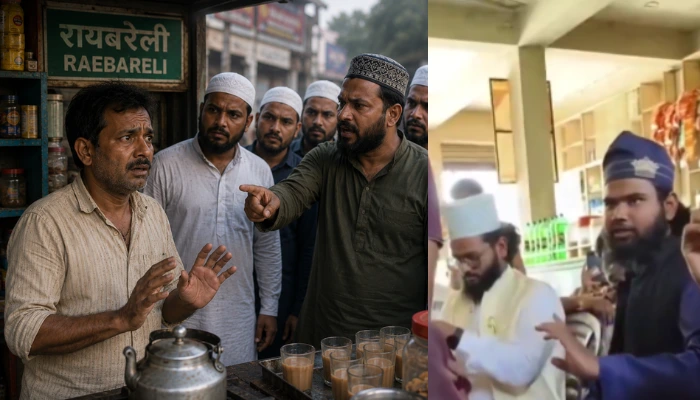
Case Summary
A Hindu tea stall owner, Chandrabhan Maurya, in Raebareli, was targeted with “Sar Tan Se Juda” beheading threats by Muslims over false allegations of blasphemy against Islam. This followed a casual conversation at his hotel that was falsely portrayed as derogatory remarks against Allah. The incident began at the victim's tea stall in Sendhiapur on the Salon–Jagatpur road, where the hotel owner and a customer were engaged in light-hearted banter on 14 May 2026. A Muslim individual present at the location subsequently circulated a social media post alleging that the hotel owner’s father had made abusive remarks against Allah and called for a boycott of the tea stall. As the video went viral on social media, religious tensions intensified, with Muslims creating outrage over the incident. The tensions escalated further, and some members of the Muslim community demanded that the Hindu hotel owner publicly apologise inside a mosque. According to the complaint filed by hotel owner Chandrabhan Maurya, 30-35 Muslim individuals, including Samajwadi Party leader Irfan Siddiqui, arrived at the hotel on 16 May 2026 and pressured him to visit the mosque and apologise. The Muslims also threatened him with beheading if he refused to comply, and gave explicit “Sar Tan Se Juda” threats over the false blasphemy accusations. Following the incident, police intervened, and Additional Superintendent of Police Alok Singh reached the hotel along with a police force to investigate the matter. During the inquiry, police found that the controversy stemmed from a playful exchange between two friends that had been deliberately misrepresented by a third party, a Muslim individual. The investigation did not confirm any derogatory remarks against any religion or community. Based on the complaint submitted by the victim, a case was registered against Samajwadi Party leader Irfan Siddiqui and unidentified Muslim individuals, while further investigation into the threats and intimidation remained ongoing. The accused Samajwadi Party leader denied the allegations and claimed that he had only attempted to counsel both sides and resolve the dispute peacefully. However, the victim’s complaint specifically stated that pressure had been exerted upon him to apologise at the mosque and that his family had faced threats of beheading if they failed to comply. Following the victim’s complaint, the local police took action and arrested several perpetrators, while simultaneously launching efforts to trace and apprehend the remaining accused individuals.
Why it is Hate Crime ?
The primary category selected in this case is- Attack not resulting in death. The subcategory selected is- Attacked over 'Blasphemy'. Blasphemy essentially refers to the desecration of anything which is held sacred/holy to a group of people. However, for religious supremacist groups, the elements of ‘blasphemy’ are ever-changing, shifting and expanding – leading to infringement on the rights of other religious groups, freedom of speech and expression, threats and even physical violence. There are instances where blasphemy is also used as a dog whistle to target Hindus owing to intrinsic animosity towards Hinduism. There are several instances where stating truths as mentioned in the non-Hindu doctrine itself has led to unmitigated violence against Hindus. There have also been instances where non-Hindus have themselves created a ‘blasphemous’ situation, like placing a Quran in a temple, to use it as an excuse to attack Hindus. Essentially, Blasphemy charges are often made up and/or are used to shut down any form of criticism of non-Hindu faiths and as a tool to target Hindus. Any physical violence over Blasphemy charges against Hindus are foundationally based on animosity for Hindus and their faith owing to religious supremacist ideologies, therefore, such attacks would be documented as religious motivated hate crimes under this category. Another primary category selected is- Hate Speech against Hindus. The subcategory selected is- Violent Threats. Violent threats, explicit, implicit or implied, is the most dangerous form of hate speech since it goes beyond discriminatory and prejudicial language to express the intent of causing harm to an individual or a group of people based on their religious identity and faith. There could be several different kinds of threats that are issued to Hindus based on religious animosity. An explicit threat would mean the direct threat of violence towards an individual Hindu, a group of Hindus or Hindus at large. Physical violence, death threats, threats of destruction of property belonging to Hindus and threats of genocide would mean explicit threats against Hindus for their religious identity. Implicit threats may not be a direct threat but implied through the use of symbols of actions – for example – in the Nupur Sharma case, other than explicit threats, there were also implicit threats when Islamists took to the streets to burn and beat her effigies. It implies that they want to do the same to Nupur Sharma – thereby is considered an implicit threat. Violent threats can be delivered in person, through letters, phone calls, graffiti, or increasingly through social media and other online platforms. It would be important to understand that a threat – explicit or implicit, online or offline – to an individual who happens to be a Hindu does not qualify as a religiously motivated threat. Such a threat, while vile and dangerous, could be owing to non-religious reasons and/or personal animosity. To qualify as a religiously motivated threat, it would need to exhibit an indication that the individual is being targeted for religious reasons and/or owing to his/her religious identity as a Hindu. In this case, a Hindu man was targeted by Muslims over an unsubstantiated and unverified accusation of blasphemy against Allah. The Hindu tea stall owner was merely engaged in light-hearted banter with a friend when a Muslim youth recorded the interaction and circulated misleading narratives portraying the conversation as insulting to Islam. This triggered outrage among members of the Muslim community, culminating in explicit “Sar Tan Se Juda” beheading threats directed at the Hindu victim and his family. The targeting of the victim solely on the basis of a supposed insult to an Islamic religious figure, despite the absence of any verified evidence, demonstrates that this was a clear case of a religiously motivated hate crime driven by hostility towards the victim’s Hindu identity. It is highly likely that many among the Muslim crowd had little or no knowledge of what the Hindu tea stall owner had actually said, but that scarcely mattered. The outrage was fuelled primarily by deep-seated religious hostility and the deliberate spreading of inflammatory narratives against the Hindu victim. In many such incidents involving accusations of “blasphemy”, Muslim mobs require only an allegation, regardless of whether it is verified, to justify threats, intimidation, and aggression against non-Muslims, particularly Hindus. The accusation itself becomes a convenient trigger to target Hindus, often based on exaggerated or fabricated claims designed to incite collective outrage. In such cases, a mere allegation of blasphemy is enough to provoke threats of violence, social ostracism, and intimidation against Hindu victims. Muslim extremists have repeatedly used such accusations as a means to harass, silence, or terrorise Hindus, while bypassing any legal or evidentiary standards. The selective targeting of Hindus in these controversies reflects a deeper pattern of religious prejudice, where allegations connected to Islam are weaponised to unleash hostility against members of the Hindu community. In this incident, too, instead of any lawful course of action, the response involved coercion, public humiliation, and threats of beheading directed at the Hindu victim and his family. The incident further escalated when members of the Muslim community pressured the Hindu tea stall owner to publicly apologise inside a mosque. According to the victim’s complaint, individuals, including Samajwadi Party leader Irfan Siddiqui, visited the hotel and exerted pressure upon him to comply, while threats of “Sar Tan Se Juda” were issued if he refused. Such conduct demonstrates that the issue had moved far beyond a disagreement over speech and had become an organised attempt to intimidate and subjugate the Hindu victim through fear of religiously sanctioned violence. The fact that the threats specifically invoked beheading over alleged blasphemy against Allah makes the religious motivation behind the targeting unmistakably clear. Importantly, the police investigation itself found that the controversy stemmed from a playful exchange between friends that had been deliberately misrepresented by a third party. The inquiry did not establish any derogatory remarks against any religion or community. Despite this, the Hindu victim and his family were subjected to threats and intimidation, highlighting how easily unverified accusations connected to Islam can place Hindus at risk of violent targeting. The absence of evidence did not diminish the hostility directed at the victim, demonstrating that the outrage was driven less by facts and more by religious sentiment weaponised against a Hindu individual. Furthermore, this is not an isolated occurrence but part of a broader and recurring pattern in which allegations of blasphemy are used to justify intimidation and violence against Hindus. In several previous incidents across India, Hindus accused of offending Islamic sentiments have faced threats, mob attacks, and calls for execution, even where the accusations were exaggerated, misleading, or entirely baseless. Such incidents reveal how allegations of blasphemy linked to Islam are repeatedly transformed into tools for collective intimidation against Hindus, creating an atmosphere of fear and vulnerability for the community. Another important point to address in this case is that the Muslim mob also issued a 'Sar Tan Se Juda' beheading threat. The use of the slogan “Sar Tan Se Juda” constitutes an explicit and religiously motivated threat directed at Hindus. “Gustakh-e-Rasool ki Ek hi saza, sar tan se Juda, sar tan se Juda”, which translates to “There is only one punishment for being disrespectful to Rasool (Prophet Muhammad), their head separated from their torso, their head separated from the torso”, is an Islamist clarion call, that has become a staple feature of violent protests that have so far claimed the lives of at least 6 Hindus, including Kanhaiya Lal in Udaipur and Umesh Kolhe in Amravati, after Muslim fundamentalists, egged on by the dog-whistling of Alt News co-founder Mohammed Zubair against former BJP spokesperson Nupur Sharma, resorted to violence for what they perceived as ‘blasphemy’ against Prophet Muhammad. From Kanpur in India’s northern plains to the southern metropolis of Bengaluru, from Kolkata in the east to Hyderabad in the south, protests in the name of blasphemy have erupted in almost every corner of the country as Islamists took to the streets running amok and shouting “Sar Tan Se Juda” chants over the perceived belief of blasphemy against their Prophet. Though a radical Muslim outfit in Pakistan coined this slogan, it has gained popularity among Islamists in regions beyond its geographical origins. Over the years, we have seen large crowds of Islamists chanting the “Sar Tan Se Juda” slogan, which is nothing but a direct incitement to violence against Hindus, leading to murders committed in the name of blasphemy. The radicalised outcry is not merely a statement of disapproval; it is a call for the execution of an individual through beheading, based on their religious identity. When this slogan is raised, it sends a clear and terrifying message not just to the individual targeted but also to anyone else who might share similar views or dare to express them. This tactic of intimidation aims to silence dissent and suppress freedom of expression, particularly in religious discourse. It aims to instil fear in the broader community. Islamists use this tactic to settle personal scores with non-Muslims, particularly Hindus, by levelling fabricated charges of blasphemy against them, which causes outrage and paints a target on them. The underlying hatred and animosity toward non-Muslims, especially Hindus, drive these false blasphemy accusations as a means to subjugate and victimise them. The slogan’s danger lies not merely in its verbal content but in its historical and contemporary consequences. Across South Asia, including India, there are multiple recorded cases where individuals accused of blasphemy have been murdered after such chants were raised by Muslim crowds. From school teachers to political leaders, victims have been executed in acts directly linked to the “Sar Tan Se Juda” call. It therefore serves as a bridge between verbal incitement and physical violence, collapsing the distance between threat and action. The slogan is not an expression of community pride or peaceful protest; it is an explicit incitement to religiously motivated killing. Even in this particular case, the connection between the “Sar Tan Se Juda” threats issued by Muslims and the intimidation directed at the Hindu tea stall owner, Chandrabhan Maurya, was immediate and direct. Following unverified allegations of blasphemy against Allah, the Hindu victim and his family were threatened with beheading and pressured to publicly apologise inside a mosque. The targeting of the Hindu man solely over accusations linked to Islamic religious sentiments made it clear that these threats were intended to incite violence and terror against a Hindu accused of ‘blasphemy’. This is not an isolated incident; Hinduphobia Tracker has recorded 51 cases of violent attacks on Hindus over allegations of blasphemy between 1 January 2023 and 18 May 2026, 49 incidents that did not result in the victim's death and two separate instances in which Hindu youths were killed. These figures demonstrate that violence against Hindus over allegations linked to Islam is not sporadic or incidental, but part of a continuing pattern in which accusations of blasphemy are used as a trigger to justify intimidation, assault, and even murder of Hindu individuals. Similarly, Hinduphobia Tracker has also documented 51 cases between 1 January 2023 and 18 May 2026 where Hindus were threatened with “Sar Tan Se Juda” beheading slogans or threats. This pattern demonstrates that attacks on Hindus, murders of Hindus, and the issuing of “Sar Tan Se Juda” threats over accusations of blasphemy are not isolated occurrences. Rather, they point towards a broader and recurring pattern of anti-Hindu targeting in which allegations of blasphemy are weaponised to inflame the Muslim community against Hindus. Such accusations often function as a dog whistle to mobilise threats, violence, and intimidation against Hindu victims, thereby amounting to religiously motivated hate crimes. In conclusion, since this case meets several parameters of a hate-driven offence, it is being added to the hate crime database of the Hinduphobia Tracker.
Victim Details
Total Victim
1
Deceased
0
Gender
- Male 1
- Female 0
- Third Gender 0
- Unknown 0
Caste
- SC/ST 0
- OBC 0
- General 0
- Unknown 1
Age Group
- Minor 0
- Adult 1
- Senior Citizen 0
- Unknown 0


Case Status
Case sub-judice


Perpetrators Details
Perpetrators
Muslim Extremists
Perpetrators Range
From 10 to 100
Perpetrators Gender
male
 Sources




