Hindu school workers at Jabalpur Christian school dismissed for refusing to convert to Christianity
 Jabalpur, Madhya Pradesh, India
  16 May, 2026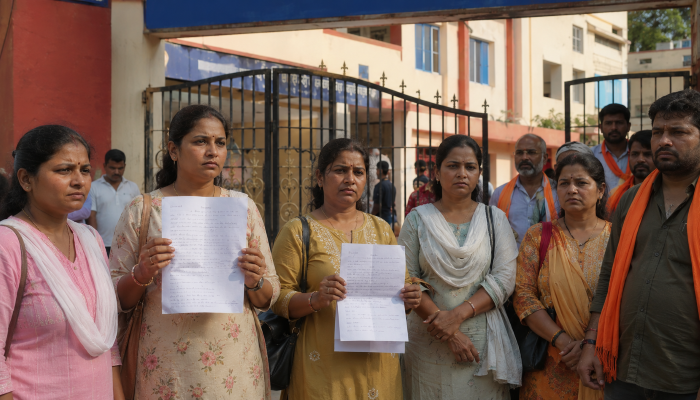
Case Summary
Multiple Hindu sanitation workers at St. Aloysius School, Sadar, Jabalpur, Madhya Pradesh, were pressured to convert to Christianity and dismissed from their jobs upon refusing. The school, a Christian institution, used employment as leverage to coerce Hindu workers into religious conversion, dismissing those who refused and retaining those who complied out of fear. As per details, Deepa Patel, a resident of Sharda Vihar Mother Teresa area, had been working as a sanitation worker at the school since 2024. Initially, the working environment was normal under Father Walter, who had originally employed her. Two to three months before the complaint, female employees were summoned and asked to attend church. Some complied out of fear. Three to four female employees, including Deepa, refused. They were subsequently told that continued employment at the school was conditional on adopting Christianity. Upon their refusal, they were dismissed. Rajesh Balmik, a resident of Kantagi who had worked at the school for 12 years, was stopped at the school gate after taking two days of leave for a family wedding in April. He was told explicitly that he must either convert his religion or not return to work. When he stated his case, he was given two months' salary and dismissed. He stated that the Father had already dismissed several other employees on the same grounds. The affected workers filed complaints with the police but received no action. They subsequently approached Additional Superintendent of Police [ASP] Suryakant Sharma, who confirmed receipt of the written complaint and assigned the investigation to Vijay Nagar police station in-charge. Hindu Dharma Sena state president Neeraj Rajput stated that the pattern of conversion-linked dismissals extended beyond Deepa Patel to several women across multiple schools in Jabalpur. The organisation warned that if action was not taken against the responsible Father, a protest would be staged outside the school.
Why it is Hate Crime ?
The primary category for this case is "Harassment, threats, coercion to conversion". The sub-category for this case is "Harassment, threats, coercion for conversion". Harassment covers a wide range of behaviours of an offensive nature. It is commonly understood as behaviour that demeans, humiliates, and intimidates a person, including threats and coercion. Harassment and threats, in this case, find their root on discriminatory grounds which has the effect of nullifying a person’s rights or infringing upon his freedom to exercise his right specifically owing to the victim’s religious identity. Verbal and physical threats and psychological or physical harassment are often used against Hindu victims because they choose to practice their professed religion. Religious harassment also includes forced and involuntary conversions by harassment, threats or coercion. Coercion includes intimidatory tactics like force-feeding a Hindu victim beef to convert to another religion, forceful circumcision etc. In several cases documented, non-Hindu perpetrators or those who harbour specific animosity towards Hinduism, harass victims simply based on their religious identity. Such cases often also include harassment to ensure the Hindu victim abandons his/her professed religion and adopts the religion of the perpetrator. Such cases where Hindu victims are harassed to convert to the perpetrator’s religion are rooted in animosity towards the victim’s religious identity and are therefore documented as religiously motivated hate crimes. The conversion pressure at St. Aloysius School was not informal or incidental. It was institutional. The school management summoned female Hindu employees, directed them to attend church, and subsequently issued an explicit ultimatum: convert to Christianity or lose your job. This was not a request. It was a condition of employment imposed by an institution with direct power over the livelihoods of economically vulnerable Hindu workers. The use of employment as the instrument of conversion pressure is the defining religious marker of this case. Hindu sanitation workers, among the most economically vulnerable members of the workforce, were placed in a position where their ability to support their families was made directly contingent on their willingness to abandon their Hindu faith. The school management's assessment that this lever would be effective reflects a deliberate targeting of workers whose economic vulnerability made them susceptible to coercion that a more economically secure employee could more easily resist. Some workers complied out of fear. This outcome confirms that the coercion was effective and that the school management was aware it would be. The dismissal of those who refused is the most explicit confirmation of institutional religious coercion in this case. Rajesh Balmik had worked at the school for 12 years. He was stopped at the gate upon returning from two days of leave and told to convert or not return. He was given two months' salary and dismissed. The termination of a 12-year employment relationship specifically because an employee refused to convert from Hinduism to Christianity establishes that the conversion demand was not peripheral to the employment relationship but had become its central condition. The school management treated Hindu religious identity as an incompatible characteristic in its workforce. The pattern dimension of this case is a further significant religious marker. Hindu Dharma Sena state president Neeraj Rajput stated that the conversion-linked dismissal pattern extended beyond St. Aloysius School to several schools across Jabalpur. The recurrence of the same institutional methodology, employment conditional on conversion, across multiple schools in the same city reflects a coordinated and organised conversion operation rather than the conduct of a single rogue administrator. The Father's documented history of dismissing multiple employees on conversion grounds establishes that the conduct was sustained and deliberate rather than situational. Given that this case met the parameters of a religiously motivated hate crime, the school management's conduct reflected more than an employment dispute. By summoning Hindu workers, directing them to attend church, issuing explicit ultimatums conditioning their employment on religious conversion, and dismissing those who refused, their actions demonstrated a deliberate and institutional campaign to exploit the economic vulnerability of Hindu workers as a lever for religious conversion. The Hindu sanitation workers of St. Aloysius School were targeted specifically because they were Hindu, and their employment was weaponised against their faith because economic dependence was assessed as the most effective instrument of coercion available against workers in their specific condition. This reflects an underlying hostility toward Hindu religious identity that cannot be characterised as anything other than religiously motivated. Given that this case met the parameters of a religiously motivated hate crime, it was added to the hate crime database of the tracker. Disclaimer: The Hinduphobia Tracker records incident dates based on when the crime occurred rather than when it was reported or published. The exact date on which the conversion pressure began was not confirmed in the source. Based on the source's statement that the pressure began two to three months before publication, and the publication date of 16 May 2026, 16 February 2026 has been used as the approximate primary incident date reflecting the commencement of the conversion ultimatums directed at Hindu workers. This was recorded for documentation purposes only. Disclaimer: The Hinduphobia Tracker records victim counts based on confirmed figures available in the source. The source confirms two named victims, Deepa Patel and Rajesh Balmik, alongside three to four additional unnamed female sanitation workers who were dismissed upon refusing conversion. For documentation purposes, a conservative count of 2, the named victims, has been used as the victim count. This was recorded for documentation purposes only.
Victim Details
Total Victim
2
Deceased
0
Gender
- Male 1
- Female 1
- Third Gender 0
- Unknown 0
Caste
- SC/ST 1
- OBC 0
- General 1
- Unknown 0
Age Group
- Minor 0
- Adult 2
- Senior Citizen 0
- Unknown 0


Case Status
Complaint filed


Perpetrators Details
Perpetrators
Christian Extremists
Perpetrators Range
One Person
Perpetrators Gender
male
 Sources




