Hindu minor girl deceived through false Hindu identity, sexually exploited after being lured into hotel room by Muslim man
 Bareilly, Uttar Pradesh, India
  14 May, 2026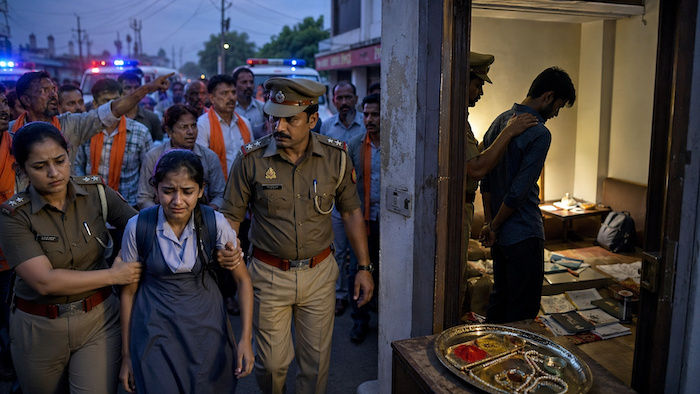
Case Summary
A 16-year-old Hindu minor girl studying in Bareilly, Uttar Pradesh, became the victim of religious deception and sexual exploitation after a Muslim man concealed his religious identity and posed as a Hindu in order to approach her. The Hindu student was targeted while pursuing her studies away from home in the Baheri area of Bareilly district. The incident triggered outrage after details emerged that the accused had deliberately adopted visible Hindu religious symbols while grooming the minor girl. The Hindu minor girl, originally from Mirzapur district, had been studying at the Government Polytechnic Institute in the Baheri area of Bareilly. During this period, she came into contact with Mujahid, a Muslim man who operated a fast food shop in the locality. Mujahid obtained the Hindu girl’s phone number while interacting with her at the shop and gradually established contact with her through repeated conversations and feigned friendship. During this interaction, Mujahid concealed his Muslim identity and presented himself in a manner consistent with Hindu religious customs. He wore a sacred thread on his wrist and applied a tilak on his forehead while interacting with the Hindu minor girl. Through this false religious presentation, he developed a proximity with the student and gained her trust. The Hindu victim was specifically approached through deception that relied upon visible imitation of Hindu religious identity. As the contact continued, Mujahid persuaded the Hindu minor girl to accompany him to a hotel in the Baheri police station area. The victim was taken to the Taj Hotel, situated on the Nainital Highway in the Bareilly district. The Hindu minor girl stayed there overnight with the accused. During this period, Mujahid sexually assaulted the Hindu student inside the hotel premises. On the morning of 15th May 2026, Hindu organisations received information regarding the presence of the Hindu minor girl and Mujahid at the hotel. Following this information, representatives of Hindu organisations informed the Baheri police. Police personnel subsequently conducted a raid at Hotel Taj at approximately 5 a.m. on 15th May 2026. During the raid, the Hindu minor girl and Mujahid were recovered from the hotel room and taken into custody for questioning. The Hindu victim’s statement was recorded by the police, and her family members were informed about the incident. During the investigation, further details emerged regarding the method used by Mujahid to approach the Hindu victim. It was found that he had deliberately altered his outward appearance in order to resemble a Hindu man while interacting with the minor girl. The use of the sacred thread and tilak formed part of this deception. The accused specifically used Hindu religious identifiers while grooming the Hindu student and concealing his Muslim identity from her. The case drew wider public attention after information surfaced that Mujahid had previously deceived multiple women using similar methods. The targeting of the Hindu student while impersonating Hindu religious identity intensified concerns among local Hindu groups regarding deliberate religious deception directed at Hindu girls. Hindu organisations gathered outside the hotel and raised objections over the incident after learning that the Hindu minor had been taken to the hotel under false pretences. Following the recovery of the Hindu victim, police registered a case against Mujahid under rape charges and provisions of the Protection of Children from Sexual Offences Act. Mujahid was formally arrested by the police on 15th May 2026. Police initiated further investigation into the hotel records, identity documents, and closed-circuit television footage connected to the stay at Hotel Taj. Investigators also examined the circumstances under which a room had been provided to the Hindu minor girl at the hotel. Police questioned the hotel management regarding identification procedures and guest verification records. The victim underwent a medical examination, and her statement formed part of the ongoing investigation. Police continued interrogating Mujahid following his arrest. The incident also led to scrutiny of the role of the hotel management after Hindu organisations raised concerns regarding accommodation being provided to a Hindu minor girl without proper verification. Members of Hindu Jagran Manch demanded strict legal action and publicly questioned the hotel's functioning. Concerns were also raised regarding whether similar incidents involving minor Hindu girls had previously occurred at the premises. The case remained under active investigation after 15/05/2026. Police continued to examine electronic evidence, hotel registers, identity documents, and witness statements related to the incident. Mujahid remained in police custody following his arrest, while legal proceedings under rape charges and the Protection of Children from Sexual Offences Act continued in connection with the sexual assault and religious deception of the Hindu minor girl.
Why it is Hate Crime ?
This case has been added to the tracker under the primary category - Predatory Proselytisation. Within this, the subcategory selected is - Proselytisation by grooming, brainwashing, manipulation or subtle indoctrination. Under this, the tertiary categories selected are - Rape and sexual assault/harassment and Victim says she was brainwashed/groomed. Religious brainwashing essentially means the often subtle and forcible indoctrination to induce someone to give up their religious beliefs to accept contrasting regimented ideas. Religious grooming or brainwashing also involves propaganda and manipulation. It involves the systematic effort, driven by religious malice and indoctrination, to persuade “non-believers’ to accept allegiance, command, or doctrine to and of a contrasting faith. Cases of such grooming or brainwashing are far more nuanced than direct threats, coercion, inducement and violence. In such cases, it is often seen that there is repeated, subtle and continual manipulation of the victim to induce disaffection towards their own faith and acceptance of the contrasting faith of the perpetrator. While subtle indoctrination is widely acknowledged as predatory, an element which is often understated in such conversions or the attempts of such conversion is the role of loyalty and trust which might develop between the perpetrator and the victim. Fiduciary relationships are often abused to affect such religious conversion. For example, an educator transmitting religious doctrine of a competing faith to a Hindu student. The Hindu student is likely to accept what the teacher is transmitting owing to existence of the fiduciary relationship. The exploitation of the fiduciary relationship to religiously indoctrinate victims would also be included in this category. Since the underlying animosity towards the victim’s faith forms the basis of predatory proselytisation, such cases are considered religiously motivated hate crimes. The other category selected here is- Crimes against women in relationships and other sexual crimes. Under this, the subcategory selected is- Man pretends to be Hindus, and the tertiary category within this- wears symbols of Hinduism. When a non-Hindu man pretends to be a Hindu to deceive a Hindu woman into a relationship, the act is seen as triggered by malafide intentions. In some cases, the woman eventually accepts the man’s original religious identity and converts after the man’s identity is revealed. These cases could be argued as cases of religious brainwashing and a result of the pressure a woman feels after getting into a relationship with a man. The woman, it can be argued, also changed her religious identity because of the stigma she believes she might face if she chooses to walk out of a deceptive relationship. However, for the purpose of documenting hate crimes, the cases in this subcategory are limited to those where there is explicit violence aimed at religious conversion against the wishes of the victim (force-feeding beef, blackmailing with intimate videos, rape on refusal to convert, etc), or if the woman herself complains of the man’s religious deception. In such cases, it is established that the deception of the non-Hindu man had a specific aim of religious conversion or targeting of the victim due to her Hindu religious identity, therefore, making it a religiously motivated hate crime. The other subcategory selected is- Brainwashed and/or groomed. The tertiary categories within this are- Pattern of targeting Hindu women, Pattern of targeting Hindus, and Victim says she was brainwashed/groomed. This case constituted a clear instance of a religiously motivated hate crime because a Hindu minor girl was deliberately targeted through religious deception by a Muslim man who concealed his identity and presented himself as Hindu in order to gain her trust. The accused did not approach the victim openly under his real identity. Instead, he consciously adopted visible Hindu religious symbols and practices to create familiarity and emotional comfort with a Hindu girl. The deception relied specifically on exploiting the Hindu victim’s religious and cultural trust, making religion central to the targeting, grooming, and subsequent sexual exploitation. The first aspect that demonstrated religious motivation was the deliberate use of Hindu identity markers to approach and manipulate the Hindu minor girl. Mujahid wore a sacred thread on his wrist and applied a tilak on his forehead while interacting with the victim. These are visible Hindu religious symbols associated with the Hindu faith and cultural identity. He consciously used these markers while befriending the Hindu girl so that she would perceive him as belonging to her own religious community. This was not incidental behaviour. The accused specifically chose Hindu symbols because he understood that presenting himself as Hindu would lower suspicion, create familiarity, and make it easier to emotionally access a Hindu minor girl. The deception depended entirely on exploiting the victim’s Hindu identity and religious trust. By impersonating a Hindu man to groom a Hindu minor, the accused weaponised Hindu religious identity itself as a tool for manipulation, revealing a clear intent to target the victim because she was Hindu. The grooming process further reflected calculated manipulation designed to gradually isolate and emotionally condition the Hindu victim. The accused exploited the trust he had manufactured through impersonation in order to gain physical access to the Hindu victim. The sexual assault, therefore, cannot be separated from the religious deception that enabled it. The grooming, concealment of identity, and assault formed part of a continuous chain of conduct directed specifically at a Hindu minor girl. The exploitation of her religious trust directly facilitated the sexual violence inflicted upon her. The targeting of a Hindu minor girl also revealed a deliberate abuse of vulnerability connected to her age, social situation, and religious identity. The victim was a minor, which essentially means that the element of consent and genuine change of conscience was missing ab initio. It is a well-established fact that children are more susceptible to manipulation since they are still developing emotionally, cognitively, and socially. Their brains are not fully mature, making them more vulnerable to influence and less capable of critically evaluating information. Moreover, subtle manipulation tactics can be difficult to detect. This makes it challenging for parents to identify and address instances of such manipulations. Since the underlying offence in this case is against children of a specific faith and involves subtle tactics of indoctrination, which obviously stems from a bias against the Hindu faith, this case has been documented as a hate crime. Another significant aspect was the victim’s own statement to the police describing the sequence through which she had been approached, befriended, and taken to the hotel by the accused. Her statement formed a crucial part of the investigation and reflected how the grooming process had gradually drawn her into the accused’s influence. The fact that the victim herself described the manipulation after police intervention demonstrated that the relationship had been built through sustained deception and emotional conditioning rather than informed consent or transparency. The recovery of the Hindu minor girl from the hotel room, followed by her statement to the police, exposed the full extent of the grooming and manipulation that had preceded the assault. The religious dimension of the offence became further evident from the sequence of events. The offence was not limited to physical exploitation alone. It involved calculated deception centred upon the victim’s Hindu identity and the strategic misuse of Hindu religious symbols to emotionally access and isolate her. Such predatory actions stem from doctrinal animosity towards the Hindu faith and its adherents. Given that this case met the parameters of a religiously motivated hate crime, it was added to the hate crime database of the tracker. Disclaimer: The Hinduphobia Tracker records incident dates based on when the crime occurred, not when it was reported or published in the media. In this case, the exact date when the Hindu minor girl first came into contact with the Muslim perpetrator was not specified in the available sources. Therefore, 15th May 2026, the date on which the incident was publicly reported and the victim was recovered during the police raid, was used as the indicative incident date for documentation purposes only.
Victim Details
Total Victim
1
Deceased
0
Gender
- Male 0
- Female 1
- Third Gender 0
- Unknown 0
Caste
- SC/ST 0
- OBC 0
- General 0
- Unknown 1
Age Group
- Minor 1
- Adult 0
- Senior Citizen 0
- Unknown 0


Case Status
Arrested


Perpetrators Details
Perpetrators
Muslim Extremists
Perpetrators Range
One Person
Perpetrators Gender
male
 Sources




