Hindu woman deceived into marriage, forcibly converted to Islam, subjected to brutal assault and prolonged confinement by Muslim man posing as Hindu
 Farrukhabad, Uttar Pradesh, India
  12 May, 2010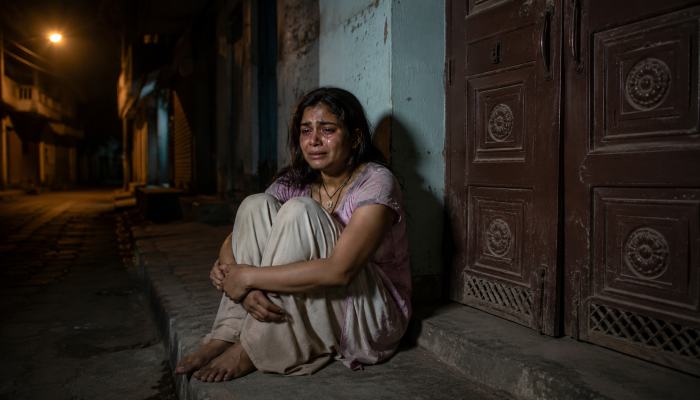
Case Summary
In Uttar Pradesh's Farrukhabad, a Hindu woman, who was originally from Rajkot, was lured into a relationship and marriage by a Muslim man posing as a Hindu. The victim was subjected to forced conversion after marriage and simultaneously subjected to prolonged confinement and brutal physical assault for 16 years. She was later abandoned by the accused. As per media reports, the accused Muslim man was from Minhajari Garhi Mohalla, Farrukhabad, Uttar Pradesh. He presented himself as Hindu to gain her trust approximately 16 years ago, married her under a false Hindu identity, and then forcibly converted her to Islam and changed her name after the marriage. He subsequently brought her to Farrukhabad, completely cutting her off from her family and home in Gujarat. The marriage was built on a lie from its foundation. Once she was isolated in Farrukhabad, far from her family and without any means of independent return, the accused subjected her to sustained physical assault, prevented her from leaving the house, and forced her to beg. On every occasion she attempted to leave, she was beaten. When she resisted his demands, she was abused and assaulted. She bore five children during the marriage; two of them died, and only three survived. On 13 May 2026, the accused beat her and threw her out of the house with only the clothes she was wearing. She spent the night on a footpath. She stated clearly that she no longer wished to live with the accused and wanted to return to her family home in Rajkot, Gujarat. She filed a complaint at the city Kotwali police station, but received no response. She subsequently submitted a complaint letter to the Superintendent of Police, demanding strict legal action against the accused and safe passage back to her home in Rajkot, Gujarat.
Why it is Hate Crime ?
The primary category for this case is "Crimes against women and relationships and other sexual crimes". The sub-category for this case is "Man pretends to be Hindu". When a non-Hindu man pretends to be a Hindu to deceive a Hindu woman into a relationship, the act is seen as triggered by malafide intentions. In some cases, the woman eventually accepts the man’s original religious identity and converts after the man’s identity is revealed. These cases could be argued as cases of religious brainwashing and a result of the pressure a woman feels after getting into a relationship with a man. The woman, it can be argued, also changed her religious identity because of the stigma she believes she might face if she chooses to walk out of a deceptive relationship. However, for the purpose of documenting hate crimes, the cases in this subcategory are limited to those where there is explicit violence aimed at religious conversion against the wishes of the victim (force-feeding beef, blackmailing with intimate videos, rape on refusal to convert, etc), or if the woman herself complains of the man’s religious deception. In such cases, it is established that the deception of the non-Hindu man had a specific aim of religious conversion or targeting of the victim due to her Hindu religious identity, therefore, making it a religiously motivated hate crime. Another sub-category for this case is "Brainwashed and/or groomed". The tertiary category here is "Victim says she was brainwashed and/or groomed". In our database, we have not added incidents where women have converted to another religion of their free will and no allegations of forced/involuntary conversion have been made. However, there are certain cases of conversion where the consent itself is a result of the brainwashing or grooming of a minor by the non-Hindu perpetrator trying to victimise a woman for her Hindu religious identity. The phenomenon of grooming points to non-Hindu perpetrators identifying their Hindu victims’ vulnerabilities and exploiting them over months and sometimes years, to extract the supposed ‘consent’ in order to convert their religion. In most cases of grooming, the victims are minors or the grooming started when the victim was a minor. In other cases of grooming, the non-Hindu perpetrator brainwashes and grooms a minor victim to extract their trust and then proceeds to rape them repeatedly with the intent of converting them to their faith. It is pertinent to understand here that when the victim is a minor, the ‘consent’ to convert or enter into a romantic relationship with an adult itself is redundant – addressed by POCSO. While every case of conversion of a minor and incidents of establishing a physical relationship with a minor by an adult is a crime, for the purpose of this database, a case would be considered a hate crime only if there is a distinct religious angle to the grooming. For example, in the UK, if a Hindu minor is targeted by Pakistani grooming gangs, it would be considered a hate crime because the victims are specifically targeted owing to their non-Muslim religious identity with the perpetrators being Muslim. In other cases, if a Hindu minor is brainwashed into entering a physical relationship with the non-Hindu adult perpetrator and the family alleges grooming/brainwashing of the minor to convert her religion, it would form a part of this database. If the victim is a Hindu adult, the case would form a part of this database only if the victim herself says that she was brainwashed/groomed to convert her religion. However, if the victim is deceased (murdered or otherwise), the case would form a part of this database if her family/friends provided testimony that the victim was brainwashed/groomed to convert her religion. Since these crimes have a distinct religious angle where the victim is being targeted owing to her Hindu religious identity, these cases are considered a hate crime. Another sub-category for this case is "Forced conversion after marriage". In such cases, a non-Hindu man marries a Hindu woman, and the force/pressure to convert to any Abrahamic faith, like Islam, begins after marriage. In such cases, typically, two patterns emerge. First, when the relationship is consensual, and the religious identity of the perpetrator is known to the Hindu woman in the relationship. The marriage could be under the Special Marriages Act, where neither parties are required to convert their religion for the marriage to be considered legitimate. While the victim in such cases enters matrimony assuming that religious identity is not a barrier, the non-Hindu man starts to pressure the woman to convert her religion after marriage. The second is when the woman gets into a marriage with the man, pretending to share her faith. Later, when the truth is revealed, the man starts pressuring the woman to convert her religion and give up her religious identity. In both situations, there is application of force by the perpetrator, including the denial of the woman’s religious rights. Some of the means by which the woman is forced/pressured to convert include force-feeding beef, being forced to read the Kalma, being forced to wear a hijab, forced to undergo Halala, etc. There are several instances where, after marriage, the woman voluntarily converts to Islam. Such cases are often argued to be a result of religious brainwashing, however, for the purpose of documenting religiously motivated hate crimes, in the absence of the victim complaining of forced conversion, such cases do not form a part of the database. In this case, the Hindu woman was deceived into a marriage by a Muslim man pretending to be Hindu. After this, she was subjected to forced conversion and later brutal physical assault and confinement for 16 years by the Muslim perpetrator. Firstly, the perpetrator's act of deception by posing as a Hindu itself demonstrates a clear bias and malicious intent towards the victim’s religion. By hiding his true identity, the Muslim man manipulated the Hindu woman's trust and targeted her under false pretences, indicating a premeditated effort to exploit the woman based on her religious background. Additionally, the marriage legitimised the relationship in the eyes of the woman and the wider Hindu community. This constituted a direct violation of her right to informed consent regarding whom she chooses to marry, as well as an infringement upon her religious beliefs. Thus, the perpetrator’s deliberate decision to hide his religious identity strongly underscores the religious motive behind this crime. In such instances, identity concealment is not just a deceptive tactic for personal reasons but a calculated strategy rooted in religious profiling and targeting. The accused was aware that the victim, being Hindu, would likely refuse his advances if she knew his real identity, and he circumvented this by lying, which directly points to a religiously driven intent. This deception reflects a larger pattern where Hindu women are specifically singled out using false identities, often with coercion or conversion in mind. Such targeted victimisation based on religion not only demonstrates a fundamental disregard for Hinduism but also exposes a deeper animosity toward Hindus and their beliefs. The subsequent act of forcibly converting the victim to Islam after marriage, along with changing her name to a Muslim identity, constitutes a direct interference with her religious freedom and personal autonomy. Forced conversion violates the victim's religious autonomy and also undermines the fundamental right to freely choose and retain one’s faith, and when imposed through coercion, isolation, or violence, it is treated as a severe violation of religious liberty. In hate crime frameworks, such compelled alteration of belief and identity is considered indicative of hostility towards the victim’s original religious identity, since the act itself seeks to replace and suppress that identity through force. The renaming of the victim is particularly significant because a name is a primary marker of cultural and religious identity. Changing it in this context functioned as an attempt to erase her public and personal connection to her Hindu identity and sever continuity with her family, heritage, and belief system. This form of identity replacement can be understood as an imposed transformation of religious and social identity, where the victim is made to adopt a new identity against her will, which is consistent with patterns seen in coercive religious domination. Therefore, this makes the religiously motivated intent behind the crime clearer. The continued physical assault, prolonged confinement, forced begging, and eventual abandonment further demonstrate a sustained pattern of coercion and control. These actions intensified the victim’s suffering and reflect a complete denial of autonomy and dignity. In hate crime analysis, prolonged abuse combined with forced religious transformation and identity suppression can be interpreted as treating the victim as an instrument for control rather than as an individual with rights and agency. The cumulative pattern of deception, coercion, violence, and abandonment is therefore examined as potentially consistent with a religiously motivated hate crime, particularly where religious identity is central to the coercion and its consequences. This assault and abandonment demonstrated that the perpetrator did not regard the Hindu woman as an individual but had reduced her to a dehumanised target for conversion. Overall, since this case meets the parameters of a religiously motivated offence, it is being added to the hate crime database of the tracker. Disclaimer: The Hinduphobia Tracker records incident dates based on when the victim's ordeal begins, rather than the date on which it is reported by the media. In the present case, available media reports do not specify the exact date on which the victim’s ordeal began. The reports only indicate that a formal complaint was filed on 13 May 2026, and that the victim was lured into the marriage approximately 16 years prior. In the absence of a precise start date, and for the purpose of documentation and chronological consistency, an indicative incident date of 13 May 2010 has been selected.
Victim Details
Total Victim
1
Deceased
0
Gender
- Male 0
- Female 1
- Third Gender 0
- Unknown 0
Caste
- SC/ST 0
- OBC 0
- General 0
- Unknown 1
Age Group
- Minor 0
- Adult 1
- Senior Citizen 0
- Unknown 0


Case Status
Complaint filed


Perpetrators Details
Perpetrators
Muslim Extremists
Perpetrators Range
One Person
Perpetrators Gender
male
 Sources




