Hindu residents in Mumbai forced to convert to Christianity under pretext of curing diseases, Hindu deities also subjected to denigration
 Mumbai, Maharashtra, India
  7 May, 2026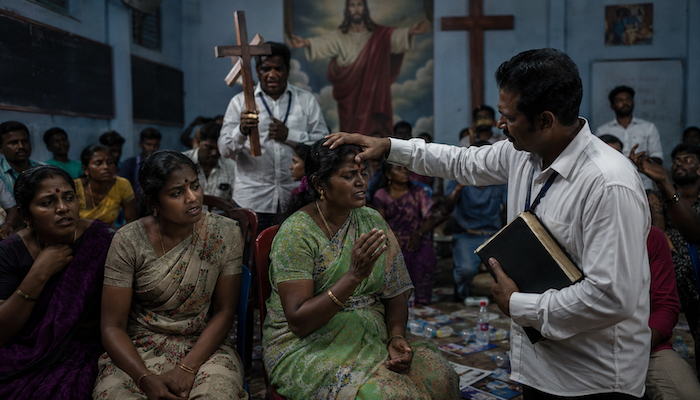
Case Summary
In Mumbai, Maharashtra, several Hindus suffering from long-term illnesses were targeted for religious conversion through organised Christian missionary gatherings. Hindus were approached inside their homes and persuaded to attend prayer meetings with promises that Jesus would cure serious medical conditions. The gatherings were conducted inside a school premises in Malad West, where Christian missionaries preached against Hindu deities and encouraged Hindus to abandon Hindu worship practices. On 8th May 2026, Hindu woman Asha Upadhyay, aged 45, a resident of Santacruz East, Mumbai, was approached at her residence by a Christian woman, Usha Gupta, along with three unidentified Christian women. Asha Upadhyay had been suffering from thyroid disorder and high blood pressure for the past seven years. The Christian missionaries manipulated her by telling her that all illnesses would be cured through prayers to Jesus. They invited her to attend a weekly Christian prayer gathering conducted every Sunday inside Rejoyce International School in Malad West. After learning about the interaction, Asha Upadhyay informed her son about the incident. On 10th May 26, her son accompanied her to the prayer meeting being conducted on the fifth floor of Rejoyce International School in Malad West. Inside the gathering, Christian missionary Ramesh Gupta was seen placing his hands on the heads of attendees and declaring that diseases were being cured through the power of Jesus. Multiple Hindus were present during the programme. During the event, Christian missionaries made statements attacking Hindu religious practices and discouraging worship of Hindu deities. Hindus attending the gathering were told that Hindu gods were of no use and were instructed not to keep photographs or idols of Hindu deities inside their homes. The gathering promoted Christian worship while simultaneously discouraging Hindu religious practices and symbols. The programme specifically targeted Hindu attendees and attempted to persuade them towards Christianity through claims of miraculous healing and religious superiority. The Christian missionaries organised the gatherings every Sunday at the school premises in Malad West. Hindu attendees were persuaded to participate through assurances that worshipping Jesus would solve personal problems and cure diseases. Individuals participating in the programme pretended to be cured after Christian missionaries placed their hands on their heads during prayers. The gatherings focused on vulnerable Hindu individuals suffering from illness and personal hardship. The matter came to wider public attention after Hindu activists and local residents raised objections regarding repeated Christian missionary activities inside the school premises. Complaints were submitted to the police regarding attempts to convert Hindus through religious inducement, superstition, and derogatory statements directed at Hindu deities and Hindu worship practices. Following the complaint filed by Asha Upadhyay and her son, Malad Police registered a case against seven Christians under the Maharashtra Prevention and Eradication of Human Sacrifice and Other Inhuman, Evil and Aghori Practices and Black Magic Act. The identified Christian missionaries included Ramesh Gupta, Usha Gupta, Aman Dubey, and Mukesh Yadav. Three additional Christian women involved in the activities remained unidentified. Police initiated action in connection with organised missionary gatherings targeting Hindus inside the school premises in Malad West, Mumbai.
Why it is Hate Crime ?
This case has been added to the tracker under the primary category- Predatory Proselytisation. Within this, the subcategory selected is - Proselytisation by grooming, brainwashing, manipulation or subtle indoctrination. Under this, the tertiary categories selected are - Pattern of targeting Hindus, and Victim says she was brainwashed/groomed. Religious brainwashing essentially means the often subtle and forcible indoctrination to induce someone to give up their religious beliefs to accept contrasting regimented ideas. Religious grooming or brainwashing also involves propaganda and manipulation. It involves the systematic effort, driven by religious malice and indoctrination, to persuade “non-believers’ to accept allegiance, command, or doctrine to and of a contrasting faith. Cases of such grooming or brainwashing are far more nuanced than direct threats, coercion, inducement and violence. In such cases, it is often seen that there is repeated, subtle and continual manipulation of the victim to induce disaffection towards their own faith and acceptance of the contrasting faith of the perpetrator. While subtle indoctrination is widely acknowledged as predatory, an element which is often understated in such conversions or the attempts of such conversion is the role of loyalty and trust which might develop between the perpetrator and the victim. Fiduciary relationships are often abused to affect such religious conversion. For example, an educator transmitting religious doctrine of a competing faith to a Hindu student. The Hindu student is likely to accept what the teacher is transmitting owing to existence of the fiduciary relationship. The exploitation of the fiduciary relationship to religiously indoctrinate victims would also be included in this category. Since the underlying animosity towards the victim’s faith forms the basis of predatory proselytization, such cases are considered religiously motivated hate crimes. The other subcategory selected in this case is - Conversion/attempts to convert by inducements. Predatory Proselytisation is not just limited to threat, harassment, force and violence, but it also has contours of stealth. In several cases, the Hindu victim is exploited to convert, with non-Hindus taking advantage of their poverty. In such cases, the Hindu victim who is suffering financially is offered monetary benefits, including lucrative offers for jobs, health treatment, education, etc, to induce the victim into changing his/her religion. In such cases, the religious identity of the victim and the aim to disenfranchise him from his faith form the heart of the crime. Also, taking advantage of and exploiting an individual’s economic vulnerabilities is widely acknowledged as exploitation, forms of which are often penalised by law. Such cases therefore are considered religiously motivated hate crimes since the victim’s religious identity forms the very heart of the crime itself. Another subcategory selected in this case is - Attempting to convert/converting by denigrating Hinduism. In several cases, Hindus are converted or an attempt is made to convert Hindus by denigrating their faith, Hinduism. In such cases, the Hindus associate with the non-Hindu perpetrators often by choice and then, the attempt to convert them by insulting their faith, showing the faith down etc begins. An example of this would be a non-Hindu gathering where the Hindus are attending the gathering of their own free will. However, once they attend the gathering, there is an explicit attempt to convert them by abusing their faith and hailing the faith of the perpetrator. The denigration of the Hindu faith is often based on misrepresentation of the Hindu faith, its doctrine and scriptures and insult to espoused traditions if not blatant lies about Hindu beliefs and ways. Such conversions or attempts at conversions are driven by animosity towards the Hindu faith and are therefore documented as religiously motivated hate crimes. This case qualified as a religiously motivated hate crime because Christian missionaries deliberately targeted vulnerable Hindu individuals for conversion through psychological manipulation, religious inducement, and denigration of Hindu beliefs. Hindu victims suffering from illness were approached and persuaded that their suffering could only be cured through Christianity and prayers to Jesus. The perpetrators specifically focused on weakening the Hindu victims’ faith in their own religion while presenting Christianity as spiritually superior. The repeated targeting of Hindu attendees, combined with direct attacks on Hindu deities and organised efforts to draw Hindus into Christian prayer gatherings, demonstrated clear religious animosity directed at Hindu identity and Hindu belief systems. The first religious marker emerged from the systematic manipulation of vulnerable Hindus suffering from long-term medical problems. Christian missionaries approached Asha Upadhyay and other Hindus after becoming aware of their health problems. Their illnesses made them emotionally vulnerable and more likely to seek hope, relief, and reassurance during prolonged periods of suffering. The perpetrators exploited this vulnerability by suggesting that prayers to Jesus would cure their illnesses and resolve their personal struggles. Instead of respecting their existing Hindu faith during a period of medical distress, they are said to have used this suffering as an entry point to weaken religious confidence and encourage engagement with Christian prayer practices. This reflects a calculated pattern of targeting vulnerable Hindus precisely at moments when religious uncertainty and desperation may increase susceptibility to conversion attempts. The use of promises of divine healing to encourage conversion was not random social interaction, but a deliberate strategy directed at individuals during their most vulnerable condition. Such acts of forced proselytisation through manipulation and indoctrination amount to a clear case of a religiously motivated hate crime. The second religious marker appeared through the organised pattern of manipulation and subtle indoctrination conducted during repeated Christian prayer meetings. The gatherings were held every Sunday and focused specifically on Hindu attendees facing illness and hardship. The religious significance of this conduct lay in the fact that the perpetrators were not merely offering prayers, but systematically drawing Hindus away from their own faith traditions and into repeated Christian religious environments centred on Jesus worship. The perpetrators deliberately used repeated exposure, emotional pressure, staged healing demonstrations, and spiritual dependency to normalise Christian practices among Hindu attendees. By repeatedly telling Hindu victims that their problems would disappear through worshipping Jesus, they attempted to create emotional reliance on Christianity while gradually distancing the victims from Hindu beliefs and worship practices. This demonstrated a sustained effort to psychologically condition Hindu attendees into accepting Christian religious authority as superior to their own faith. The repeated nature of the meetings showed long-term targeting rather than a single isolated interaction, proving deliberate religious motivation. Furthermore, the Hindu victim, Asha, herself recognised the manipulation and approached the police after witnessing the nature of the activities. Asha Upadhyay initially attended the gathering after being persuaded through promises of healing. However, after witnessing the conduct inside the prayer meeting and discussing it with her family, she proceeded with a complaint regarding the activities targeting Hindus. This was significant because the victim herself identified that the gatherings were not neutral spiritual meetings but organised attempts to influence Hindu attendees towards Christianity through emotional and psychological pressure. The perpetrators deliberately cultivated trust, used health-related fears, and encouraged repeated participation before introducing attacks on Hindu beliefs and the promotion of Christian superiority. This demonstrated an indoctrinated process where the Hindu victim was first emotionally drawn in before exposure to deeper anti-Hindu messaging and conversion pressure. The victim’s eventual complaint showed that she recognised the manipulative intent behind the programme and understood that her Hindu identity had been specifically targeted for religious conversion. The third religious marker was the use of inducement and promises of miraculous healing to persuade Hindus to move away from Hinduism towards Christianity. The missionaries repeatedly told Hindu victims that Jesus would cure diseases, remove suffering, and solve life problems. This was religiously significant because the inducement was directly tied to abandoning confidence in Hindu spiritual traditions and placing faith in Christian religious authority instead. The perpetrators deliberately used physical illness, emotional desperation, and hope for healing as tools to influence Hindu victims towards Christianity. The inducement was not financial or social alone, but deeply spiritual and psychological. Hindu victims were encouraged to believe that relief from suffering could only come through Christian worship and not through their own faith. This demonstrated clear religious intent because the perpetrators specifically linked healing and recovery to acceptance of Christianity while targeting vulnerable Hindus facing medical hardship. Their actions revealed a deliberate effort to use suffering as leverage for religious conversion. The fourth religious marker emerged through the direct denigration of Hinduism and Hindu deities during the gatherings. Hindu attendees were told that Hindu gods were useless and were instructed not to keep photographs or idols of Hindu deities inside their homes. This was religiously significant because Hindu deities, idols, and household worship practices form an integral part of Hindu spiritual life and personal religious identity. The perpetrators deliberately attacked those sacred beliefs while simultaneously presenting Jesus as spiritually superior and capable of healing illnesses that Hindu gods supposedly could not. This was not passive religious preaching. It was an intentional attempt to break the Hindu victims’ emotional and spiritual connection to their own faith by humiliating and discrediting Hindu worship practices. By targeting sacred Hindu symbols and directly insulting Hindu deities, the perpetrators attempted to create religious shame and insecurity among Hindu attendees so that Christianity would appear more powerful and desirable. This demonstrated explicit hostility towards Hinduism itself and revealed a conscious strategy of conversion through religious degradation. The final religious marker emerged from the broader pattern of organised targeting of Hindus through recurring missionary activities. The gatherings specifically focused on Hindu attendees and were repeatedly conducted inside the same school premises over an extended period. The religious significance of this pattern lay in the systematic nature of the targeting. Multiple Hindu individuals were approached, persuaded through promises of healing, exposed to anti-Hindu statements, and encouraged towards Christian worship practices. The perpetrators deliberately created an organised environment where Hindus could be repeatedly influenced through emotional manipulation, religious pressure, and attacks on their faith. This demonstrated that the conduct was not an isolated misunderstanding involving one Hindu woman. It reflected a larger pattern of calculated conversion activity directed specifically at Hindus as a religious community. The repeated targeting of Hindus through inducement, grooming, and denigration of Hindu beliefs revealed clear religious animosity and a deliberate intention to weaken Hindu religious identity in favour of Christian conversion efforts. These instances of targeted proselytisation activities stem from inherent hostility towards the victims' professed faith since Abrahamic faiths believe that any non-adherent to their faith is subject to being dehumanised till they convert, making it a religiously motivated crime against Hindus. Therefore, this case is being added to the hate crime database of the Hinduphobia Tracker. Disclaimer: In this case, multiple Hindu individuals were targeted; however, the total number of victims has not been specified in available reports. Only Asha Upadhyay and her son are explicitly identified. Therefore, for documentation purposes, the victim count has been recorded as 2 as a conservative and verifiable minimum estimate.
Victim Details
Total Victim
2
Deceased
0
Gender
- Male 1
- Female 1
- Third Gender 0
- Unknown 0
Caste
- SC/ST 0
- OBC 0
- General 2
- Unknown 0
Age Group
- Minor 0
- Adult 2
- Senior Citizen 0
- Unknown 0


Case Status
Arrested


Perpetrators Details
Perpetrators
Christian Extremists
Perpetrators Range
From 5 to 10
Perpetrators Gender
both
 Sources




