Hindu families deceived into consuming urine-contaminated mutton sold as “pure halal” by Muslim meat seller in Bihar
 Sitamarhi, Bihar, India
  12 May, 2026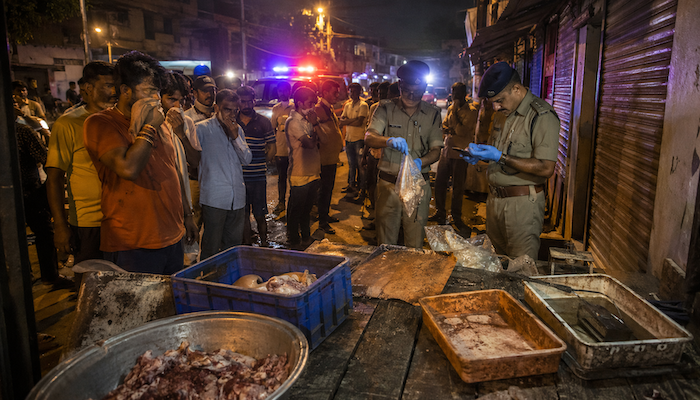
Case Summary
Hindu families in Sitamarhi, Bihar, consumed mutton that had been deliberately contaminated with human urine by a Muslim meat seller who marketed the meat as “pure halal” to Hindu customers. The incident triggered outrage across the area after local residents witnessed the meat being washed with urine before being sold to unsuspecting Hindu consumers. The act directly targeted Hindu customers who had regularly purchased meat from the vendor in good faith. The incident came to light on 14 May 2026 in the Nagar Police Station area on Riga Road in Sitamarhi, Bihar. Mohammad Mukhtar Ansari operated a roadside mutton stall near a private hotel and sold meat to local residents, including Hindu families from the surrounding area. Residents stated that Hindu customers had been purchasing meat from the shop for a long period and trusted the vendor’s claims regarding the quality and purity of the meat being sold. The matter escalated after local residents saw Mukhtar Ansari washing goat meat with his own urine before selling it to customers. Residents stated that he carried urine in bottles, poured it over the meat, and then sold the contaminated mutton while describing it as “pure halal” meat. Hindu customers who had unknowingly consumed the meat became the direct victims of the act. As information spread throughout the locality, large numbers of Hindu residents gathered near the stall, and anger intensified across the area. Hindu families expressed outrage after discovering that the meat they had consumed had been deliberately contaminated before sale. The incident created panic and disgust among local residents because the contaminated meat had already been distributed among customers in the area. Mukhtar Ansari fled the scene carrying a black bag after crowds began gathering at the location. Other nearby meat vendors shut their shops immediately as tensions escalated in the market area. Residents demanded strict action against the perpetrator and called for an investigation into the contamination of food sold to Hindu consumers. Police personnel from Dial 112 reached the spot after receiving information regarding the incident and brought the situation under control. City Police Station Officer Dhananjay Chaudhary later arrived with additional police personnel and calmed the crowd. Police seized the mutton being sold at the stall and sent samples to the Food Safety Department for testing. Police officials stated that action would be initiated following the investigation findings. Authorities also began searching for Mukhtar Ansari after he absconded from the scene. The seized meat remained under examination while police continued their inquiry into the contamination of food sold to Hindu consumers in Sitamarhi.
Why it is Hate Crime ?
This case has been added to the tracker under the primary category - Attack not resulting in death. Within this, the subcategory selected is - Attacked for Hindu identity. In several cases, Hindus are attacked merely for their Hindu identity without any perceived provocation. A classic example of this category of religiously motivated hate crime is a murder in 2016. 7 ISIS terrorists were convicted for shooting a school principal in Kanpur because they got ‘triggered’ seeing the Kalava on his wrist and tilak that he had put. In this, the Hindu victim had offered no provocation except for his Hindu religious identity. The motivation for the murder was purely religious, driven by religious supremacy. Such cases where Hindus are targeted merely for their religious identity would be documented as a hate crime under this category. This case represented a clear instance of a religiously motivated hate crime, as Hindu families were deceptively fed mutton contaminated with human urine by the Muslim perpetrator. The victims were not random consumers but specifically Hindu customers who had trusted the vendor and regularly purchased meat from his shop in good faith. The deliberate contamination of food consumed by Hindu families demonstrated targeted hostility directed at them because of their religious identity. Such conduct went beyond ordinary food adulteration and reflected deep-seated religious animosity, as the perpetrator intentionally subjected Hindu victims to humiliation, contamination and deception in a manner that directly violated their dignity and sense of personal safety. The selective targeting of Hindu customers for the consumption of contaminated meat further highlighted the religious nature of the act. The perpetrator marketed the mutton as “pure halal” while secretly contaminating it with urine before selling it to Hindu consumers, indicating conscious and deliberate targeting rather than an indiscriminate act. Feeding contaminated food to members of a specific religious community demonstrated hostility towards that community and exposed an intent to degrade, insult and psychologically harm the victims. The act carried a deeply dehumanising dimension, as the perpetrator treated Hindu customers with contempt and subjected them to conduct that no individual would reasonably inflict upon people they viewed with basic human respect. By deliberately exposing Hindu families to contaminated meat, the perpetrator reduced the victims to objects of mockery and humiliation because of their religious identity, making the incident a clear example of religiously motivated hatred. Food, purity and dietary practices hold profound religious and cultural significance within Hindu traditions. Hindus place strong emphasis on cleanliness, purity and the sanctity of food consumption, viewing food not merely as sustenance but as something deeply connected to spiritual discipline, personal ethics and religious practice. The deliberate contamination of food with human urine, therefore, carried an additional layer of humiliation and symbolic degradation. By deceptively forcing Hindu families to consume contaminated meat, the perpetrator violated not only their physical well-being but also their cultural and religious sensibilities. The act appeared designed to insult, mock and emotionally wound Hindu victims by desecrating values associated with purity and respect surrounding food within Hindu culture. Such conduct reflected an intent to target and victimise Hindus specifically because of their religious identity, reinforcing the hateful and discriminatory nature of the crime. The final religious marker was the deliberate use of the phrase “pure halal” while selling contaminated meat to Hindu customers. The perpetrator knowingly used religious terminology associated with Muslim meat preparation while simultaneously contaminating the product with urine before sale. This reflected conscious and intentional mockery because the phrase was used to falsely assure customers of purity while the meat had been intentionally contaminated. The deception demonstrated hostility toward Hindu consumers because the perpetrator knowingly exploited their trust while violating the bodily and religious sensitivities of Hindu families. The act revealed deliberate intent to target Hindus through humiliation attached to food consumption, contamination, and concealment. The perpetrator chose this method specifically because it inflicted degradation upon Hindu victims in a way designed to provoke disgust, outrage, and communal trauma tied directly to their Hindu identity. Given that this case met the parameters of a religiously motivated hate crime, it was added to the hate crime database of the tracker. Disclaimer: The Hinduphobia Tracker records incident dates based on when the crime occurred rather than when it was reported or published in the media. In this case, the exact date on which the contamination and sale of the mutton began was not specified in the available reports. Therefore, 13th May 2026, the date on which the incident was first publicly reported in the media, has been used as the indicative incident date for documentation purposes only.


Case Status
Complaint filed


Perpetrators Details
Perpetrators
Muslim Extremists
Perpetrators Range
One Person
Perpetrators Gender
male
 Sources




