Hindu religious sentiments outraged after Islamic flags placed on temple wall in Jind, Haryana
 Jind, Haryana, India
  25 June, 2017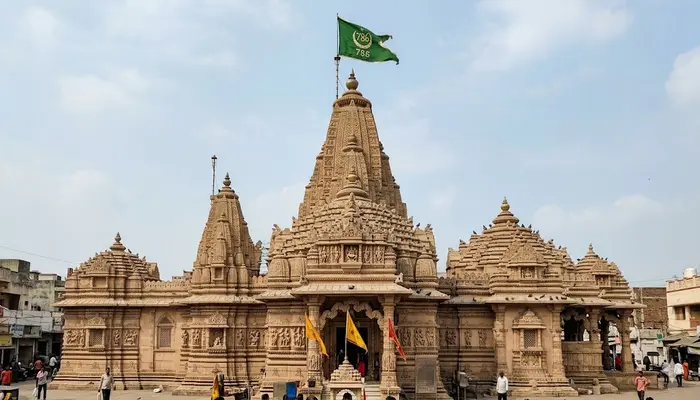
Case Summary
In the Anchra Khurd village of Jind district, Haryana, Hindu sentiments were insulted after blue flags bearing the number “786” were put on the walls of a Hindu temple. According to reports, the unrest began on the night of 25 June 2017, when a group of unidentified youths entered a mosque in the village while preparations for Eid were underway and assaulted members of the Muslim community. Three individuals, including the imam of the mosque, sustained injuries in the attack. Following the incident, Senior Superintendent of Police Shashank Anand, along with administrative officials, reached the village and remained there through the night to prevent further escalation and maintain law and order. The situation escalated further the following day on 26 June 2017, when blue-coloured flags inscribed with “786”, a number regarded as sacred in Islam, were found placed on the wall of a Hindu temple in the village. The appearance of the flags triggered outrage among local Hindu residents and heightened communal tensions in the area. Villagers and administrative officials later removed the controversial flag from the temple premises. A heavy police deployment was carried out across the village, in order to prevent violence and maintain peace during Eid celebrations. Despite the tense atmosphere, no further violent incidents were reported due to the continuous presence of police and district authorities. Safidon SDM Virendra Singh Sangwan stated that anti-social elements attempting to disturb communal harmony would not be spared and confirmed that the administration was closely monitoring the situation. Police also initiated a search operation to identify and apprehend those responsible for the assault on the imam and other mosque attendees.
Why it is Hate Crime ?
This case has been added to the tracker under the primary category of - Attack on Hindu religious representation. Within it, the sub-category selected is - Desecration of Hindu religious symbols. Icons and symbols or a religious representation of a spiritual ideal are widely revered in Hinduism. Iconography is of vital significance in the Hindu milieu. It helps connect people’s spiritual beliefs with the real world. Iconography within the Hindu faith takes several shapes and forms. Murtis are of most significance to Hindus, to which daily rituals, prayers and offerings are done. Besides the murtis, there are several other symbols which have deep significance in the Hindu faith – the Om and Swastika for example. Since these Hindu religious symbols hold paramount importance in Hinduism, any desecration of symbols, icons, murtis, religious representations and manifestations, is driven by animosity towards the faith itself which manifests itself through these murtis, icons and symbols. Therefore, any desecration of these Hindu religious symbols and representations is considered religiously motivated hate crimes under this category. The other sub-category selected is- Breaking rules of place of worship. Sanatan Dharma is not a religion of one book, which is to say that while it has religious scriptures that form the central tenets of the faith, there are several traditions followed through thousands of years, mostly passed from generation to generation orally. One of these oral traditions or written traditions is the rules of specific temples. Certain temples have rules which are traditional rules, dependent on the worship of the presiding deities. These rules and traditions have been followed for thousands of years whether they find scriptural mention or not. Such traditions are based on the nature and rules of worship of the presiding deity of that temple. Any non-compliance of these traditions owing to animosity towards the faith or for the sake of activism stems not only from the lack of faith in the presiding deity but also disregard for the faith of the devotees of that deity/temple and implicit bias against the faith, the tradition and the deity itself. Since these specific traditions are central to the faith of the devotees of that specific temple and presiding deity, any non-compliance with these traditional rules would be considered a religiously motivated hate crime. This case was added to the hate crime database because unidentified perpetrators deliberately targeted a Hindu temple in Anchra Khurd village in Haryana by placing blue flags inscribed with the number “786”, a symbol closely associated with Islam, on the wall of the temple premises. The act occurred shortly after communal tensions had already escalated in the village following an attack on members of the Muslim community during Eid preparations, making the deliberate placement of Islamic symbols on a Hindu place of worship a calculated act capable of provoking religious unrest and deeply hurting Hindu religious sentiments. In Hinduism, temples are not ordinary public structures but sacred spaces believed to house the divine presence of Hindu deities. Devotees visit temples to pray, perform rituals, seek spiritual peace and maintain a sacred connection with their faith. Every aspect of the temple premises, including its walls, symbols and surroundings, is treated with reverence by worshippers. Introducing overt religious symbols associated with another faith into such a sacred Hindu space amounted to a direct violation of the sanctity and religious character of the temple. The placement of flags bearing “786”, a number regarded as holy within Islam, was therefore not a neutral act of mischief but a deliberate intrusion into a Hindu religious site that transformed a place of devotion into a site of communal provocation. The act also constituted desecration of the temple because it imposed the religious symbolism of another faith onto a sacred Hindu site without the consent of devotees or temple caretakers. Hindu temples operate according to established religious customs and codes that preserve the purity and exclusively Hindu character of the place of worship. The deliberate hoisting of Islamic symbols on the temple wall violated these norms and disrupted the sanctity associated with the premises. Such conduct showed open disregard for Hindu religious traditions and the emotional attachment devotees have towards their temples and sacred spaces. Such incidents fit within a broader pattern in which religious symbols and places of worship are deliberately targeted to assert dominance, provoke communities and undermine the sanctity of sacred spaces. For Hindus, temples are central to communal and spiritual life, and any deliberate defilement or imposition of external religious symbols upon them is considered as an attack on the faith itself. The placement of Islamic flags on the temple wall caused emotional distress among devotees, disrupted communal harmony and amounted to religious harassment directed at the Hindu community. Taken together, the circumstances surrounding the incident, combined with the deliberate targeting of a Hindu religious site using Islamic symbols, demonstrated that the act was religiously motivated in nature and therefore warranted inclusion in the Hinduphobia Tracker database as an anti-Hindu hate crime. Disclaimer: The Hinduphobia Tracker records incidents based on when an event occurred or when the victim’s ordeal began. In this case, the incident involving the placement of Islamic flags bearing “786” on the Hindu temple premises came to light on 26 June 2017. Therefore, for documentation purposes, the date of the incident has been recorded as 26 June 2017.


Case Status
Unknown


Perpetrators Details
Perpetrators
Unknown
Perpetrators Range
Unknown
Perpetrators Gender
unknown
 Sources




