Anti-Hindu hate speech: Indian politician deliberately recites anti-Hindu couplet to humiliate Brahmin Hindu community
 New Delhi, Delhi, India
  4 May, 2026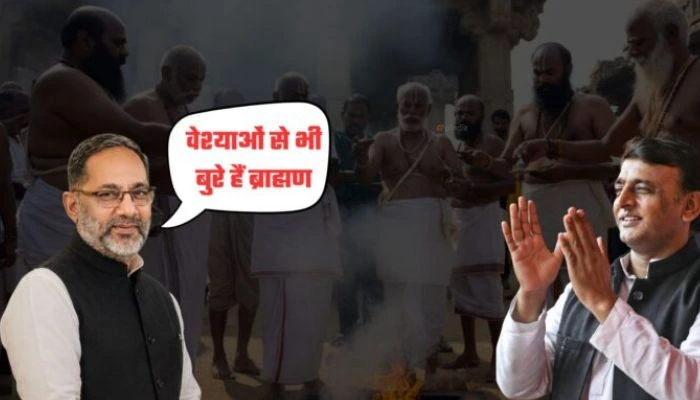
Case Summary
The Hindu Brahmin community was humiliated and denigrated on 5 May 2026 by Samajwadi Party (SP) national spokesperson Rajkumar Bhati. The accused used a book launch event at Jawahar Bhawan, Delhi, associated with the Rajiv Gandhi Foundation, as a platform to recite an anti-Hindu couplet targeting Brahmins before an applauding audience. The book that was getting launched was titled "The Virus of Caste and Communalism", authored by two Muslim writers, Dr Rafraf Shakeel Ansari and Javed Anwar. Neither of them addressed social evils within their own religious tradition during the event. During the book launch, Bhati recited the couplet: “ब्राह्मण भला न वेश्या, इनमें भला न कोय! और कोई-कोई वेश्या तो भली, ब्राह्मण भला न कोय”. The couplet directly compared Brahmins unfavourably to prostitutes. It further stated that some prostitutes were better than Brahmins. Bhati laughed while reciting the couplet. The audience applauded. One individual called for posters of the couplet to be displayed. The event was attended by Yogendra Yadav, Professor Ratan Lal, Ashutosh, and Sheeba Aslam Fahmi. All of them had documented histories of making derogatory statements about Hinduism. The audience celebrated the anti-Hindu and anti-Brahmin remark of Bhati rather than condemning the denigration. The video of Bhati’s remarks went viral and caused widespread outrage among the Brahmin and broader Hindu community. A First Information Report was registered against Bhati at Kavi Nagar police station, Ghaziabad, on the complaint of Bharatiya Janata Party’s former city president Ajay Sharma. He stated that Bhati had made indecent and objectionable remarks against the Brahmin Hindu community. He also stated that Bhati had compared them to women engaged in unethical work using offensive language. He added that the sentiments of the Brahmin community had been deeply hurt. Following the outrage, Bhati posted a video offering an apology. He stated that a seven-second clip had been taken out of context. The apology was widely characterised as insincere. The video showed Bhati reading from a paper and laughing while reciting the couplet. His supporters were seen in the background demanding that posters of the insult be displayed publicly. The Brahmin community announced a Mahapanchayat (a large community assembly convened to deliberate on matters of communal concern) for 15 May 2026. Uttar Pradesh Congress president Ajay Rai also demanded action against Bhati from Akhilesh Yadav, leader of the Samajwadi Party in Uttar Pradesh. Bhati carried a documented prior record of anti-Hindu statements. He had previously referred to “Brahminism”, a term used in this context as a euphemism targeting Hinduism, as a "virus". He had also called for a vaccine against it. He had denigrated the Ramcharitmanas (the sacred Hindu epic composed by the saint-poet Tulsidas, revered by hundreds of millions of Hindus as a divine text) as an ordinary poem. He had questioned the existence of Hindu deities while publicly declaring on television that he considered no one greater than the Prophet Muhammad. He had also stated that if he were Lord Rama, he would advise Brahmins to abandon their hypocrisy.
Why it is Hate Crime ?
The primary category for this case is "Hate speech against Hindus". The subcategory for this case is "Anti-Hindu slurs, mocking faith". Anti-Hindu slurs and the deliberate mocking of the Hindu faith owing to religious animosity involve the usage of derogatory terms, stereotypes, or offensive references to religious practices, symbols, or figures. One of the common anti-Hindu slurs used against Hindus is “cow-worshipper” and “cow piss drinker”. The intention of using this term is to demean and mock Hindus as a group and their religious beliefs since Hindus consider the cow holy. Additionally, some symbols and the slurs attached to them have a historical context that exacerbates the insult, hate, stereotyping, dehumanisation and oppression against Hindus. Cow worship has been used for centuries to denigrate Hindus, insult their faith and oppress Hindus specifically as a religious group. There has been overwhelming documentation about how cow slaughter has been used to persecute Hindus with cow meat being thrown in temples and places of worship. There has also been overwhelming documentation where cow meat (beef) has been force-fed to Hindus to either forcefully convert them to Islam or denigrate their faith. Apart from cow worship, the Swastika – which holds deep religious significance for the Hindus – has also been misinterpreted and distorted to use as a slur against Hindus. Similarly, the worship of the Shivling has been used by supremacist ideologies and religions to denigrate Hindus owing to religious animosity. Such slurs and denigration stem out of inherent animosity and hate towards Hindus and their faith, therefore, it is categorised as hate speech targeted at Hindus specifically owing to their religious identity. This incident exemplifies anti-Hindu hate speech, as Samajwadi Party spokesperson Rajkumar Bhati deliberately recited a vitriolic anti-Hindu couplet denigrating the Brahmin Hindu community, equating them to prostitutes and deeming some prostitutes superior, during a public event in Delhi, inciting applause and communal humiliation under the guise of literary discourse. Bhati's remarks targeted Brahmins, custodians of Hindu sacred texts like the Vedas and Ramcharitmanas, and experts in religious doctrines central to Hindu practice. By assailing this knowledgeable community, which transmits scriptural wisdom to all Hindus, the attack transcends caste critique to strike at Hinduism's foundational transmission of dharma, masking religious animosity towards Hindus as opposition to "Brahminism", a euphemism routinely deployed to vilify the Hindu faith itself. Such rhetoric perpetuates fake upper-caste/lower-caste narratives to target Brahmins, thereby undermining Hindus collectively, as Bhati's platform at the Rajiv Gandhi Foundation-linked event demonstrates. Narratives portraying "upper caste" Hindus as tyrannical towards disadvantaged sections of Hindu society are essentially anti-Hindu in nature, owing to the intention behind spreading disinformation of this kind. It is often claimed that even such disinformation cannot be termed anti-Hindu since both the purported victim and aggressor are from the Hindu community; however, it is spread with the specific intent of discrediting Hindu society and their faith by branding it oppressive and tyrannical. The intent of such disinformation is to signal that Sanatan Dharma itself is discriminatory in nature and meant only for the practice of a specific class of Hindus considered "upper caste". This false narrative is perpetuated to discredit and delegitimise the faith and dehumanise its followers. The direct consequence of creating such false "atrocity literature" is an increase in violence against specific sections of Hindus and the exertion of pressure on another section to alienate themselves from their professed faith, convincing them that the faith itself discriminates against them. Bhati's couplet and book launch echo this "atrocity literature", fostering prejudice, hate, and violence against Brahmins, alienating lower castes from their faith, and eroding Hinduism's core through calculated communal venom. Since such narratives attack the core of the faith with the intention of delegitimisation, dehumanisation, and alienation of Hindus, they constitute a hate crime against Hindus and the faith they profess, exposing the event as a deliberate assault on Hindu unity under the guise of caste critique. Such attacks on Brahmins are strategically designed to shatter Hindu unity by igniting caste divides and sowing infighting within the community, marking the initial thrust in a broader assault on all Hindus, every practising devotee of Sanatan Dharma. This calculated denigration goes far beyond mere caste rhetoric; it strikes directly at the collective religious identity and shared heritage of Hindus, transforming a public platform into a weaponised space for communal provocation and establishing it as a clear case of religiously motivated hate crime. Rajkumar Bhati's extensive history of religious animosity cements this incident's hateful core: he has repeatedly denigrated the Ramcharitmanas, Tulsidas's sacred epic, revered by hundreds of millions as a divine sculpting of devotion and moral guidance, as nothing more than an ordinary poem; openly exalted Prophet Muhammad as supreme while hurling derogatory barbs at Hindu gods and goddesses, questioning their very existence; and labelled Hinduism itself as "Brahminism", framing it as a pernicious virus that demands a societal vaccine for eradication. This pattern of prejudice lays bare his deep-seated animus towards Hindu faith, scriptures, deities, traditions, and the community at large, unequivocally amounting to anti-Hindu hate speech. The event's stark anti-Hindu character is undeniable, given the presence of notorious figures like Yogendra Yadav, Professor Ratan Lal, Ashutosh, and Sheeba Aslam Fahmi, each with a documented trail of anti-Hindu rhetoric, from dismissing Hindu rituals as superstitious relics to branding devotional practices as tools of oppression or bigotry. Their silent complicity, coupled with the audience's enthusiastic applause for Bhati's slur at Jawahar Bhawan, exposes the gathering's true intent: not scholarly discourse, but a deliberate echo chamber amplifying collective contempt for Hindus. This orchestrated applause amid such company transforms the book launch into an unabashed platform for anti-Hindu hate speech. Given that this case meets the parameters of a religiously driven hate speech, it is being added to the hate crime database of the Hinduphobia Tracker.


Case Status
Complaint registered


Perpetrators Details
Perpetrators
Others
Perpetrators Range
One Person
Perpetrators Gender
male
 Sources




