Hindus lured to convert to Christianity through inducements and brainwashing in Bhubaneshwar, Odisha
 Bhubaneshwar, Odisha, India
  12 May, 2026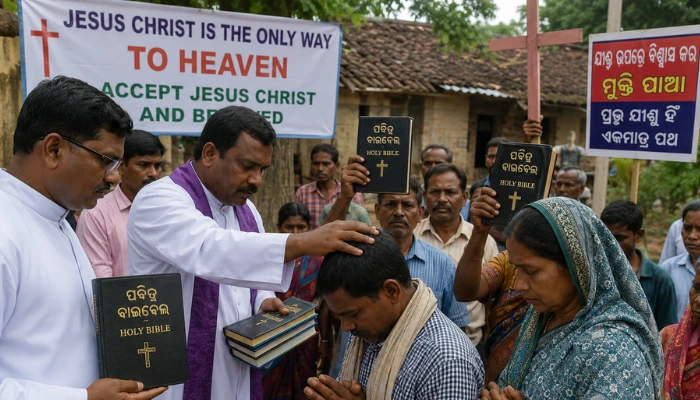
Case Summary
In Odisha's Bhubaneshwar, Hindu residents were targeted for religious conversion by members of Christian missionaries. The accused lured victims for conversion by providing inducements and brainwashing them with Christian religious texts. According to media reports, this incident occurred on Wednesday, 13 May 2026. It came to light when the Commissionerate Police received information that religious conversion activities were being conducted inside a hotel in the Nayapalli area of Odisha under the guise of non-governmental organisation workshops and social programmes. Acting on a complaint, a police team raided the hotel and entered a room where the Christian prayer meeting was taking place. According to local Hindu residents, similar meetings had been organised at the hotel on previous occasions under the cover of non-governmental organisation workshops and awareness programmes. Residents stated that Hindus from different areas were invited to attend these sessions and were offered inducements, counselling, religious preaching, and brainwashing aimed at influencing them towards conversion. Some locals further stated that documents recovered from the hotel contained references to strategies targeting members of the Hindu community for conversion. The sudden police action created tension in the locality, with a large number of local Hindu residents gathering outside the hotel and protesting against the conversion activities. During the raid, police recovered several Christian religious books and related literature from the hotel room. These texts and literature were used to indoctrinate Hindu victims into converting. Four Christian individuals present at the scene were detained by the police for questioning. Police officials stated that they were investigating the exact nature of the activities conducted inside the hotel room. Statements from the detained individuals, hotel staff, and witnesses were being recorded as part of the inquiry. Authorities added that further legal action would depend on the evidence collected during the ongoing investigation.
Why it is Hate Crime ?
The primary category selected in this case is- Predatory Proselytisation. The subcategory selected is- Conversion/attempts to convert by inducement. Predatory Proselytisation is not just limited to threat, harassment, force and violence, but it also has contours of stealth. In several cases, the Hindu victim is exploited to convert, with non-Hindus taking advantage of their poverty. In such cases, the Hindu victim who is suffering financially is offered monetary benefits, including lucrative offers for jobs, health treatment, education, etc, to induce the victim into changing his/her religion. In such cases, the religious identity of the victim and the aim to disenfranchise him from his faith form the heart of the crime. Also, taking advantage of and exploiting an individual’s economic vulnerabilities is widely acknowledged as exploitation, forms of which are often penalised by law. Such cases therefore are considered religiously motivated hate crimes since the victim’s religious identity forms the very heart of the crime itself. The other subcategory selected is- Proselytisation by grooming, brainwashing, manipulation or subtle indoctrination. The tertiary category selected is- Pattern of targeting Hindus. Religious brainwashing essentially means the often subtle and forcible indoctrination to induce someone to give up their religious beliefs to accept contrasting regimented ideas. Religious grooming or brainwashing also involves propaganda and manipulation. It involves the systematic effort, driven by religious malice and indoctrination, to persuade “non-believers’ to accept allegiance, command, or doctrine to and of a contrasting faith. Cases of such grooming or brainwashing are far more nuanced than direct threats, coercion, inducement and violence. In such cases, it is often seen that there is repeated, subtle and continual manipulation of the victim to induce disaffection towards their own faith and acceptance of the contrasting faith of the perpetrator. While subtle indoctrination is widely acknowledged as predatory, an element which is often understated in such conversions or the attempts of such conversion is the role of loyalty and trust which might develop between the perpetrator and the victim. Fiduciary relationships are often abused to affect such religious conversion. For example, an educator transmitting religious doctrine of a competing faith to a Hindu student. The Hindu student is likely to accept what the teacher is transmitting owing to existence of the fiduciary relationship. The exploitation of the fiduciary relationship to religiously indoctrinate victims would also be included in this category. Since the underlying animosity towards the victim’s faith forms the basis of predatory proselytization, such cases are considered religiously motivated hate crimes. In this case, Hindu residents were targeted for forced religious conversion by Christian missionaries through inducements, counselling, religious preaching, and the use of Christian religious texts and literature. The organised nature of these conversion activities, combined with the specific targeting of Hindus, demonstrates that the actions were directed against the Hindu community as a collective. When members of a particular religious community are singled out for conversion efforts, it reflects a fundamental disregard for their existing faith and religious identity. Conversion achieved through sustained persuasion, inducements, and psychological influence is not merely the sharing of religious beliefs, but an attempt to weaken and replace the religious identity, traditions, and beliefs of the targeted Hindu community. In this case, Hindus were specifically targeted for conversion, making the incident religiously motivated in nature. The use of inducements to encourage conversion further demonstrates that these activities were deliberate and premeditated efforts aimed at vulnerable Hindus. By offering assistance, counselling, and other benefits with the objective of influencing Hindus to abandon their faith, the perpetrators exploited vulnerable individuals specifically because of their religious identity. Such tactics are frequently employed in organised conversion campaigns where socially and economically vulnerable Hindus are targeted in order to advance religious conversion efforts. This form of manipulation undermines the agency and dignity of the victims and places pressure on them to renounce their faith. These actions were not isolated acts of charity or religious outreach, but systematic attempts to persuade Hindus to discard their faith and convert to Christianity, reflecting hostility towards the religious identity of the victims. The Christian missionaries also attempted to influence Hindu victims through counselling sessions, religious preaching, and sustained ideological persuasion aimed at weakening their attachment to Hinduism and encouraging conversion to Christianity. Such methods go beyond the mere expression of religious belief and instead involve deliberate psychological and emotional manipulation intended to make Hindu victims question, abandon, and detach themselves from their own faith and religious identity. The use of repeated counselling, religious narratives, and targeted preaching to persuade Hindus to renounce their religion demonstrates a calculated attempt to strip them of their cultural and spiritual roots. When members of one religious community specifically target another community for organised conversion efforts through indoctrination and psychological influence, it reflects a fundamental disrespect towards the beliefs, traditions, and identity of that community. In this case, the efforts were specifically directed at Hindus, which demonstrates clear religious animosity towards the Hindu faith and its followers. Such actions were designed to erode the religious identity of Hindu victims and replace it with another faith, making the incident religiously motivated in nature. The recovery of Christian religious books and related literature from the hotel room further highlights the organised and ideological nature of the conversion activities. These texts and materials were used to indoctrinate and brainwash Hindu victims into conversion. The deliberate use of the scriptures and literature of one religion to influence and manipulate members of another faith community, with the clear objective of conversion, constitutes a direct attack on the religious beliefs and identity of the targeted group. Such actions are intended to undermine the faith of Hindu victims and weaken their attachment to their religious traditions. The systematic use of religious literature, counselling, and preaching in organised gatherings demonstrates that this was not an isolated act of evangelism, but part of a broader and coordinated effort aimed at converting Hindus. Local Hindu residents further stated that similar conversion-related meetings had been organised previously under the guise of non-governmental organisation workshops, awareness programmes, and social activities. The repeated organisation of such gatherings indicates that this was not an isolated incident, but part of a broader and systematic pattern of targeting Hindus for conversion. The use of social programmes and non-governmental organisation activities as a cover to conduct religious conversion efforts demonstrates premeditation and organised intent. By repeatedly targeting Hindus in this manner, the perpetrators sought to expand Christian conversion activities within the area and influence a larger section of the Hindu community. Such organised and repeated attempts to convert Hindus in large numbers reflect a deliberate effort to undermine the demographic and religious character of the local Hindu community while asserting the dominance and expansion of Christianity in the area. This pattern of repeatedly targeting Hindus for conversion showcases hostility towards the Hindu faith and community, making the incident a clear example of a religiously motivated hate crime rooted in anti-Hindu animosity. These instances of targeted proselytisation activities stem from inherent hostility towards the victims' professed faith since Abrahamic faiths believe that any non-adherent to their faith is subject to being dehumanised till they convert, making it a religiously motivated crime against Hindus. Therefore, this case is being added to the hate crime database of the Hinduphobia Tracker.


Case Status
Arrested


Perpetrators Details
Perpetrators
Christian Extremists
Perpetrators Range
From 2 To 5
Perpetrators Gender
unknown
 Sources




