Hindu children and teachers attacked by Muslim mob for carrying yellow colour flag during Republic Day parade
 Murliganj, Bihar, India
  25 January, 2026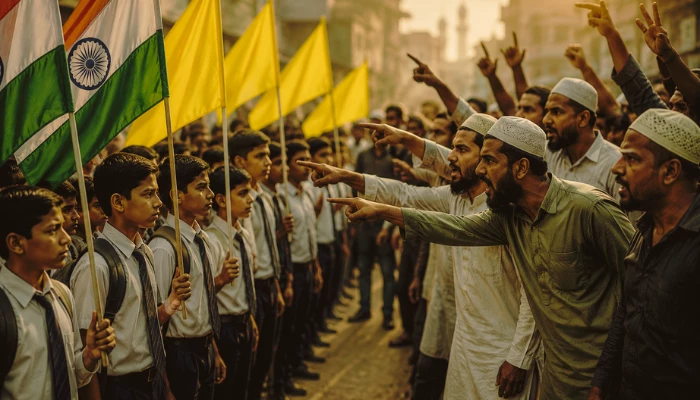
Case Summary
In Bihar’s Madhepura district, Hindu students and teachers participating in a Republic Day Prabhat Pheri (early morning patriotic procession) were stopped, harassed, and assaulted by members of the Muslim community over the colour of flags being carried during the event. The incident occurred on 26 January 2026 in the Murliganj area. Students and teachers of a private school were participating in the procession carrying yellow flags bearing patriotic slogans when members of the Muslim community objected to the colour of the flags. They questioned why the flags were yellow instead of green and began heckling those participating in the procession. The accused stated that yellow represented Hinduism and insisted that green flags should have been used instead. Green is widely associated with Islam in religious and cultural contexts. The confrontation escalated, and some students and teachers were assaulted during the dispute. As tensions rose, local Hindu villagers gathered at the spot, and a communal clash broke out in the area. The incident created significant tension in the locality, following which a heavy police deployment was made to prevent further escalation. Senior police and administrative officials reached the area after receiving information about the confrontation. Authorities stated that the situation was eventually brought under control and security arrangements were strengthened to maintain peace. Police initiated an investigation into the incident following the communal tension surrounding the Republic Day procession.
Why it is Hate Crime ?
This case is being added to the tracker under the primary category "Attack not resulting in death". The sub-category selected is: "Attack on religious procession". The outward celebration and display of religious symbols is an intrinsic part of Hinduism. Religious processions on various festivals are age-old traditions and a way to manifest faith and form a part of the religious practices of Hindus. On several occasions, such religious processions come under attack by non-Hindu mobs, in a manifestation of their animosity towards Hinduism and its practices. The reasons cited for such violent attacks are many and range from crossing a non-Hindu resident-dominated area to playing loud music, crossing from an area where there is a religious structure of another faith, etc. The violent attacks are triggered by the outward display of religiosity by Hindus. The attacks are mainly a manifestation of religious supremacist doctrine, which believes that idolatry, essentially the Hindu faith, deserves to be annihilated since the very tenets of Hinduism, its practices and traditions are considered a sin in those doctrines. Since these attacks emanate from intrinsic and doctrinal animosity towards Hindus and Hinduism, it is considered a religiously motivated hate crime under this category. Another subcategory selected is "Communal Clash/Attack". Communal clash is a form of collective violence that involves clashes between groups belonging to different religious identities. For a communal clash between Hindus and non-Hindus to qualify as a religiously motivated hate crime, the trigger of the violence itself would have to be anti-Hindu in essence. For example, if there is a Hindu religious procession that comes under attack from a non-Hindu mob and after the initial attack, Hindus retaliate in self-defence, leading to a communal clash between the two religious communities. While at a later stage, both communities are involved in the clash/violence, the initial trigger of the violence was by the non-Hindu mob against the Hindus, and therefore, it could safely be termed as an anti-Hindu violence. Further, the trigger would also have to be religiously motivated. In the cited example, the attack by the non-Hindu mob was against religious processions and therefore can be concluded to be religiously motivated. In some cases, the trigger may be non-religious; however, it develops into religious violence against Hindus at a later stage. In such cases, too, the foundational animosity towards Hindus becomes the motivating factor of the crime, and therefore, it would be classified as a religiously motivated hate crime against Hindus under this category. The other subcategory selected is- Attacked for Hindu identity. In several cases, Hindus are attacked merely for their Hindu identity without any perceived provocation. A classic example of this category of religiously motivated hate crime is a murder in 2016. 7 ISIS terrorists were convicted for shooting a school principal in Kanpur because they got ‘triggered’ seeing the Kalava on his wrist and tilak that he had put. In this, the Hindu victim had offered no provocation except for his Hindu religious identity. The motivation for the murder was purely religious, driven by religious supremacy. Such cases where Hindus are targeted merely for their religious identity would be documented as a hate crime under this category. The incident in Madhepura carries clear religious markers because Hindu students and teachers participating in a peaceful Republic Day Prabhat Pheri were specifically targeted over the colour of the flags they were carrying. The objection raised was not about public disturbance, unlawful conduct, or any administrative issue. The confrontation began solely because the procession carried yellow flags, which the Muslim group openly identified as representing Hinduism, while insisting that green flags should have been used instead. Green is widely associated with Islam in religious and cultural contexts. This makes the religious motivation behind the targeting explicit. The Hindu students and teachers were not attacked for any act of provocation but because visible symbols associated with Hindu identity were considered unacceptable by the accused. The fact that children participating in a patriotic Republic Day procession were confronted and assaulted over the use of a colour associated with Hinduism demonstrates clear hostility towards Hindu religious and cultural expression in public space. The assault on students and teachers further intensified the religious nature of the incident. Teachers and minor children taking part in a national celebration became targets simply because the procession visibly reflected Hindu cultural identity through the use of yellow flags. Such conduct reflects intolerance towards Hindu assertion even in peaceful civic and patriotic events. The communal clash that followed must also be understood in its proper context. Reports indicate that local Hindus gathered only after the students and teachers were stopped, harassed, and assaulted. The reaction from the Hindu side emerged in response to the attack on the procession participants and in defence of the children and teachers present at the spot. There is no indication that the Hindu participants initiated the confrontation. Rather, the violence escalated after objections were raised against the Hindu-associated colour and physical aggression was directed towards those participating in the procession. The incident, therefore, was not an ordinary clash between two groups but a targeted act of hostility against Hindu students, teachers, and visible Hindu cultural expression during a national event. The attack over the use of yellow flags, identified by the accused themselves as representing Hinduism, demonstrates direct animosity towards Hindu identity and religious symbolism. Since the targeting occurred specifically on the basis of Hindu association and expression, the case was added to the hate crime database of the tracker as a religiously motivated incident.


Case Status
Unknown


Perpetrators Details
Perpetrators
Muslim Extremists
Perpetrators Range
Unknown
Perpetrators Gender
male
 Sources




