Hindu girl lured into relationship and marriage by Muslim man posing as Hindu in Gujarat; accused had similarly targeted two other Hindu girls
 Valsad, Gujarat, India
  11 May, 2025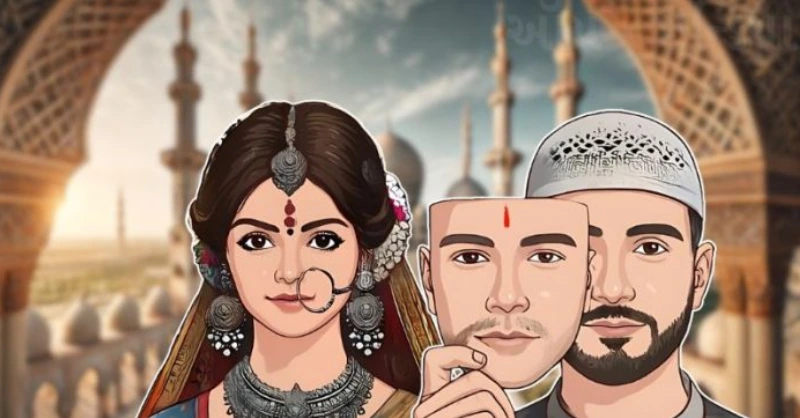
Case Summary
A Hindu tribal girl from Valsad, Gujarat, was trapped in a relationship and marriage with a Muslim man named Arbaaz, who pretended to be a Hindu man. The accused created fake social media profiles under Hindu names such as “Jiya Nayaka” and “Ankit Dhodiya Patel”. Using these fake Hindu identities, he befriended the Hindu tribal girl and, after gaining her trust over the course of a year, trapped her into marriage. The entire incident began through a social media platform, where the accused sent a friend request to the Hindu tribal girl using the fake account named “Jiya Nayaka”, alias “Ankit”. Over time, he built a close friendship with her while continuing to conceal his real identity. What started as an online interaction gradually progressed towards marriage, with the girl and her family believing that he belonged to the Hindu tribal Dhodiya Patel community. Even after Diwali, when he took the girl to visit his aunt’s house, he maintained the same fake Hindu identity so that the deception remained undiscovered. When the girl’s parents invited him to discuss marriage, the accused continued misleading them. Instead of bringing elders from his family, he arrived only with two young friends so that his real identity would not be exposed. By speaking about community values and cultural traditions, he convinced the girl’s family to agree to the marriage, after which he married the Hindu tribal girl according to Hindu traditions. The truth came to light only after the marriage rituals had been completed and the girl reached her in-laws’ house. She then discovered that the man she had married was not Hindu but Muslim, and that his real name was Arbaaz. The revelation left the victim devastated. After she came to know the truth, the accused and his family seized her mobile phone and confined her inside the house. Despite the pressure and fear, she managed to contact her family and inform them about what had happened. Serious concerns were also raised regarding the conduct of the police in the matter. According to the victim’s family and Hindu organisations, a written complaint regarding the matter had already been submitted one to two months earlier, between March 2026 and April 2026, yet no action was taken. The victim’s family had to struggle through the night at the police station in pursuit of justice, leading to widespread anger among local residents and Hindu organisations. Hindu organisations further stated that the accused had previously trapped two other Hindu girls in a similar manner. He was also accused of involvement in illegal activities such as narcotics trade and liquor smuggling. Following the incident, a large number of Hindu organisations and community leaders gathered at the Valsad Rural Police Station and demanded strict action against the accused under Gujarat’s anti-conversion laws. They also warned that if prompt and appropriate action was not taken by the police administration, a large-scale protest movement would be launched.
Why it is Hate Crime ?
This case is added to the tracker under the primary category- Crimes against women in relationships and other sexual crimes. The subcategory selected is- Man pretends to be Hindu. The tertiary categories selected are- Name Changed, Marries as per Hindu rituals, and Pattern of targeting Hindu women. When a non-Hindu man pretends to be a Hindu to deceive a Hindu woman into a relationship, the act is seen as triggered by malafide intentions. In some cases, the woman eventually accepts the man’s original religious identity and converts after the man’s identity is revealed. These cases could be argued as cases of religious brainwashing and a result of the pressure a woman feels after getting into a relationship with a man. The woman, it can be argued, also changed her religious identity because of the stigma she believes she might face if she chooses to walk out of a deceptive relationship. However, for the purpose of documenting hate crimes, the cases in this subcategory are limited to those where there is explicit violence aimed at religious conversion against the wishes of the victim (force-feeding beef, blackmailing with intimate videos, rape on refusal to convert, etc), or if the woman herself complains of the man’s religious deception. In such cases, it is established that the deception of the non-Hindu man had a specific aim of religious conversion or targeting of the victim due to her Hindu religious identity, therefore, making it a religiously motivated hate crime. This case was a clear instance of a religiously motivated hate crime, as a Hindu girl was lured into a relationship and then marriage by a Muslim man who was pretending to be Hindu. This deception and entrapment of a Hindu girl in a romantic relationship and marital union showcased the malicious and predatory nature of the accused. First, the perpetrator’s act of deception by posing as a Hindu demonstrated clear bias and malicious intent towards the victim’s religion. By hiding his true identity, Arbaaz manipulated the Hindu girl’s trust and targeted her under false pretences, indicating a premeditated effort to exploit her based on her religious background. Additionally, the accused created fake social media identities under Hindu names such as “Jiya Nayaka” and “Ankit Dhodiya Patel” in order to legitimise his fabricated identity in the eyes of the victim and her family. This constituted a direct violation of her right to informed consent regarding whom she chose to be in a relationship and marriage with, as well as an infringement upon her religious beliefs. Thus, the perpetrator’s deliberate decision to hide his religious identity strongly underscored the religious motive behind this crime. In such instances, identity concealment was not merely a deceptive tactic for personal reasons but a calculated strategy rooted in religious profiling and targeting. The accused knew that the victim, being Hindu, would likely refuse his advances if she knew his real identity, and he circumvented this by lying and assuming a fake Hindu identity, which directly pointed to religiously driven intent. This deception reflected a larger pattern where Hindu girls were specifically singled out using false Hindu identities by Muslim men. Such targeted victimisation based on religion demonstrated a fundamental disregard for Hinduism and exposed deeper animosity towards Hindu girls and their beliefs, making it a religiously driven hate crime. The accused continued maintaining the false Hindu identity throughout the relationship and even during marriage discussions with the girl’s family. He deliberately avoided bringing elders from his own family so that his real identity would not be exposed, and instead arrived only with a few young associates to sustain the deception. By speaking about Hindu community values, traditions, and cultural practices, he gained the trust of the victim’s family and secured their approval for the marriage under completely false pretences. This demonstrated a highly calculated and premeditated intention to specifically target and exploit the girl because of her Hindu identity. The sustained deception over a long period, including during sensitive matrimonial discussions, showed that the accused consciously weaponised religious identity in order to manipulate, entrap, and exploit the victim, making the act religiously motivated in nature. The marriage itself was conducted according to Hindu rituals and customs, which further deepened the deception and violated the victim’s religious beliefs and sentiments. Hindu marriage rituals are regarded as sacred and spiritually significant within the Hindu community. By participating in these rituals under a fabricated Hindu identity and using them merely as a tool to trap the victim into a predatory marital union, the accused reduced sacred religious traditions to instruments of deception. This amounted to a serious insult to the sanctity of Hindu marriage customs and caused deep emotional and religious harm not only to the victim but also to her family and wider Hindu community. The deliberate misuse of Hindu traditions in order to legitimise a fraudulent marriage reflected clear disregard and hostility towards Hindu religious practices, thereby making the act a hate crime driven by religious animosity. The fact that the accused had previously targeted two other Hindu girls in a similar manner further demonstrated that this was not an isolated incident but part of a broader and repeated pattern of targeting Hindu girls through deception and false religious identities. The repeated selection of Hindu victims indicated deliberate religious profiling and showed that Hindu girls were specifically viewed as vulnerable targets to be manipulated, exploited, and violated through fraudulent relationships and marriages. Such repeated conduct reflected a dehumanising attitude towards Hindu girls, reducing them to objects for exploitation while showing complete disregard for their autonomy, dignity, religious beliefs, and consent. This established a continuing pattern of religiously motivated targeting and exposed deeper animosity towards Hindus and Hindu women, making the crime not merely personal in nature but rooted in religious hostility and bias. Given that this case meets the parameters of a hate-driven offence, it is being added to the hate crime database of the Hinduphobia Tracker. Disclaimer: The Hinduphobia Tracker records incident dates based on when the victim’s ordeal began, rather than when the case was reported in the media. In this case, the exact beginning of the victim’s ordeal has not been specified. The available information only provides an estimated timeframe, indicating that her suffering began in 2025, while the only exact date mentioned is 12 May 2026, which is the date of the media report’s publication. Based on these details, an indicative incident date of 12 May 2025 has been selected. This date is recorded for documentation purposes only. In this case, although the primary victim is the Hindu tribal girl, the accused had similarly targeted two other girls as well. Therefore, the total victim count has been recorded as three.
Victim Details
Total Victim
3
Deceased
0
Gender
- Male 0
- Female 3
- Third Gender 0
- Unknown 0
Caste
- SC/ST 1
- OBC 0
- General 0
- Unknown 2
Age Group
- Minor 0
- Adult 1
- Senior Citizen 0
- Unknown 2


Case Status
Complaint filed


Perpetrators Details
Perpetrators
Muslim Extremists
Perpetrators Range
One Person
Perpetrators Gender
male
 Sources




