Hindu temple targeted, sacred idols of Hindu deities desecrated by miscreant in Sikar, Rajasthan
 Sikar, Rajasthan, India
  7 May, 2026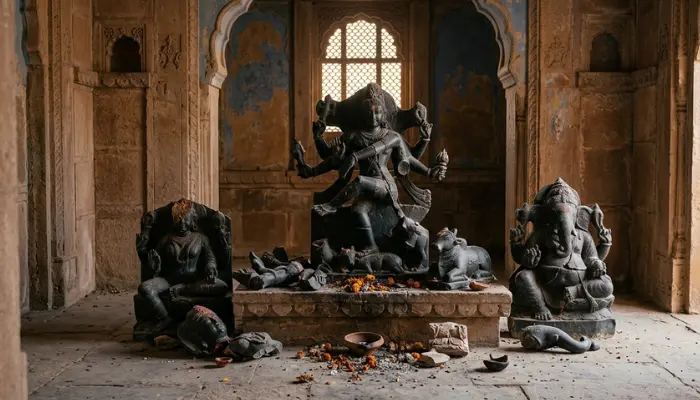
Case Summary
In Bhalabhdaspura village, in the Neem Ka Thana area of Rajasthan's Sikar district, a Hindu temple of Lord Shiva was targeted and its sacred idols were desecrated by a miscreant named Lali Devi. This incident occurred on the night of Friday, 8 May 2026, following which tension and anger prevailed throughout the village. The incident came to light on the morning of Saturday, 9 May 2026, when villagers found the idols missing from the temple. According to villagers, some young people from the village had come to the temple at around 5 a.m. to offer prayers. They became suspicious when they found the idols missing. A search of the surrounding area led to the discovery of broken idols of the Shiva family lying in a field some distance from the temple. This scene caused widespread anger among the Hindu villagers. News of the incident quickly spread throughout the village, and a large number of people gathered at the scene. The villagers described the incident as a serious matter involving religious sentiments and demanded immediate action. Following this, the police were alerted about the incident and took a suspect named Lali Devi into custody. Sadar Police Station officer Rajesh Doodi said, “The woman, Lali Devi, suspected in this case, was taken into custody for questioning. During interrogation, the woman claimed that she was angry with God, which was why she broke the idols in the temple that morning and threw them into a field.” The police arrested the accused woman, Lali Devi. At the time of writing this report, they were investigating the entire case and were also looking into other aspec+ts of the incident.
Why it is Hate Crime ?
This case is added to the tracker under the primary category: Attack on Hindu religious representations. The subcategory selected is: Desecration of Hindu religious symbols. Icons and symbols or a religious representation of a spiritual ideal are widely revered in Hinduism. Iconography is of vital significance in the Hindu milieu. It helps connect people’s spiritual beliefs with the real world. Iconography within the Hindu faith takes several shapes and forms. Murtis are of most significance to Hindus, to which daily rituals, prayers and offerings are done. Besides the murtis, there are several other symbols which have deep significance in the Hindu faith – the Om and Swastika for example. Since these Hindu religious symbols hold paramount importance in Hinduism, any desecration of symbols, icons, murtis, religious representations and manifestations, is driven by animosity towards the faith itself which manifests itself through these murtis, icons and symbols. Therefore, any desecration of these Hindu religious symbols and representations is considered religiously motivated hate crimes under this category. The other subcategory selected is- Attack on Temples. In Hinduism, a temple is the abode of the Deity. The Deity in the Temple is consecrated, thereby, making it a real, breathing entity. Hindus believe that not just the Deity but the temple premises itself are sacred to Hindus since Hindus hold the faith that the entire Temple space is an amalgamation of the divine energy of the deity. Given the central significance of Temples in Hindu Dharma, any attack against a Hindu Temple or its peripheral premises is an attack on the faith itself and is born out of animosity towards the faith, of which, the Temple is a central tenet. Any manner of attack against a Temple and/or its premises would therefore be considered a religiously motivated hate crime. This case is a clear example of a religiously motivated hate crime, as the perpetrator desecrated sacred idols of Lord Shiva and the Shiva family inside a Hindu temple, amounting to a clear case of an offence motivated by anti-Hindu hatred and bigotry. In Hinduism, idols are not treated as mere objects or decorative artefacts. Consecrated idols are revered as sacred embodiments of deities and are worshipped with devotion, rituals, and reverence by devotees. Hindus believe that the divine resides within these consecrated idols, making them central to religious life and spiritual practice. Lord Shiva, Goddess Parvati, and Lord Ganesha are among the most deeply revered deities in Hinduism, worshipped across households and temples throughout the country. The deliberate targeting of consecrated Hindu idols cannot be dismissed as a random act of destruction or ordinary vandalism because the act specifically targeted symbols that hold immense religious importance for Hindus and struck at the spiritual core of the Hindu faith. Such actions are not value-neutral acts but deeply provocative acts that attack the religious identity, beliefs, and dignity of the Hindu community. Therefore, the act of desecrating these idols showcases deep-seated religious animosity towards the Hindu community and faith, making it a hate crime. When sacred Hindu symbols are intentionally desecrated inside a place of worship, it reflects hostility towards the faith itself and creates fear, pain, and insecurity among devotees. Such acts of desecration violate Hindu sentiments and cause deep hurt to the feelings of the Hindu community. The destruction of sacred idols is experienced by devotees as an attack on their faith, traditions, and collective religious identity. Similarly, Hindu temples hold immense spiritual and cultural significance in Hinduism. They are not merely physical structures but sacred institutions that are believed to be the abode of deities and centres of worship, devotion, and community life. Hindus visit temples to pray, seek blessings, celebrate festivals, and maintain a spiritual connection with their faith. The idols within temples are inseparable from the larger temple ecosystem because they form the spiritual heart of the temple itself. Therefore, desecrating idols inside a Hindu temple also amounts to an attack on the temple ecosystem as a whole. Such attacks deeply wound Hindu sentiments because they violate spaces that Hindus consider sacred and inviolable. The deliberate targeting of a Hindu temple environment creates anguish among devotees and fosters a sense of insecurity regarding the protection of their religious institutions and beliefs. This transforms the act from ordinary vandalism into a hate crime driven by religious hostility. The act of the accused claiming that she broke the temple idols because she was angry with God appears to be an excuse used to desecrate the temple and make her actions appear justified. Personal anger or frustration can never justify the destruction of sacred religious idols that are revered not only by an individual but by the entire Hindu community. Religious idols inside temples are collective symbols of faith and devotion, and damaging them knowingly demonstrates disregard towards the religious sentiments of millions of Hindus. Being angry with God is no justification for desecrating consecrated idols inside a temple, especially when such actions cause widespread emotional and religious harm to an entire community. The nature of the act, the deliberate targeting of sacred idols, and the location of the offence inside a Hindu temple together indicate hostility towards Hindu religious symbols and practices, making it a hate crime motivated by religious animosity. Given that this case meets the parameters of a religiously motivated offence, it is being added to the hate crime database of the Hinduphobia Tracker.


Case Status
Arrested


Perpetrators Details
Perpetrators
Others
Perpetrators Range
One Person
Perpetrators Gender
female
 Sources




