Hindu man brutally stabbed by Muslim wife's brother and accomplice over interfaith marriage in Maharashtra
 Ulhasnagar, Maharashtra, India
  3 May, 2026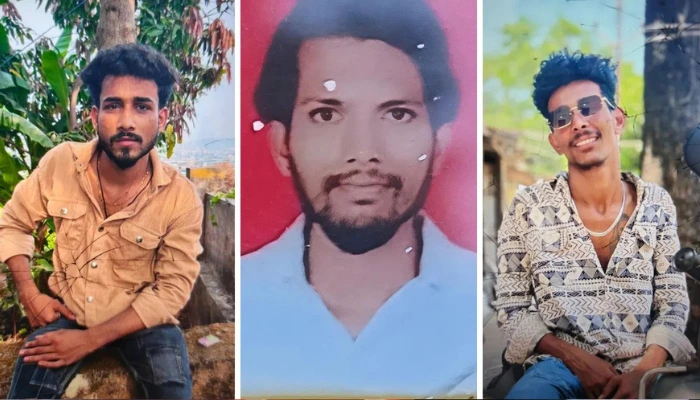
Case Summary
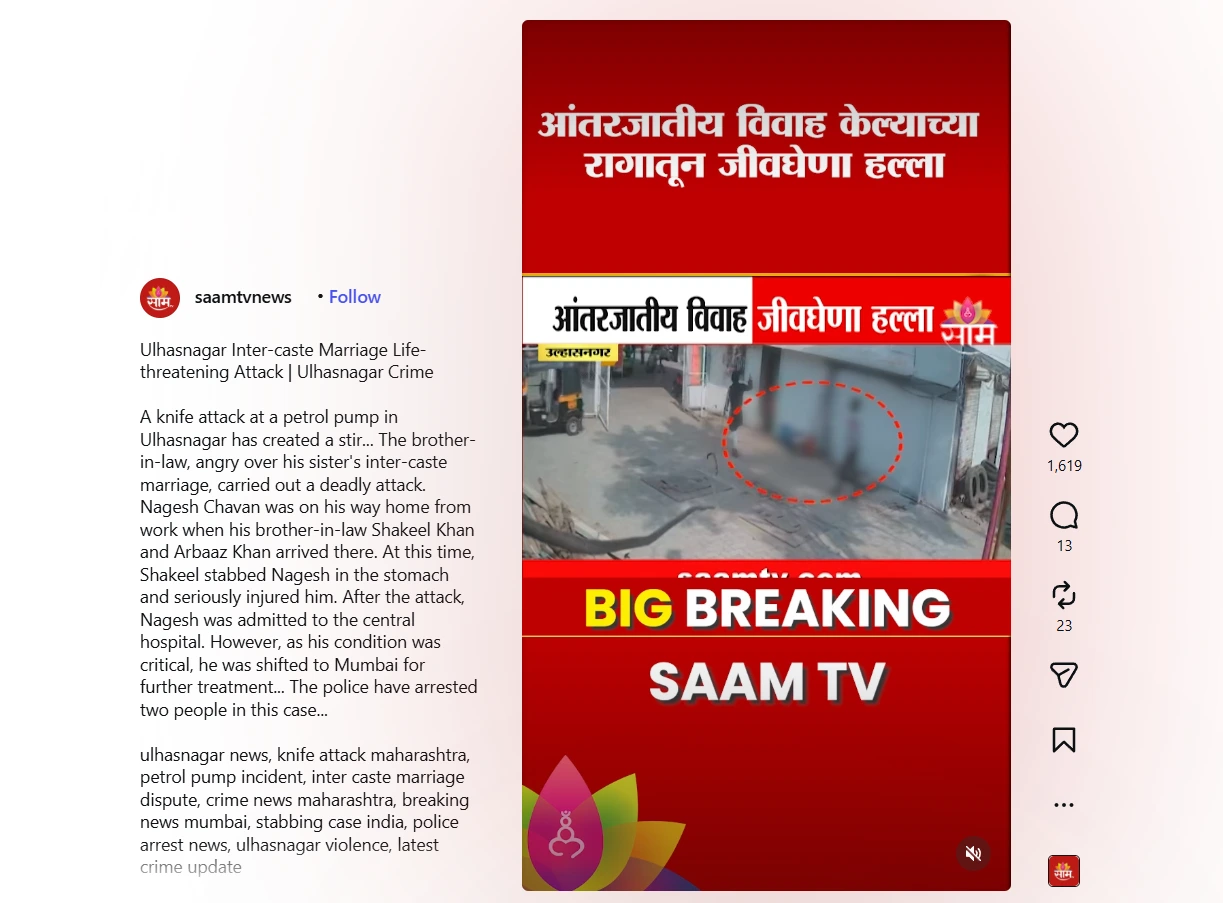
In Ulhasnagar, Maharashtra, a Hindu man, Nagesh Chavan, was brutally stabbed by his Muslim wife's brother and his accomplice over his interfaith marriage. According to media reports, the entire incident took place at a petrol pump located in Ulhasnagar Camp No. 5. The victim, Nagesh Chavan, worked at this petrol pump. On Monday (4 May 2026) night, as Nagesh was preparing to return home after finishing his work, his brother-in-law, Shakeel Khan, arrived with his friend, Arbaaz Khan. Closed-circuit television (CCTV) footage showed that, without any argument, Shakeel suddenly pulled out a knife and began stabbing Nagesh. The angry Shakeel stabbed Nagesh multiple times in the stomach and seriously injured him. Nagesh was caught off guard by this sudden attack and collapsed, covered in blood. The accused fled the scene after the attack. The injured Nagesh was immediately rushed to the Central Hospital in Ulhasnagar, but due to his critical condition, doctors referred him to Mumbai for better treatment. The Hillline Police Station, recognising the seriousness of the case, immediately launched an investigation and, based on CCTV footage, arrested the main accused, Shakeel Khan, and his accomplice, Arbaaz Khan. During police interrogation, Shakeel confessed to his crime, stating that he was furious with his Muslim sister's interfaith marriage with a Hindu man and wanted to teach his brother-in-law a lesson.
Case Images
Why it is Hate Crime ?
This case has been added to the tracker under the primary category- Men attacked for being associated with non-Hindu women. Within this, the subcategory selected is- Attacked by non-Hindu partner or/and her family. When Hindu men are in a relationship with non-Hindu women, there are cases where the man is forced to convert his religion and upon his refusal to do so, the partner or/and her family attacks the victim. Such relationships may be consensual with the religious identity of the non-Hindu woman known to the victim. Somewhere along the relationship, the non-Hindu woman or her family starts forcing/pressurizing the Hindu man to convert. In some of these cases, the association could be non-consensual as well or, the religious identity of the non-Hindu woman could be previously unknown to the Hindu victim. In such cases, the Hindu man is first forced/pressurized to change his religion by the non-Hindu woman or her family. The force/pressure could involve threats. The trigger for directing violence against the Hindu man is in these cases his refusal to comply and change his religion under threat and/or force. In other cases that have been documented, it is also seen that the Hindu partner is assaulted by the non-Hindu woman or her family simply for his relationship with the non-Hindu woman and by virtue of him following the Hindu faith and not the religion of the non-Hindu woman. In such cases, the relationship is consensual in most cases and the religion of both partners is known to the other. Often, in such cases, there is no direct force/pressure to convert either, however, the attack is a result of the Hindu man being in a relationship with the non-Hindu partner and not following her religion/following Hinduism specifically. Such cases are driven by specific religious motivations and against the religious identity of the victim and are therefore qualified as hate crimes. The second primary category selected here is- Attack not resulting in death, and within this, the subcategory selected is- Attacked for Hindu identity. In several cases, Hindus are attacked merely for their Hindu identity without any perceived provocation. A classic example of this category of religiously motivated hate crime is a murder in 2016. 7 ISIS terrorists were convicted for shooting a school principal in Kanpur because they got ‘triggered’ seeing the Kalava on his wrist and tilak that he had put. In this, the Hindu victim had offered no provocation except for his Hindu religious identity. The motivation for the murder was purely religious, driven by religious supremacy. Such cases where Hindus are targeted merely for their religious identity would be documented as a hate crime under this category. This case has been added to the tracker because the violence inflicted upon the Hindu victim, Nagesh Chavan, was not random or merely interpersonal; it was directly connected to his religious identity and his marriage to a Muslim woman. The brutal attack by the Muslim woman’s brother, Shakil Khan and his accomplice, Arbaz Khan, was triggered by their disapproval of the Hindu man being married to a woman from their community. The assault at a petrol pump in Thane, Maharashtra, was not merely an act of family opposition to an interfaith marriage; rather, it was a deliberate, premeditated, and targeted attack rooted in hostility towards the Hindu faith of the victim, Nagesh. It is important to note that both Nagesh Chavan and his Muslim wife were adults and capable of making their own decisions and life choices. They knew about each other's religious identity and had entered into a marital union with full informed consent of each other. Despite this, Nagesh was brutally stabbed, highlighting that the hostility was directed specifically at the victim for being Hindu. Such actions go far beyond personal outrage and reflect a deeper religious hostility. The intensity and nature of the violence, stabbing at a public petrol pump, demonstrate not only a desire to cause grievous harm but also to punish him for daring to be in a relationship and marry a Muslim woman. The calculated and deliberate violence and its intensity underscore the profound hostility at the heart of this crime. This was not simply a matter of personal vengeance, but rather a stark manifestation of communal hatred. This incident falls into a broader and disturbing pattern where Hindu men are targeted specifically for being in relationships with Muslim women. These assaults are often framed as matters of "honour," but the underlying motivation is deeply religious. In the Islamic faith, a marriage is considered invalid if a Muslim woman marries a non-Muslim man who does not convert to Islam. In many such cases, the religious identity of the Hindu male partner, or his family, becomes the key trigger for violence, especially when there is no conversion to Islam. Even if conversion is not directly demanded in every case, the death threats or violence are often aimed at punishing the Hindu man for not adhering to Islamic norms in the context of a relationship with a Muslim woman. This can also be seen in the case of Nagesh Chavan. He was targeted and attacked not for any other reason but for being a Hindu man who married a Muslim woman without converting to Islam. This was not just a matter of "honour'. It was an attack on a Hindu man for transgressing religious boundaries and being with a Muslim woman. This showcases deep-seated religious animosity towards the victim and his Hindu identity, making it a clear case of a religiously motivated hate attack. Such attacks on Hindu men in interfaith relationships with Muslim women are rooted in the "Bhagwa Love Trap" conspiracy theory, a narrative steeped in anti-Hindu hatred spread in Muslim circles. It falsely claims that Hindu men trap Muslim women in predatory relationships because of their Muslim identity, with no evidence or basis whatsoever. This propaganda serves as an excuse to target and assault Hindu men for their religious identity and for entering fully consensual relationships where both parties know each other's backgrounds. Hindu men face vicious attacks under this fabricated "Bhagwa Love Trap" pretext, exposing it as a clear case of propaganda-driven violence fueled by anti-Hindu animosity. Overall, such incidents reflect a broader ecosystem of intolerance, where Hindu men are seen as transgressors for engaging in interfaith relationships or marriages with Muslim women. Nagesh Chavan’s assault was not incidental; it was deliberate and symbolic, aimed at enforcing religious boundaries through violence. For these reasons, this case is being added to the hate crime database of the Hinduphobia Tracker.
Victim Details
Total Victim
1
Deceased
0
Gender
- Male 1
- Female 0
- Third Gender 0
- Unknown 0
Caste
- SC/ST 0
- OBC 0
- General 0
- Unknown 1
Age Group
- Minor 0
- Adult 1
- Senior Citizen 0
- Unknown 0


Case Status
Arrested


Perpetrators Details
Perpetrators
Muslim Extremists
Perpetrators Range
From 2 To 5
Perpetrators Gender
male
 Sources




