Hindu priest's family subjected to months of conversion pressure by Muslim neighbour in Deoria
 Deoria, Uttar Pradesh, India
  24 April, 2026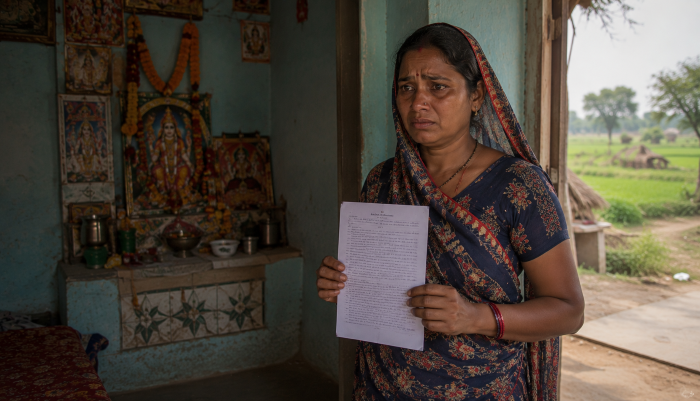
Case Summary
A Brahmin Hindu family from Grampurpur/Sahadpur village, Bariyarpur police station area, Deoria district, Uttar Pradesh, was subjected to sustained harassment, abuse of Hindu deities, and pressure to convert to Islam over a period of several months by Hasnain Khan, son of Kitab Mian, a Muslim resident of Chandpur in the same police station area. The family's head was a priest, and had a temple within their house. Sushma Devi, a member of the family, stated in a video that went viral that Hasnain had been abusing Hindu deities and pressuring the family to accept Islam for several months. When the family attempted to file a complaint at the Bariyarpur police station, the police refused to register their First Information Report [FIR]. Instead of recording the Hindu family's complaint, police registered a case against the victim's family members. The situation escalated on 25 April 2026 at approximately 8 pm when an altercation occurred near the family's house. Hasnain sustained injuries in the confrontation, including a broken leg, and was sent to Deoria District Hospital, where he underwent surgery. A case was subsequently registered at Bariyarpur police station against Sushma Tiwari's son, Sunny Kumar, and his two companions, Adarsh and Deepak, on the complaint of Hasnain's brother, Nijamuddin. The Deoria Police issued a statement characterising Sushma Tiwari's allegations as fabricated and baseless, dismissing her account of sustained religious harassment and conversion pressure. The Hindu family's complaint of sustained abuse of Hindu deities, conversion pressure, and police refusal to register their complaint remained unaddressed at the time of publication.
Why it is Hate Crime ?
The primary category for this case is "Predatory Proselytisation". The sub-category for this case is "Harassment, threats, coercion for conversion". Harassment covers a wide range of behaviours of an offensive nature. It is commonly understood as behaviour that demeans, humiliates, and intimidates a person, including threats and coercion. Harassment and threats, in this case, find their root on discriminatory grounds which has the effect of nullifying a person’s rights or infringing upon his freedom to exercise his right specifically owing to the victim’s religious identity. Verbal and physical threats and psychological or physical harassment are often used against Hindu victims because they choose to practice their professed religion. Religious harassment also includes forced and involuntary conversions by harassment, threats or coercion. Coercion includes intimidatory tactics like force-feeding a Hindu victim beef to convert to another religion, forceful circumcision etc. In several cases documented, non-Hindu perpetrators or those who harbour specific animosity towards Hinduism, harass victims simply based on their religious identity. Such cases often also include harassment to ensure the Hindu victim abandons his/her professed religion and adopts the religion of the perpetrator. Such cases, where Hindu victims are harassed to convert to the perpetrator’s religion, are rooted in animosity towards the victim’s religious identity and are therefore documented as religiously motivated hate crimes. This was not an ordinary neighbourhood dispute. A Brahmin Hindu family headed by a Hindu priest was systematically targeted through abuse of Hindu deities and repeated pressure to convert to Islam. The family’s Hindu identity was not incidental to the harassment but the very reason they were targeted. Their household temple, devotional practices, and the priestly role of the head of the family made them a visible and vulnerable target for sustained religious intimidation. The repeated abuse of Hindu deities while pressuring the family to convert to Islam clearly demonstrates the religious nature of the targeting. For Hindu devotees, deities are not symbolic figures or abstract theological concepts. They are worshipped as living manifestations of the divine and occupy a central place in the spiritual, emotional, and cultural life of Hindu families. Daily prayers, rituals, and devotional practices are often centred on these deities, especially in priestly households, where worship is an integral part of everyday life. The insults directed at the deities worshipped by the family were therefore not random acts of provocation. They were used as tools of coercion to humiliate the family’s faith, weaken their religious attachment, and pressure them into abandoning their Hindu identity. The combination of deity abuse and conversion demands reflected a deliberate pattern of religious intimidation rather than a personal disagreement. The entire pattern of conduct reflected clear hostility towards the family’s Hindu identity and religious beliefs. The Hindu priest’s family was targeted specifically because they were Hindu, and the methods used against them were chosen to attack the core of their religious faith and devotional life. Since this case involved sustained anti-Hindu abuse, religious coercion, and pressure to convert, it met the parameters of a religiously motivated hate crime and was added to the hate crime database of the tracker.
Victim Details
Total Victim
4
Deceased
0
Gender
- Male 3
- Female 1
- Third Gender 0
- Unknown 0
Caste
- SC/ST 0
- OBC 0
- General 0
- Unknown 4
Age Group
- Minor 0
- Adult 1
- Senior Citizen 0
- Unknown 3


Case Status
Complaint registered


Perpetrators Details
Perpetrators
Muslim Extremists
Perpetrators Range
One Person
Perpetrators Gender
male
 Sources




