Temple sanctity violated as sacred Bhog room encroached upon and used as political party office in West Bengal for years
 Birbhum district, West Bengal, India
  3 May, 2026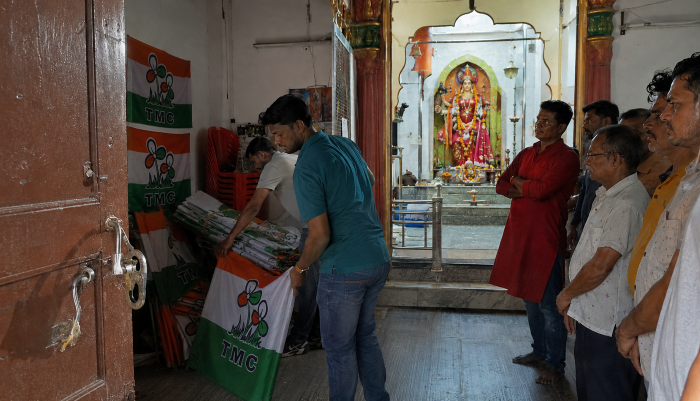
Case Summary
The Bhog room [the sacred kitchen of a Hindu temple where prasad, devotional food offerings to the deity, is prepared and distributed to devotees] of the Sri Sri Radha Govinda Temple in Rampurhat, Birbhum district, West Bengal, had been illegally occupied for years and converted into a Trinamool Congress [TMC] party office. The sacred space, which had previously served as the place where prasad [sanctified food offered to Lord Jagannath and distributed to devotees as a mark of divine blessing] was regularly prepared, had its religious activities stopped completely over the years of occupation. Banners, chairs, and other materials associated with political activities had been installed within the temple's sacred premises. On 4 May 2026, following the BJP's landslide electoral victory in West Bengal, BJP leaders arrived at the temple, broke the locks on the Bhog room, and removed political materials from the temple premises. Videos shared by Banglar Barta Digital News showed BJP workers clearing the room of chairs, banners, and other TMC-linked materials. For local residents, the reclamation carried significant emotional and symbolic weight. They described the reopening not merely as the restoration of a physical space but as the recovery of a religious space they believed had been deliberately suppressed and politically controlled under the previous TMC administration.
Why it is Hate Crime ?
The primary category for this case is "Attack against Hindu religion". The sub-category for this case is "Encroachment or illicit takeover of temple land/land near temple". The conversion of the Bhog room of Sri Sri Radha Govinda Temple into a TMC party office was not an act of opportunistic space utilisation. It was the deliberate occupation of a sacred functional space within a Hindu temple and its repurposing for political activity. The Bhog room is not a peripheral or administrative part of a temple. It is the space within which prasad is prepared for Lord Jagannath, a direct act of devotional service to the deity. Its occupation by a political party did not merely deprive the temple of a room. It terminated the devotional function that the room existed to perform, severing the daily ritual of prasad preparation that connected the temple's Hindu community to their deity. The other subcategory selected is- Breaking rules of place of worship. Sanatan Dharma is not a religion of one book, which is to say that while it has religious scriptures that form the central tenets of the faith, there are several traditions followed through thousands of years, mostly passed from generation to generation orally. One of these oral traditions or written traditions is the rules of specific temples. Certain temples have rules which are traditional rules, dependent on the worship of the presiding deities. These rules and traditions have been followed for thousands of years whether they find scriptural mention or not. Such traditions are based on the nature and rules of worship of the presiding deity of that temple. Any non-compliance of these traditions owing to animosity towards the faith or for the sake of activism stems not only from the lack of faith in the presiding deity but also disregard for the faith of the devotees of that deity/temple and implicit bias against the faith, the tradition and the deity itself. Since these specific traditions are central to the faith of the devotees of that specific temple and presiding deity, any non-compliance with these traditional rules would be considered a religiously motivated hate crime. The other subcategory relevant here is- Defiling religious customs. Sanatan Dharma is not a religion of one book, which is to say that while it has religious scriptures that form the central tenets of the faith, there are several traditions followed through thousands of years, mostly passed from generation to generation orally. There are several such customs and traditions that are followed by various Hindus and Hindu sects. Defiling of these traditions and customs is a breach of an individual or group’s religious practices. Such practices can range from dietary restrictions like not eating non-vegetarian food for a certain period of the year, not eating non-vegetarian food at all, not eating beef since the cow is considered holy in Hinduism, the sanctity of religious customs followed in the house (like many ISCKON devotees), etc. Any malicious action leading to the breach of such traditions or defilement of these traditions owing to animosity towards the faith or for the sake of activism stems not only from the lack of faith in the religion itself but also from disregard for the faith of the devotees who follow the customs/traditions and implicit bias against the faith, the tradition itself. Since these specific traditions are central to the faith of the devotees of that specific sect of Hindus, any non-compliance with these traditional rules would be considered a religiously motivated hate crime. The incident at the Sri Sri Radha Govinda Temple in Rampurhat carries clear religious markers because it involved the prolonged encroachment and political occupation of a sacred Hindu religious space. The Bhog room of a Hindu temple is not an ordinary storage or administrative area. It is a sanctified part of the temple premises where prasad is prepared and offered to the deity before being distributed to devotees as a form of divine blessing. Such spaces hold deep ritual and spiritual significance within Hindu religious practice and are governed by customs of purity, sanctity, and devotional use. A key religious marker in this case is the illicit encroachment and conversion of this sacred temple space into a political party office. The reported installation of banners, chairs, and other political materials associated with the Trinamool Congress inside the Bhog room fundamentally altered the character of the space, shifting it from one meant for worship and ritual preparation to a centre for political activity. The use of a consecrated Hindu religious space for partisan political operations represents a direct violation of the sanctity attached to temple premises and reflects disregard for the religious sensitivities of Hindu devotees. The second important religious marker is the disruption and suppression of temple customs and devotional practices. Reports state that the preparation of prasad and other religious activities associated with the Bhog room had ceased entirely during the years of occupation. In Hindu tradition, the preparation and offering of bhog and prasad are not symbolic formalities but integral acts of worship through which devotees express reverence and maintain ritual continuity with the deity. Preventing these practices effectively interrupted the functioning of an important religious space and deprived devotees of the ability to perform established temple rituals in accordance with Hindu customs. The third significant religious marker is the defilement of the temple premises' sacred character through political occupation. Hindu temples operate under norms of ritual purity and are regarded as spaces dedicated exclusively to religious and spiritual purposes. The conversion of a Bhog room into a political office for years, complete with political banners and meeting infrastructure, amounted to the desacralisation of a space regarded by devotees as holy. Such use reflects not merely administrative misuse but a broader disregard towards the sanctity of Hindu places of worship and the customs governing them. The broader pattern of the All India Trinamool Congress government's record toward Hindu religious spaces in West Bengal provides important context for this case. The occupation of the Bhog room at Sri Sri Radha Govinda Temple did not occur in isolation. It emerged within a wider pattern of political interference in Hindu religious spaces, restrictions and disputes surrounding Hindu festivals and processions, and institutional indifference towards attacks on Hindu temples and religious practices in the state. From restrictions on Hindu religious processions, attacks on temples, communal clashes during Hindu religious events, to her stoic silence whenever Hindus get attacked by Islamists in the state, there is evidence to show that the erstwhile Mamata Government in West Bengal has, in the past, passed umpteen prejudicial orders to clamp down on the religious rights of Hindus and show her affinity towards the Muslims in the state. Within this broader backdrop, the prolonged use of a sacred temple space as a political office reinforced the fact that the Trinamool Congress Party, led by West Bengal's former CM Mamata Banerjee, had a clear disregard for Hindus and their faith. Taken together, the illegal occupation of a sacred temple space, the interruption of Hindu devotional customs, and the prolonged political use of an area meant exclusively for religious purposes indicate conduct that violated the sanctity of a Hindu place of worship and disrespected Hindu religious traditions and sentiments. The case, therefore, carried clear religious markers and was added to the tracker's hate crime database.


Case Status
Unknown


Perpetrators Details
Perpetrators
State and Establishment
Perpetrators Range
Unknown
Perpetrators Gender
unknown
 Sources




