Hindu families targeted through inducement based Christian conversion meetings near temple in Bihar
 Rohtas, Bihar, India
  10 May, 2026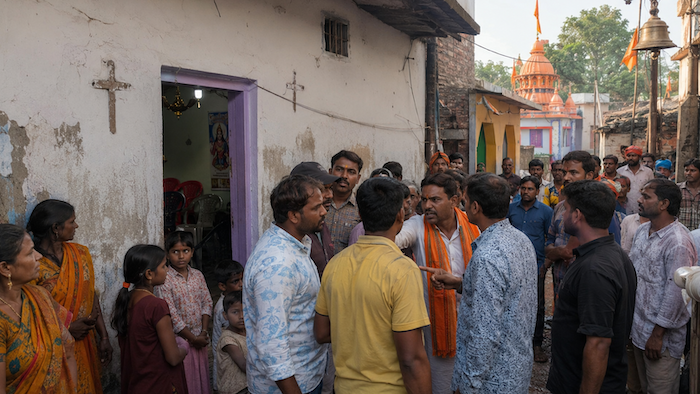
Case Summary
Hindu residents in Dehri, Rohtas district, Bihar, were drawn into organised Christian prayer gatherings that had been operating for months near the Sheetla Mata Temple in the New Area locality. Hindu women and children were among those attending the gatherings, where inducements were used to influence vulnerable attendees. The meetings were conducted inside a rented house and were presented as routine prayer sessions while sustained conversion activities continued in the background. On 10th May 2026, tensions escalated after local Hindu organisations discovered that the gatherings had been repeatedly targeting Hindus from surrounding villages. Members of the Vishwa Hindu Parishad and Bajrang Dal intervened and stopped one such meeting after information emerged that Hindus were being assembled regularly and persuaded to abandon their faith. The matter quickly drew public attention because the gatherings had allegedly continued unchecked for several months near an important Hindu religious site. The prayer meetings had reportedly been conducted once every week inside a rented property in Ward Number 17 of the New Area locality in Dehri. Hindu residents from nearby villages were brought to the location under the guise of religious prayer and healing sessions. Women and children were specifically included in these gatherings, indicating sustained outreach towards vulnerable sections of the Hindu community. The rented house where the meetings were held was located near the Sheetla Mata Temple, a site of religious importance for local Hindus. Despite the Hindu religious character of the surrounding locality, Christian organisers continued operating the gatherings in close proximity to the temple for several months. Hindu residents stated that inducements and incentives were being offered to attendees during these meetings in order to encourage religious conversion away from Hinduism. As the meetings expanded, concerns grew among local Hindu residents and organisations that the gatherings were being deliberately structured to weaken Hindu religious identity through systematic targeting of economically and socially vulnerable Hindus. The repeated organisation of prayer meetings near a Hindu temple, combined with the inclusion of women and children and the reported use of inducements, intensified fears that the gatherings were focused specifically on drawing Hindus away from their faith under the cover of religious prayer. On 11th May 2026, members of the Vishwa Hindu Parishad and Bajrang Dal reached the rented house after receiving information regarding ongoing conversion activities. The activists stopped the prayer meeting and confronted the organisers regarding the continued gatherings. Police were informed immediately afterwards, following which officers from the Dehri police station arrived at the scene with a police team. Police questioned the organisers regarding the gathering and objected to such meetings being conducted without informing the administration or local police station. Officers instructed the organisers that any future prayer meetings or healing gatherings would require prior administrative permission. The ongoing meeting was shut down by the police for being conducted without permission inside the rented property. The organisers of the gathering denied that any religious conversion activity had taken place and stated that people gathered only for weekly prayer sessions. However, Hindu residents continued expressing concern that church style activities had been operating from the private house for several months and that Hindus from different villages had been specifically assembled there through inducements. The incident generated widespread discussion among local residents in Dehri, particularly because the gatherings had been taking place near the Sheetla Mata Temple and involved sustained contact with Hindu families. Police refrained from issuing detailed public comments while examining the matter further. No arrests were confirmed at the time the incident entered public circulation, and the investigation remained ongoing.
Why it is Hate Crime ?
This case has been added to the tracker under the primary category Predatory Proselytisation. Within this, the subcategory selected is - Conversion/attempts to convert by inducements Predatory Proselytisation is not just limited to threat, harassment, force and violence, but it also has contours of stealth. In several cases, the Hindu victim is exploited to convert, with non-Hindus taking advantage of their poverty. In such cases, the Hindu victim who is suffering financially is offered monetary benefits, including lucrative offers for jobs, health treatment, education, etc, to induce the victim into changing his/her religion. In such cases, the religious identity of the victim and the aim to disenfranchise him from his faith form the heart of the crime. Also, taking advantage of and exploiting an individual’s economic vulnerabilities is widely acknowledged as exploitation, forms of which are often penalised by law. Such cases therefore are considered religiously motivated hate crimes since the victim’s religious identity forms the very heart of the crime itself. The other subcategory selected in this case is - Proselytisation by grooming, brainwashing, manipulation or subtle indoctrination. Under this, the tertiary category selected is - Pattern of targeting Hindus. Religious brainwashing essentially means the often subtle and forcible indoctrination to induce someone to give up their religious beliefs to accept contrasting regimented ideas. Religious grooming or brainwashing also involves propaganda and manipulation. It involves the systematic effort, driven by religious malice and indoctrination, to persuade “non-believers’ to accept allegiance, command, or doctrine to and of a contrasting faith. Cases of such grooming or brainwashing are far more nuanced than direct threats, coercion, inducement and violence. In such cases, it is often seen that there is repeated, subtle and continual manipulation of the victim to induce disaffection towards their own faith and acceptance of the contrasting faith of the perpetrator. While subtle indoctrination is widely acknowledged as predatory, an element which is often understated in such conversions or the attempts of such conversion is the role of loyalty and trust which might develop between the perpetrator and the victim. Fiduciary relationships are often abused to affect such religious conversion. For example, an educator transmitting religious doctrine of a competing faith to a Hindu student. The Hindu student is likely to accept what the teacher is transmitting owing to existence of the fiduciary relationship. The exploitation of the fiduciary relationship to religiously indoctrinate victims would also be included in this category. Since the underlying animosity towards the victim’s faith forms the basis of predatory proselytization, such cases are considered religiously motivated hate crimes. This case constituted a clear example of a religiously motivated hate crime because Hindu residents in Dehri were systematically targeted through organised Christian prayer gatherings designed to weaken and replace their Hindu religious identity. The gatherings operated for several months in a rented house near the Sheetla Mata Temple and specifically focused on bringing Hindus, including women and children, into repeated religious contact under the guise of prayer meetings and healing sessions. The sustained nature of the activities, the deliberate selection of vulnerable Hindus, and the use of inducements demonstrated a coordinated attempt to draw Hindus away from their faith through psychological, social, and religious influence. The conduct was not incidental or random. It reflected a deliberate effort to target Hindus because they were Hindus and to gradually separate them from their religious traditions and community identity. The primary religious marker in this case was the sustained proselytisation through grooming, brainwashing, manipulation, and subtle indoctrination. For several months, Christian prayer meetings were organised repeatedly inside a rented house in Dehri, drawing Hindus from surrounding villages into continuous religious engagement. This was religiously significant because the purpose of the gatherings was not limited to ordinary social interaction or community meetings, but involved repeated exposure of Hindus to Christian religious messaging in an environment specifically structured around prayer and healing. The organisers deliberately created a setting where Hindus could be gradually influenced over time through repeated attendance, emotional dependency, and continuous interaction with Christian religious practices. The prolonged duration of these gatherings showed a clear intent. The organisers did not attempt a one-time outreach effort. Instead, the meetings continued week after week for months, allowing sustained influence over attendees. Such long-term engagement demonstrated a calculated effort to weaken Hindu religious attachment gradually rather than through open confrontation. This revealed deliberate targeting because the perpetrators specifically chose Hindu attendees and repeatedly exposed them to Christian religious influence until conversion became more psychologically and socially achievable. The method itself demonstrated religious intent. By presenting the gatherings as prayer and healing sessions while continuing the activity for months, the organisers created a controlled religious environment aimed at reshaping the beliefs and loyalties of Hindu attendees over time. The second religious marker was the clear pattern of targeting Hindus, especially vulnerable sections of the Hindu community, such as women and children. The gatherings specifically involved Hindu residents from multiple nearby villages, and reports confirmed that women and children were regularly brought into these meetings. This was religiously significant because women and children often serve as the cultural and spiritual foundation of Hindu family life, traditions, and intergenerational continuity. Targeting them was not merely about increasing attendance at prayer meetings. It directly affected the preservation and continuation of Hindu identity within families and communities. The organisers deliberately focused on socially and economically vulnerable Hindus because such groups are more susceptible to emotional pressure, dependency, and manipulation. The repeated inclusion of women and children demonstrated that the perpetrators were not simply spreading religious teachings in a neutral setting. They specifically identified groups within the Hindu community who could be influenced more easily and who could subsequently influence entire households. This revealed deliberate religious targeting because the organisers selected vulnerable Hindus precisely because they could be separated from their traditional faith structure with less resistance. The gatherings, therefore, became a mechanism not only for religious outreach but for systematic erosion of Hindu community identity from within. The location of the meetings further reinforced the religious targeting. The prayer gatherings were conducted near the Sheetla Mata Temple, an important Hindu religious site in the locality. This was religiously significant because the organisers chose to operate directly within a Hindu religious environment rather than in a neutral or isolated setting. Conducting sustained Christian prayer meetings near a Hindu temple symbolically challenged the religious identity of the surrounding Hindu community while simultaneously attempting to draw Hindus away from their faith in the shadow of one of their own sacred spaces. This choice revealed deliberate intent because the organisers knowingly operated within an area deeply connected to Hindu religious life. The proximity to the temple was not accidental. It allowed the perpetrators to access Hindu families regularly while normalising Christian religious activity inside a Hindu-dominated locality. This demonstrated that the organisers intentionally positioned their activities in a way that maximised religious influence over Hindus while weakening the religious and cultural authority of the local Hindu environment itself. The third religious marker was the use of inducements and incentives to encourage conversion away from Hinduism. Hindu residents stated that inducements and incentives were being offered to attendees during the prayer meetings in order to encourage religious conversion. This was religiously significant because the use of inducements transformed the gatherings from ordinary religious assemblies into a targeted conversion mechanism directed at vulnerable Hindus. The focus was not merely on sharing religious teachings but on creating material or emotional dependency capable of influencing religious decisions. The organisers deliberately exploited the economic and social vulnerabilities of Hindu attendees in order to make conversion appear attractive or necessary. This demonstrated calculated religious targeting because the perpetrators specifically identified vulnerable Hindus and used inducements as a tool to weaken their attachment to Hinduism. Such methods showed that the objective was not coexistence between religions but the replacement of Hindu identity through pressure and manipulation disguised as charity, healing, or prayer. The repeated organisation of these meetings near the Sheetla Mata Temple, combined with the systematic inclusion of women and children and the reported use of inducements, demonstrated a structured effort to draw Hindus away from their faith under the cover of religious prayer. The gatherings created an environment where Hindu attendees could gradually become detached from their religious traditions while becoming increasingly dependent on Christian organisers and practices. The perpetrators deliberately chose methods designed to avoid direct confrontation while still achieving religious conversion through subtle psychological and social influence. The sustained nature of the gatherings, the targeting of vulnerable Hindus, the use of inducements, and the operation near a Hindu temple collectively demonstrated that the Hindu identity of the victims was central to the perpetrators’ actions. Hindus were not targeted randomly. They were targeted because their religious identity was seen as something to be altered, weakened, and replaced through organised religious influence and manipulation. The deliberate focus on vulnerable Hindus showed a clear intent to exploit weakness in order to undermine Hindu religious continuity within the community. Given that this case met the parameters of a religiously motivated hate crime, it was added to the hate crime database of the tracker.


Case Status
Complaint filed


Perpetrators Details
Perpetrators
Christian Extremists
Perpetrators Range
Unknown
Perpetrators Gender
unknown
 Sources




