Hanuman idol damaged as Hindu temple desecrated in Jharkhand, locals say accused is a repeat offender while family claims he is 'mentally unstable'
 Dhanbad, Jharkhand, India
  7 May, 2026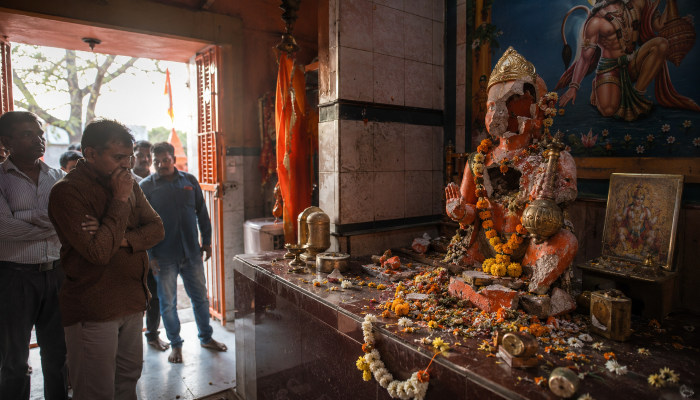
Case Summary
A Hindu temple in Bhuli B Block, Dhanbad, Jharkhand, was found desecrated on the morning of 8th May 2026. When devotees arrived for puja in the morning, they found the idol of Lord Hanuman installed in the temple in a damaged state. The desecration caused immediate alarm among the Hindu community, and a crowd gathered at the temple premises. A youth found present at the scene was questioned by those gathered. He admitted to having damaged the idol. People tied him to a nearby pole and informed the police. Police arrived promptly and took him into custody. The youth was identified as Ravindra Kumar, a resident of Bhuli Panchavati. Ravindra Kumar's family stated that he had been suffering from mental illness for the past 15 years. He had previously been treated at a mental health institution in Ranchi but his condition had not improved as expected. His family noted that his behaviour frequently became uncontrollable, making him difficult to manage. The temple priest and local residents, however, confirmed that Ravindra Kumar had previously attempted to damage the idol on multiple occasions by entering the temple premises. They also stated that hHis behaviour in the area had been consistently problematic, including incidents of indecent behaviour and harassment of local residents, particularly women. The temple committee and local residents demanded that the administration ensure the installation of a new Hanuman idol at the temple. Police took Ravindra Kumar into custody and initiated an investigation. The situation in the area normalised following police intervention.
Why it is Hate Crime ?
The primary category for this case is "Attack on Hindu religious representations". The sub-category for this case is "Desecration of Hindu religious representations". Icons and symbols or a religious representation of a spiritual ideal are widely revered in Hinduism. Iconography is of vital significance in the Hindu milieu. It helps connect people’s spiritual beliefs with the real world. Iconography within the Hindu faith takes several shapes and forms. Murtis are of most significance to Hindus, to which daily rituals, prayers and offerings are done. Besides the murtis, there are several other symbols which have deep significance in the Hindu faith – the Om and Swastika for example. Since these Hindu religious symbols hold paramount importance in Hinduism, any desecration of symbols, icons, murtis, religious representations and manifestations, is driven by animosity towards the faith itself which manifests itself through these murtis, icons and symbols. Therefore, any desecration of these Hindu religious symbols and representations is considered religiously motivated hate crimes under this category. Another sub-category for this case is "Attack on Temples". In Hinduism, a temple is the abode of the Deity. The Deity in the Temple is consecrated, thereby, making it a real, breathing entity. Hindus believe that not just the Deity but the temple premises itself are sacred to Hindus since Hindus hold the faith that the entire Temple space is an amalgamation of the divine energy of the deity. Given the central significance of Temples in Hindu Dharma, any attack against a Hindu Temple or its peripheral premises is an attack on the faith itself and is born out of animosity towards the faith, of which, the Temple is a central tenet. Any manner of attack against a Temple and/or its premises would therefore be considered a religiously motivated hate crime. The desecration of the Hanuman idol at the Bhuli B Block temple was not an isolated act of random damage. Bhagwan Hanuman is one of the most widely venerated deities in Hinduism, revered as the protector of the faithful and the embodiment of devotion and divine strength. His idol's presence in a neighbourhood temple is understood by the Hindu community as a source of spiritual protection for those who worship there. Its deliberate physical damage was not merely the destruction of a religious object. It was an act directed at the devotional centre of the Hindu community's daily worship and their sense of divine protection. The perpetrator's prior attempts to damage the idol on multiple occasions establish that the act on this occasion was not random or impulsive. The temple priest and local residents confirmed that Ravindra Kumar had previously entered the temple premises and attempted to damage the idol. A pattern of repeated targeting of the same Hindu religious object in the same Hindu place of worship reflects a directional hostility toward the specific Hindu devotional symbol rather than generalised disruptive behaviour. The attribution of the desecration to mental illness warrants examination in the context of a documented pattern of such attributions in cases involving the vandalisation of Hindu religious sites. Across multiple recorded incidents in India, the mental illness explanation has been introduced by law enforcement and media in cases involving non-Hindu perpetrators who have targeted Hindu places of worship. The attack on the Gorakhnath temple and the incident in Telangana in which two Muslim women wearing a burqa [full Islamic face and body covering] attempted to damage temple idols represent documented precedents in which the mental illness narrative was deployed to remove the religious dimension of the act from institutional consideration. The consistent application of this explanation in cases of this specific character raises questions about its function as an analytical category rather than an accurate account of motivation. The central analytical limitation of the mental illness attribution in cases of this kind is its inability to account for the selectivity of the targeting. Documented instances of this pattern share a common feature: the perpetrator targeted Hindu religious objects specifically while leaving non-Hindu religious sites and secular structures in the same vicinity undisturbed. Mental illness as a clinical category does not produce selective religious targeting of this kind. The repeated and exclusive focus on the Hanuman idol across multiple visits to the temple is more consistent with directed religious hostility than with the generalised disruptive behaviour associated with the mental health conditions cited in such cases. The institutional effect of the mental illness attribution in cases involving attacks on Hindu religious representations is twofold. It removes the perpetrator from criminal accountability under provisions relating to religiously motivated offences, and it removes the act from the category of communally significant incidents that would otherwise attract investigative and administrative scrutiny. Both outcomes result in the systematic under-recording of attacks on Hindu religious sites as religiously motivated crimes, obscuring the pattern of such targeting and denying the affected Hindu community institutional recognition of the religious character of the harm they suffered. Given that this case met the parameters of a religiously motivated hate crime, the perpetrator's conduct reflected more than disruptive behaviour in a public space. By repeatedly entering a Hindu temple and targeting the Hanuman idol specifically across multiple incidents, his actions demonstrated a sustained and directional pattern of hostility toward a Hindu sacred symbol that cannot be characterised as anything other than religiously motivated. Given that this case met the parameters of a religiously motivated hate crime, it was added to the hate crime database of the tracker.


Case Status
Complaint filed


Perpetrators Details
Perpetrators
Others
Perpetrators Range
One Person
Perpetrators Gender
male
 Sources




