Hindu families attacked, houses vandalised and women subjected to rape threats by Muslim mob for backing a pro-Hindu party in West Bengal
 North 24 Parganas district, West Bengal, India
  3 May, 2026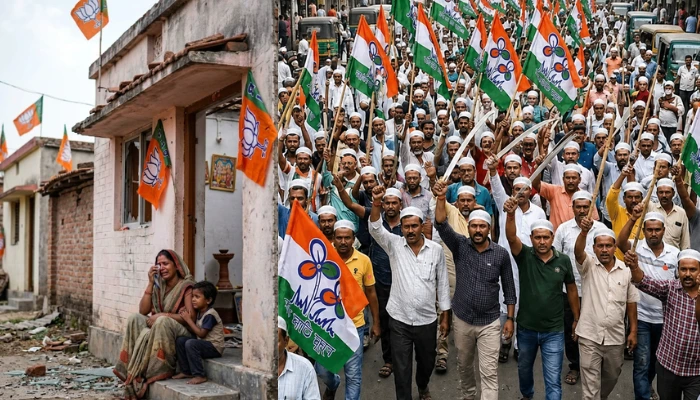
Case Summary
In the Amdanga Assembly constituency in West Bengal’s North 24 Parganas district, several Hindu families, including Dalits, were attacked, their houses were vandalised, and they were issued death and rape threats for voting for the Bharatiya Janata Party (BJP) in the state legislative elections of 2026. The attack was carried out by a mob of 150 Muslim men belonging to the Trinamool Congress party (TMC). The backdrop of this incident is the West Bengal Assembly Elections, which saw the Bharatiya Janata Party (BJP) achieve a historic landslide victory, sweeping over 200 seats in the 294-member assembly and ending the Trinamool Congress (TMC)'s 15-year rule under Mamata Banerjee. Held in multiple phases during late April 2026, with counting on 4 May 2026, the BJP capitalised on anti-incumbency, consolidated Hindu votes, fragmented Muslim support for TMC, strong urban performance, and welfare schemes. After the victory, BJP workers and ordinary Hindu citizens celebrated by raising BJP flags with slogans of "Jai Shri Ram" and by applying saffron gulal (coloured powder) on each other. The incident came to light when several Hindu residents from multiple villages in North 24 Parganas said that their homes had been attacked, women had been assaulted and threatened with rape, and Hindu youths had been forced to flee after being targeted for supporting the Bharatiya Janata Party. Local Hindu residents said that tension escalated in several pockets of the Amdanga Assembly constituency after the election results were declared, with Hindu families stating that Muslim Trinamool Congress groups attacked Hindu houses and threatened those suspected of voting for the Bharatiya Janata Party. Villagers said that homes were vandalised, family members were assaulted during the violence, and several residents were warned not to step outside, creating an atmosphere of fear in the area. A Hindu woman from the locality narrated the ordeal faced by her family and neighbours. She said, “Muslims have threatened us. We cannot go outside because of fear. They have vandalised our houses. They have threatened to murder the boys of our families as we voted for the Bharatiya Janata Party. For the last 14 years, we have been experiencing this." Hindu locals said that several Hindu youths fled from villages in North 24 Parganas, fearing physical attacks and murder threats. They also stated that women in the area were physically assaulted and threatened during the violence. According to villagers, women faced intimidation inside their homes as attackers attempted to force families into silence through fear. The victim families also stated that many affected households were now living in constant fear and demanded immediate protection from the administration. The complaints from Hindus triggered sharp political reactions, with Bharatiya Janata Party leaders accusing the local administration of failing to protect vulnerable Hindu communities in violence-hit areas. Amidst growing outrage, senior Bharatiya Janata Party leader and Member of the Legislative Assembly Arjun Singh visited the affected areas in North 24 Parganas on 5 May 2026 and met families who said they had been attacked and threatened. During the visit, Bharatiya Janata Party workers interacted with local residents and assured them that the matter would be raised before the administration and higher authorities. A member of the National Commission for Scheduled Castes also visited the violence-affected areas and spoke to victims regarding the incidents of intimidation and assault. Hindu locals stated that newly elected Trinamool Congress Member of the Legislative Assembly Kasim Siddiqui was behind the attacks and intimidation campaign in the area. However, no official response from Siddiqui regarding the allegations had emerged by the time of writing this report. Police officials had not issued a detailed statement regarding this attack on Hindus in North 24 Parganas, and it remained unclear whether any First Information Reports or arrests had been made in connection with the reported incidents.
Why it is Hate Crime ?
The primary category selected in this case is- Attack not resulting in death. The subcategory selected is- Attacked for Hindu identity. In several cases, Hindus are attacked merely for their Hindu identity without any perceived provocation. A classic example of this category of religiously motivated hate crime is a murder in 2016. 7 ISIS terrorists were convicted for shooting a school principal in Kanpur because they got ‘triggered’ seeing the Kalava on his wrist and tilak that he had put. In this, the Hindu victim had offered no provocation except for his Hindu religious identity. The motivation for the murder was purely religious, driven by religious supremacy. Such cases where Hindus are targeted merely for their religious identity would be documented as a hate crime under this category. The other subcategory selected is- Attacked for supporting/being part of perceived Hindu party/org or working for Hindu community. In several cases, Hindus are attacked specifically or tangentially for their association with parties or organisations perceived to be pro-Hindu and/or for working in favour of the Hindu community. One of the classic cases was the attack against a Bharatiya Janata Party Yuva Morcha (BJYM) worker Praveen Nettaru. Nettaru was attacked and hacked to death for his association with Hindu organizations and his work for the Hindu community. He was murdered by PFI, a terror organization which aimed to commit a genocide of Hindus, target Hindu leaders specifically and turn India into an Islamic Nation. In such cases, it is possible that the immediate trigger for the violence is non-religious – either according to the perpetrator or the police. However, there are surrounding circumstances from which the conclusion can be reached that the victim was attacked for his association with a Hindu organization. In a similar case, Rinku Sharma was attacked by radicals. He was a member of Bajrang Dal and regularly worked for the Hindu community. While the police cited a different non-religious trigger for the attack, it is true that he was associated to a Hindu organization and the family of Rinku Sharma specifically attributed his gruesome murder to him working for Bajrang Dal and raising Jai Shree Ram slogans. Such cases are intrinsically driven by religious hate and would therefore be documented as a hate crime under this category. The other subcategory selected is- Communal Clash/Attack. Communal clash is a form of collective violence that involves clashes between groups belonging to different religious identities. For a communal clash between Hindus and non-Hindus to qualify as a religiously motivated hate crime, the trigger of the violence itself would have to be anti-Hindu in essence. For example, if there is a Hindu religious procession that comes under attack from a non-Hindu mob and after the initial attack, Hindus retaliate in self-defence, leading to a communal clash between the two religious communities. While at a later stage, both communities are involved in the clash/violence, the initial trigger of the violence was by the non-Hindu mob against the Hindus and therefore, it could safely be termed as an anti-Hindu violence. Further, the trigger would also have to be religiously motivated. In the cited example, the attack by the non-Hindu mob was against religious processions and therefore, can be concluded to be religiously motivated. In some cases, the trigger may be non-religious, however, it develops into religious violence against Hindus at a later stage. In such cases too, the foundational animosity towards Hindus becomes the motivating factor of the crime and therefore, it would be classified as a religiously motivated hate crime against Hindus under this category. Another primary category selected is- Hate Speech against Hindus. The subcategory selected is- Violent Threats. Violent threats, explicit, implicit or implied, is the most dangerous form of hate speech since it goes beyond discriminatory and prejudicial language to express the intent of causing harm to an individual or a group of people based on their religious identity and faith. There could be several different kinds of threats that are issued to Hindus based on religious animosity. An explicit threat would mean the direct threat of violence towards an individual Hindu, a group of Hindus or Hindus at large. Physical violence, death threats, threats of destruction of property belonging to Hindus and threats of genocide would mean explicit threats against Hindus for their religious identity. Implicit threats may not be a direct threat but implied through the use of symbols of actions – for example – in the Nupur Sharma case, other than explicit threats, there were also implicit threats when Islamists took to the streets to burn and beat her effigies. It implies that they want to do the same to Nupur Sharma – thereby is considered an implicit threat. Violent threats can be delivered in person, through letters, phone calls, graffiti, or increasingly through social media and other online platforms. It would be important to understand that a threat – explicit or implicit, online or offline – to an individual who happens to be a Hindu does not qualify as a religiously motivated threat. Such a threat, while vile and dangerous, could be owing to non-religious reasons and/or personal animosity. To qualify as a religiously motivated threat, it would need to exhibit an indication that the individual is being targeted for religious reasons and/or owing to his/her religious identity as a Hindu. This case stands as a stark example of a religiously motivated hate crime as Hindu families in Amdanga faced selective, brutal attack solely for their religious identity and political choice. The Muslim attackers vandalised their homes, issued death threats to the men, and rape threats to the women, all because they supported the Bharatiya Janata Party, viewed by perpetrators as a pro-Hindu force. A mob of 150 Muslim men affiliated with the Trinamool Congress carried out these acts, exposing raw animosity towards Hindus who dare to back parties championing their interests. This violence erupted because Hindu families in Amdanga voted for the Bharatiya Janata Party's victory, a party widely seen by Muslim radicals and the broader Muslim community as a Hindu or Hindutva force advancing Hindu interests and rights. The Trinamool Congress's 15-year rule in West Bengal entrenched pro-Muslim bias, prioritising radical Muslim interests while stifling Hindu expression, like restricting Durga Puja to accommodate Ramadan or Muharram, banning "Jai Shri Ram" slogans as provocative yet allowing "Allahu Akbar" freely, arresting Hindu sadhus for challenging anti-Hindu policies while appeasing Muslim clerics, and attacking Hindu processions and temples. This defined West Bengal under Trinamool Congress rule, where Hindus lived in fear like second-class citizens. The Bharatiya Janata Party's landslide triumph, perceived as pro-Hindu, provoked fury in the Muslim community, who interpreted it as a Hindu victory over their Islamic dominance. The Amdanga attacks fitted this explosive context. A mob of 150 Muslim men, armed with lathis and sharp weapons, brutalised Hindu families, vandalised homes, and issued death and rape threats, targeting them for their religious identity and BJP allegiance, a party viewed by attackers as backing Hindu causes. This savagery flowed directly from the victims' Hindu identity and interests, proving beyond doubt a religiously motivated hate crime. Assaults on Hindus for embracing pro-Hindu parties expose the perpetrators' visceral religious animosity towards the Hindu faith and ideology, embodying a textbook hate crime. The attack was a clear communal hate crime because Hindu families were singled out, their homes were vandalised, and they were threatened with death and rape for supporting the Bharatiya Janata Party. This was not ordinary violence or a political disagreement. It was a deliberate assault on people because of their Hindu identity and their perceived support for a pro-Hindu party. The scale of the attack made its hateful intent unmistakable. A mob of around 150 men moved together, entered Hindu homes, destroyed property, beat residents, and used brutal threats to terrorise an entire community. When women are threatened with rape and men with murder, the purpose is not just to harm individuals, but to break the spirit of the whole community and force it into fear and silence. The violence also exposed deep hostility towards Hindu identity and political expression. The victims were targeted not for any personal wrongdoing, but because they were seen as aligned with a party that represented Hindu interests in the eyes of the attackers. That made the attack a direct strike at the community’s religious identity, political choice, and right to live without fear. This was a coordinated attempt to intimidate Hindus, damage their homes, and send a message that they could be attacked for their beliefs and support. The destruction of houses, the assaults on residents, and the threats against women showed a level of cruelty that went far beyond public disorder. It was an attack meant to dominate, terrify, and humiliate an entire community, which is why it amounted to a hate crime. The perpetrators’ brutal threats to kill Hindu men and rape Hindu women showed violent intimidation aimed at an entire community. These threats were not limited to individual victims, but were meant to frighten Hindu families as a whole, especially because they were tied to their Hindu identity and support for the Bharatiya Janata Party. The language of the threats was designed to silence, terrify, and punish Hindus for expressing their political and religious position, which made it a clear form of hate speech and violent threats aimed at silencing and arm-twisting Hindus into silence. The mob’s actions caused lasting damage to the affected families. Homes, which should have been places of safety, were vandalised and left badly damaged, while residents were beaten and left traumatised by the violence. By attacking people inside their neighbourhood and destroying the space they lived in, the perpetrators sent a message of domination and fear. The brutality of the attack showed a clear attempt to humiliate and subdue the Hindu community, which is what made this a hate-driven offence. Overall, this incident constitutes a blatant communal attack on Hindus, rooted in seeded religious animosity towards Hinduism and its followers. The Muslim perpetrators struck not at individuals but at the Hindu community, exploiting post-election tensions to inflict collective trauma. Such violence perpetuates cycles of fear, demanding recognition as targeted communal aggression. Given that this case fully meets hate crime parameters, it has been added to the hate crime database of the Hinduphobia Tracker. Disclaimer: The Hinduphobia Tracker records incident dates based on when the crime occurred, rather than when it is reported by the media. In this case, however, the exact date of the incident had not been specified in the available media reports. It only states that this occurred after the election results were announced on 4 May 2026. Therefore, 4 May 2026 has been selected as the indicative incident date for documentation purposes only.


Case Status
Unknown


Perpetrators Details
Perpetrators
Muslim Extremists
Perpetrators Range
From 10 to 100
Perpetrators Gender
male
 Sources




